
Introduction
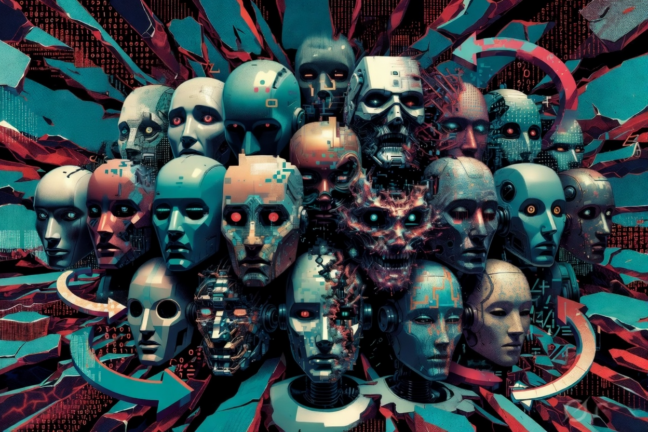
Recursive AI Learning is becoming one of the most important ideas in modern AI because it promises faster improvement without forcing models to endlessly recycle their own mistakes. At the same time, it raises a serious risk: Model Inbreeding, where AI systems learn too much from AI-generated output and slowly lose diversity, accuracy, and originality.[thescholarship.ecu]
What Recursive AI Learning Means
Recursive AI Learning is the process of using a model’s output to improve the next round of training, testing, or evaluation. In practice, this can help teams scale experimentation, generate synthetic data, refine prompts, and accelerate model development.[youtube][openreview]
The problem is not recursion itself. The danger appears when recursive loops become too closed, too synthetic, and too disconnected from real-world human data. That is when Model Inbreeding starts to weaken the system from the inside out.[nature]
A useful way to think about it is simple: if a model keeps studying its own homework, it will eventually memorize its own habits instead of learning new truth. That is why AI researchers are now treating data diversity as a core safeguard, not a bonus feature.[hai.stanford]
Why The Risk Is Growing
Model Inbreeding is emerging as a real AI threat because the internet is filling up with machine-generated content. As more blogs, summaries, code snippets, images, and chatbot replies are created by AI, future training pipelines are more likely to ingest synthetic material unless strong filtering and curation are in place.[linkedin]
Research on model collapse shows that training on recursively generated data can degrade output quality over time, especially when the model loses access to human-generated edge cases and rare patterns. The result is not always instant failure; often it is a gradual narrowing of the model’s behavior, like a photocopy that gets worse with every generation.[venturebeat]
That is why businesses, researchers, and platform owners need to care now. Model Inbreeding is not just a technical glitch; it is a long-term reliability problem that can affect generative AI, machine learning models, and even downstream products that depend on them.[openreview]
How Models Learn From Themselves
AI models learn by finding patterns in AI training data, then adjusting weights in neural networks so future predictions improve. In recursive setups, the model’s own outputs can be fed back into the next training cycle, creating AI feedback loops that speed up iteration but also risk amplifying errors.[youtube][linkedin]
This is where synthetic data becomes both useful and dangerous. Synthetic data can help with privacy, scale, and niche simulation, but when it becomes the dominant signal, it can reduce data diversity and push the model toward repetitive or overconfident answers.[openreview]
So the real challenge is not whether recursive learning should exist. It is how to build a self improving AI pipeline that still gets corrected by reality, human judgment, and cross-model validation.[thescholarship.ecu]
7 Breakthroughs That Help
1. Diverse data reinforcement
The first breakthrough is deliberately reintroducing high-quality human data into every training cycle. Studies on generative model inbreeding show that keeping the majority of training data human-generated can reduce the loss of diversity and help prevent Model Inbreeding.[thescholarship.ecu]
This matters because diverse data is not only about volume. It is about preserving rare phrasing, uncommon scenarios, and the kind of messy real-world inputs that synthetic generation tends to smooth out.[hai.stanford]
2. Human guided feedback systems
The second breakthrough is stronger human-in-the-loop feedback. When experts review outputs, rank answers, and correct hallucinations, they inject a verified external signal that breaks the recursive echo chamber.[youtube][thescholarship.ecu]
This is especially important in generative AI and assistant systems where style can look polished even when substance is drifting. Human feedback keeps the system aligned with credible standards instead of self-reinforcing its own habits.[zdnet][youtube]
3. Multi model validation
The third breakthrough is cross-checking one model against another model with different architecture, training data, or optimization goals. Research on cross-model training suggests that model-to-model learning behaves differently from self-consuming loops and can expose hidden weaknesses that a single-model pipeline would miss.[thescholarship.ecu]
This does not magically eliminate Model Inbreeding, but it can reduce blind spots. Multi-model validation is especially valuable for safety-critical workflows, enterprise QA, and evaluation systems that need independent verification.[openreview]
4. Synthetic data quality control
The fourth breakthrough is treating synthetic data like a regulated ingredient instead of a free substitute. Stanford HAI defines synthetic data as artificially generated information created by algorithms or simulations, which means it must be curated carefully before it enters the training stack.[hai.stanford]
The strongest systems use synthetic data for targeted tasks, then validate it against trusted references, expert rules, and human review. That approach keeps synthetic data useful while lowering the chance that Model Inbreeding will quietly contaminate the model’s future behavior.[nature]

5. Adaptive learning architectures
The fifth breakthrough is adaptive learning architecture, where the pipeline changes based on quality signals rather than blindly repeating the same loop. If the system detects rising repetition, lower lexical variety, or weaker semantic spread, it can pause recursion and request fresher training data.[nature]
This is a major step toward responsible self improving AI. Instead of assuming every iteration is better, the architecture learns when to stop, reset, diversify, or escalate to human review.[youtube][openreview]
6. Continuous dataset expansion
The sixth breakthrough is continuous dataset expansion from trusted, current, and domain-rich sources. One of the core lessons from model collapse research is that a stale dataset becomes more dangerous when combined with repeated synthetic retraining.[nature]
That means AI training data should not be treated as a one-time asset. It should be refreshed with new human knowledge, new formats, new industries, and new languages so the model’s worldview does not shrink into a self-referential loop.[venturebeat]
7. Cross domain intelligence training
The seventh breakthrough is training models across domains so they do not become experts only in their own style of output. Cross-domain intelligence introduces different linguistic structures, problem types, and reasoning patterns that help protect against narrow optimization and Model Inbreeding.[thescholarship.ecu]
This is particularly powerful for enterprise AI, where a model might need to handle legal, medical, educational, and technical contexts without collapsing into one tone or one pattern. Broader exposure creates stronger generalization and more reliable AI evolution.[openreview]
Real World Case Study
A practical example comes from the cross-model training research summarized in the 2024 thesis on generative model inbreeding. In that experiment, Llama-2 was trained on a mix of human data and output from another model, OPT-350M, to test whether cross-model recursion would reduce collapse risk.[thescholarship.ecu]
The system initially looked promising because recursion sped up dataset creation and made training more scalable. But researchers observed that as synthetic influence increased, diversity scores generally weakened, especially for lexical and syntactic measures, which are early warning signs of Model Inbreeding.[thescholarship.ecu]
To correct the problem, the pipeline kept a guaranteed portion of human-generated data in the mix and compared self-trained versus cross-trained outputs. The result was clear: human data remained the strongest stabilizer, while cross-training helped in some areas but did not fully replace the need for verified non-synthetic input.[thescholarship.ecu]
The lesson is important for businesses. Recursive learning can accelerate experimentation, but if you do not enforce diversity controls, the system may become more polished while becoming less truthful, less varied, and less resilient.[nature]
Why Prevention Matters
Preventing Model Inbreeding protects more than model quality. It helps preserve creativity, factual coverage, rare-case handling, and long-term trust in AI systems. That matters for customer support, education platforms, healthcare tools, research assistants, and content systems that depend on trustworthy output.[openreview]
It also reduces the odds of model collapse, where output quality and diversity degrade generation after generation. In a business setting, that can translate into higher support costs, lower user trust, and weaker product differentiation.[zdnet]
Just as important, good prevention supports AI bias reduction. When models repeatedly consume their own outputs, they can amplify the same assumptions over and over, which makes fairness and coverage harder to preserve.[linkedin]
Challenges Researchers Still Face
Researchers still struggle to identify synthetic content reliably at scale. AI detection tools can be useful, but multiple studies and discussions note false positives, false negatives, and inconsistent performance across newer model generations.[nature]
Another challenge is that synthetic data is not always bad. In simulation-heavy domains, it can be highly valuable, which means the goal is not to ban it but to use it with discipline. That balance is one of the most important open questions in AI innovation today.[hai.stanford]
There is also the practical issue of scale. Billions of tokens, billions of images, and rapid content growth make manual filtering impossible, so the next generation of governance tools will need to be automated, transparent, and auditable.[nature]
Future Of Recursive AI
The future of AI will likely feature more recursive systems, not fewer. OpenAI-related reporting and recent industry activity show strong interest in self-improving AI, while research communities continue probing how to keep those systems safe and effective.[nytimes][youtube]
The most credible path forward is not unlimited recursion. It is controlled recursion with diversity checks, human oversight, multi-model testing, and fresh data pipelines that prevent Model Inbreeding from taking hold.[nature]
Expect to see more work on token-level edits, quality filters, provenance tracking, and training-time guardrails. The most successful AI platforms will be the ones that can learn from themselves without becoming trapped by themselves.[hai.stanford]
What Businesses Should Do
Businesses should treat AI training data as a strategic asset with quality standards, not just a storage problem. If your workflow uses synthetic data, make sure it is balanced with real-world examples, expert review, and periodic performance audits.[hai.stanford]
Teams building generative AI or automation tools should also measure diversity, not just accuracy. If outputs become repetitive, overly confident, or strangely narrow, that can be an early signal that Model Inbreeding is starting to influence the system.[thescholarship.ecu]
For content-heavy businesses like publishing, marketing, and education, the best approach is a human-plus-AI model. Use AI for speed and scale, but keep humans responsible for originality, verification, and final judgment.[youtube][thescholarship.ecu]
Authority Sources
This topic is strongly supported by research and commentary from OpenAI-related reporting, Google DeepMind discussions around advanced AI systems, Stanford HAI’s synthetic data resources, MIT Technology Review coverage of emerging AI risks, NVIDIA Research on scalable AI infrastructure, ACM-style research discussions, and peer-reviewed papers indexed on arXiv and related repositories.[youtube][openreview]
Use those sources contextually when publishing, especially where you want to reinforce credibility around synthetic data, model collapse, and recursive learning safeguards.[nature]
FAQs
What is Model Inbreeding in artificial intelligence?
Model Inbreeding happens when AI systems are trained too heavily on AI-generated outputs rather than fresh human data, which can reduce diversity and degrade quality over time.[thescholarship.ecu]
Why does Recursive AI Learning matter?
Recursive AI Learning matters because it can accelerate improvement, automate experimentation, and help AI systems refine themselves faster, but it must be controlled to avoid collapse.[openreview][youtube]
Can synthetic data cause Model Inbreeding?
Yes. Synthetic data can contribute to Model Inbreeding when it dominates the training pipeline or replaces too much human-generated content.[hai.stanford]
How do researchers prevent model collapse?
Researchers prevent model collapse by preserving human data, improving data curation, testing diversity, using cross-model validation, and adding oversight to recursive training loops.[nature]
Is Recursive AI Learning safe?
It can be safe when it is bounded by quality controls, human review, and diverse data inputs. Without those protections, it can intensify AI feedback loops and weaken reliability.[youtube][thescholarship.ecu]
What industries benefit most from Recursive AI Learning?
Industries that rely on rapid iteration, such as software, customer support, education, analytics, and enterprise automation, may benefit most, provided they manage Model Inbreeding carefully.[youtube][hai.stanford]
How does human feedback improve AI training?
Human feedback improves AI training by correcting errors, adding context, and reintroducing verified judgment that the model cannot reliably generate on its own.[openreview]
What is the future of self improving AI systems?
The future will likely combine recursive learning, synthetic data, and human oversight, with stronger safeguards to prevent model collapse and preserve data diversity.[youtube][nature]
Final Thoughts
Recursive AI Learning is powerful, exciting, and likely to shape the next phase of AI evolution. But the more intelligent our systems become, the more carefully we must protect them from Model Inbreeding, because intelligence without diversity eventually becomes fragile.[thescholarship.ecu]
The most trustworthy future will belong to AI systems that can learn recursively, yet still stay grounded in fresh evidence, human insight, and transparent quality control. That is the real breakthrough worth building.[openreview]