
Imagine a young mother we will call Asha. Her baby girl is three weeks old. She feeds, sleeps, and smiles at the ceiling fan. Relatives say, “She looks perfect.” Asha almost cancels the next visit.
She goes anyway. The health worker weighs the baby, listens to her heart and lungs, checks her hips, and asks one calm question: “How many wet nappies did she have yesterday?”
Asha has to stop and think. Suddenly she is not sure.
No real patient, hospital, or result is described here. But the question is real. Can a simple Baby Health Checkup protect a baby’s future? Often it can. Not by magic, but by catching small problems while they are still small.
Table of Contents
What Is a Baby Health Checkup?
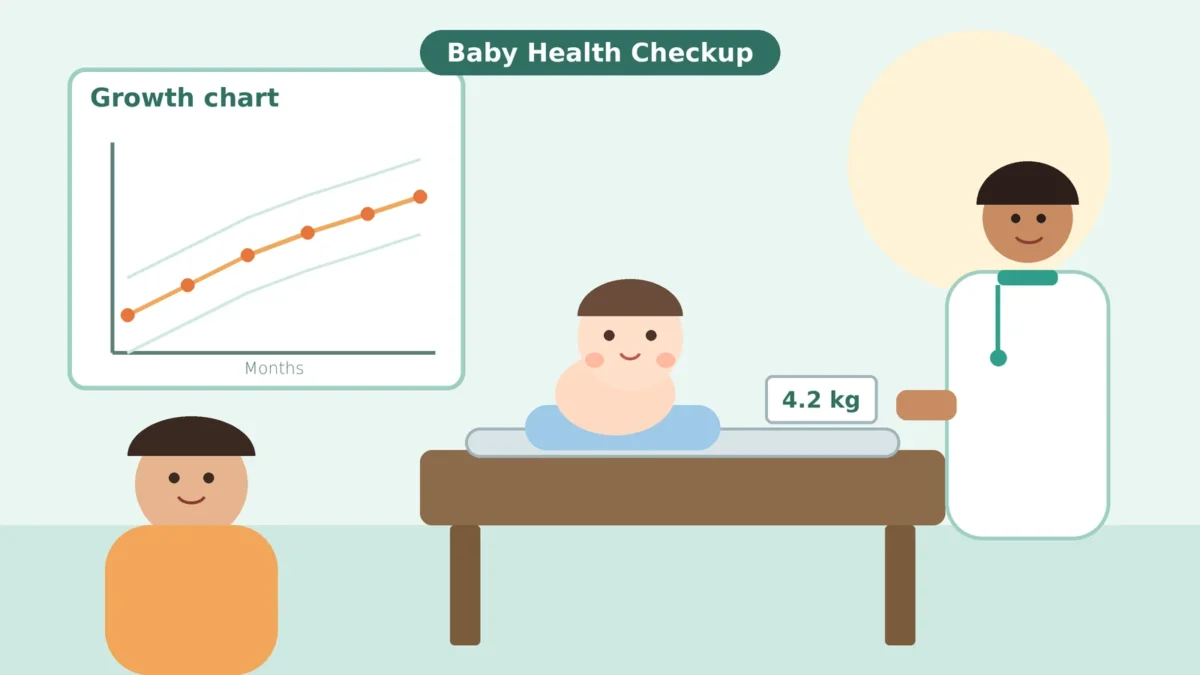
A Baby Health Checkup is a planned visit made when your baby is well. It is not a sick visit. A trained health worker or paediatrician (a doctor for children) measures growth, examines the body, asks about feeding and sleep, watches development, reviews vaccines, and answers your questions.
Think of it as a progress report that arrives early, while there is still time to act. Doctors call this preventive care.
Why an Early Baby Health Checkup Matters
A baby changes faster in the first year than at almost any other time. That makes four things possible:
- Growth tracking. One weight is a dot. Many weights make a line, and the line tells the story.
- Early detection. Some conditions are hard to see at home. The NHS repeats its newborn physical examination at 6 to 8 weeks because some conditions take a while to develop.
- Prevention. Vaccines, safe sleep, and feeding advice arrive before trouble starts.
- Parent confidence. Hearing “she is fine, and here is why” is powerful.
Real world evidence. India’s Home Based Newborn Care programme sends ASHA workers to visit babies at home. The health ministry reports that more than 1.46 crore newborns (89.3%) received scheduled visits in financial year 2023 to 24. Older studies in Maharashtra and Uttar Pradesh, described in a 2014 WHO Western Pacific paper, found that newborn deaths fell by 62% and 54% when trained community workers made repeated home visits. The limit: those were research settings with strong support, so results for one family may differ.
Routine Baby Health Checkup vs Sick Visit
These two visits look alike but do different jobs.
| Routine checkup | Sick visit | |
|---|---|---|
| Trigger | The calendar. Baby is well | A symptom or a worry |
| Main question | Is my baby growing and developing well? | What is wrong today? |
| Focus | Trends, prevention, vaccines, advice | Diagnosis and treatment |
| If skipped | Slow trends and late problems go unseen | The illness may get worse |
A sick visit fixes today’s problem. A routine visit protects next year. Neither replaces the other.
When Should a Baby Health Checkup Happen?
Each Baby Health Checkup schedule reflects its health system. A city clinic in the United States and a village in India do not work the same way. None of these is wrong.
| Source | Suggested contacts |
|---|---|
| WHO (2022) | Within 24 hours, then 48 to 72 hours, days 7 to 14, and week 6 |
| India, NHM | ASHA home visits on days 3, 7, 14, 21, 28 and 42 (plus day 1 for home births), then visits at 3, 6, 9, 12 and 15 months |
| AAP (USA) | Newborn, 3 to 5 days, by 1 month, then 2, 4, 6, 9, 12, 15, 18, 24 and 30 months |
| NHS (UK) | Physical examination within 72 hours and again at 6 to 8 weeks |
Vaccines have their own dates. In India, doses are given at birth, 6, 10 and 14 weeks, and again around 9 months. See the UNICEF India immunization guide and ask your doctor for the current chart.
Babies with extra needs, such as those born early or small, need more visits. The AAP notes that additional visits may be needed when circumstances differ from normal.
What Happens During a Baby Health Checkup?
- Weight and length. Plotted on a growth chart so the line can be followed.
- Head circumference. The distance around the head follows brain growth.
- Feeding. How often, how long, and how many wet nappies.
- Physical examination. Heart, lungs, belly, hips, eyes, skin, and reflexes.
- Vision and hearing. Do the eyes follow a face? Does your baby react to sound? Ask if a newborn hearing test was done.
- Milestones. Smiles, head control, rolling, babbling.
- Vaccination review. What is done, and what is due.
- Sleep and safety. Safe sleep position, car seat, and home hazards. See our guide to safe sleep and crib death.
- Your questions. The most important part.
Growth and Development: What Should Parents Watch?
Babies are not machines. One baby rolls at four months, another at six. Both can be healthy.
The CDC gives parents milestone checklists. Since 2022, each age lists skills that at least 75% of children are expected to show by that visit. Missing one is not a diagnosis. It is a reason to talk to your doctor, who may use a screening tool. The AAP recommends such general screening tools at the 9, 18 and 30 month visits.
What the Numbers Can and Cannot Tell You
Growth measurements show a trend. A single low reading may be a measuring error. A line that slowly drifts away from where it started is more meaningful. They cannot tell you the cause.
Development observations show what your baby does, not what your baby will become.
Screening results sort babies into “look closer” or “no concern now.” A positive screen is not a diagnosis. A negative screen is not a lifetime promise, which is why some tests are repeated.
Data point. The Government of India, citing NFHS-5 (2019 to 21), reports that among children under five, 35.5% were stunted, 19.3% wasted, and 32.1% underweight. Stunting means short for age. Wasting means thin for height. It means roughly one in three young children is not growing as expected, and regular measuring is how this shows up in one child. Limits: these are survey estimates. The same reply says the government’s Poshan Tracker showed lower wasting and underweight rates in December 2023, so methods matter. Never judge your own baby against a national average.
Baby Health Checkup: Warning Signs Parents Must Not Ignore
Waiting for the next routine visit is wrong when you see these.
Emergency. Go to the nearest hospital or call your local emergency number now:
- Hard or very fast breathing, or the belly sucking in under the ribs
- Blue, grey, pale, or blotchy skin or lips
- Very sleepy, floppy, hard to wake, or a weak, high pitched cry
- A rash that does not fade when a clear glass is pressed on it, or a stiff neck
- A fit (seizure)
- A soft spot on the head that bulges outward
- Any fever of 38°C (100.4°F) or higher in a baby under 3 months, according to the NHS
See a doctor the same day:
- Refusing feeds, or feeding poorly
- Signs of dehydration: very few wet nappies, sunken eyes, no tears
- Yellow skin in the first 24 hours of life, or yellow palms and soles at any age
- Fever of 39°C (102.2°F) or higher at 3 to 6 months, or any fever lasting over 5 days
Where advice differs: WHO community guidance for health workers flags a temperature of 37.5°C or more, or below 35.5°C, so that babies are referred early. The NHS uses 38°C for parents. When unsure, call your doctor. Do not guess, and do not treat a young baby’s fever at home without medical advice.
The 5-Step Baby Health Checkup Preparation Plan
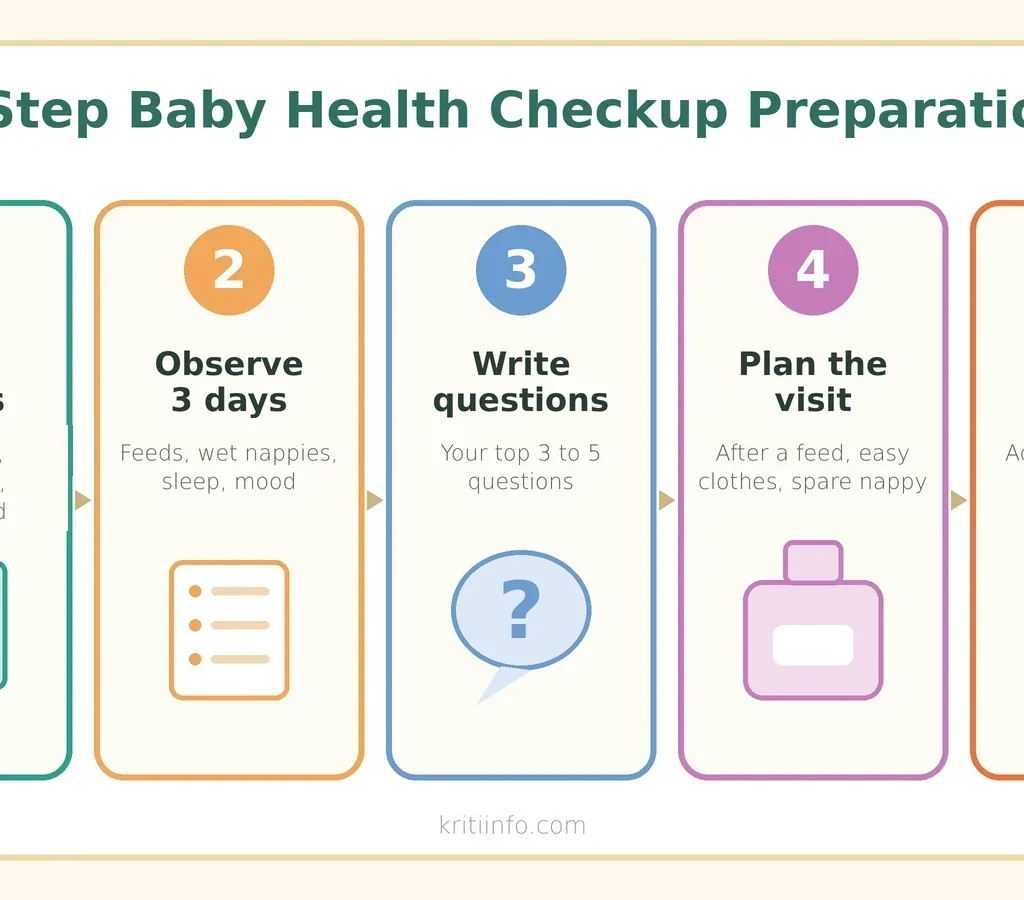
- Collect records. Bring the hospital discharge papers, birth weight, vaccine card, and past growth readings.
- Observe for three days. Note feeds, wet nappies, stools, sleep, and mood in a phone note.
- Write your questions. Pick your top three to five. The AAP suggests this to keep visits focused.
- Plan the visit. Go after a feed, dress your baby in easy clothes, carry a spare nappy, and bring the second caregiver if you can.
- Record the result. Write down advice, the next date, and red flags. Set a phone reminder.
Illustrative Example: One Visit, One Useful Question
Fictional example, for teaching only.
Rohan is a made up six month old. His parents kept a three day log before the visit. It showed he took only a few spoons of thin porridge and few solid feeds. At the visit his weight line had flattened compared with earlier readings. The doctor did not diagnose anything from the log. Instead, the doctor asked about foods, adjusted the feeding plan, and booked a recheck in a month.
The Baby Health Checkup did not find a disease. It caught a drift, early, and gave the parents a plan. That is what prevention looks like.
Using Baby Health Checkup Advice at Home
- Feeding: Use the growth line, not neighbours’ opinions, to judge whether feeding is enough.
- Sleep: Follow the safe sleep advice you were given every night, including naps.
- Hygiene: Wash hands before handling the baby. Keep the cord stump clean and dry, as WHO advises in most settings.
- Vaccination: Put due dates in your phone.
- Development: Play, talk, and give tummy time. Our guides on common infant problems and newborn care can help between visits.
Benefits and Limits
A regular Baby Health Checkup spots growth drift, catch some hidden conditions early, keep vaccines on time, and calm worried parents. But they cannot prevent or find everything. Some problems appear between visits, and some tests are not perfect. That is why you still watch your baby daily and act on warning signs.
Common Misconceptions
“A healthy looking baby does not need a Baby Health Checkup.” Looks can hide problems. Hips, heart, hearing, and growth trends are not visible from outside.
“Vaccination alone is enough.” Vaccines protect against specific diseases. They do not measure growth, review feeding, or screen development.
“Every baby develops at the same speed.” Normal has a range. Milestone checklists exist to open a conversation, not to rank babies.
“Wait until symptoms become serious.” Serious symptoms in young babies can progress quickly. Prevention works because it is early.
Frequently Asked Questions
1. How often does a newborn need a baby health checkup? WHO recommends contacts within 24 hours, at 48 to 72 hours, days 7 to 14, and week 6. Your local programme may add more.
2. What happens during a baby health checkup? Measurements, a physical examination, feeding and sleep review, developmental questions, and vaccine review.
3. When should the first baby health checkup happen? WHO advises within 24 hours of birth, including home births. The NHS offers a full examination within 72 hours, and the AAP lists a visit at 3 to 5 days.
4. Why are weight and head measurements important? They show growth over time. Doctors look for a steady line, not one perfect number.
5. Can a baby look healthy but still have a health problem? Yes. Conditions of the eyes, heart, and hips can be silent early. That is why screening exists.
6. What should parents carry to a baby health checkup? Health and vaccine cards, discharge papers, your three day log, a short question list, and a spare nappy.
7. When should parents seek urgent medical attention? For breathing trouble, colour change, unusual sleepiness, a fit, a non fading rash, or fever of 38°C or higher under 3 months.
8. Is a baby health checkup still needed after vaccination? Yes. Vaccination protects against certain diseases, but a checkup also covers growth, feeding, development, and safety.
Conclusion: Your Next Step
A Baby Health Checkup is not just a weight and a height. It helps you understand how your baby is growing, catches concerns while they are small, and gives you confidence for everyday decisions.
Do one thing this week: check your baby’s card, find the next age appropriate preventive visit, and book it.
Medical Disclaimer
This article is for education only. It does not replace professional medical advice, diagnosis, or treatment. Always ask your paediatrician or health worker about your baby’s own needs.