
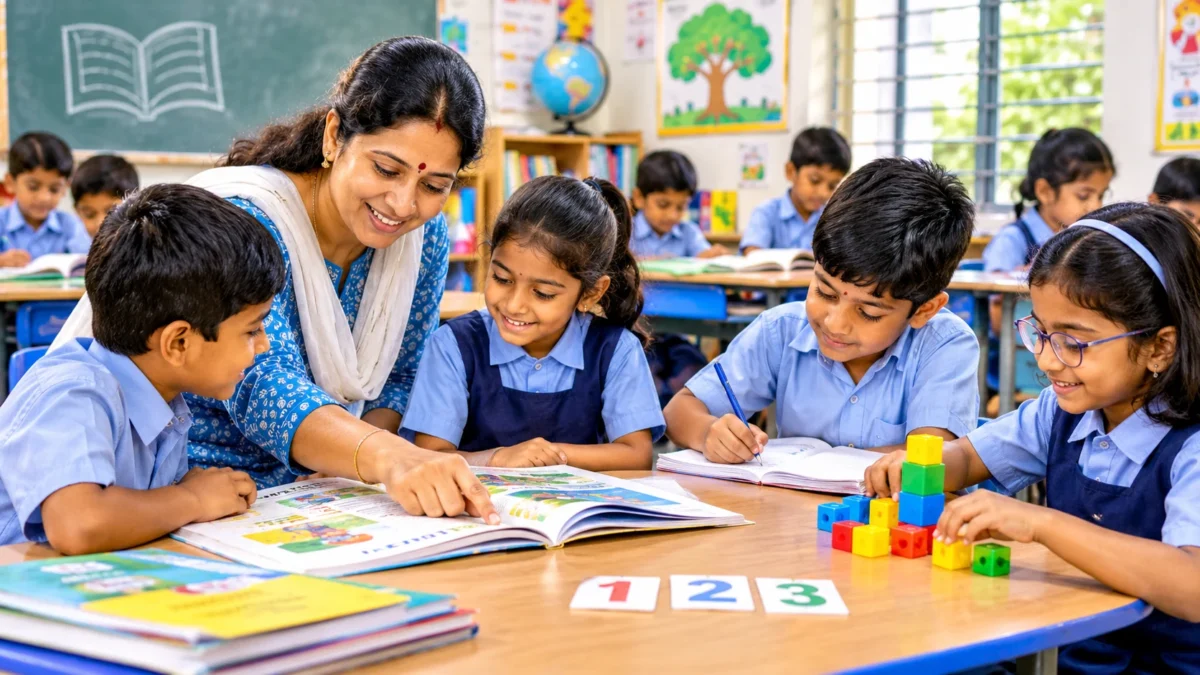
Imagine a classroom with 40 children.
Some can read a complete story. Some can read only a few sentences. A few can solve multiplication problems, while others still struggle with addition.
The teacher starts a new lesson because the timetable says it is time to move forward.
But what happens to the children who have not understood the previous lesson?
They become more confused. After some time, they may lose interest in school.
This is one of the biggest challenges facing education systems today.
Education management and closing learning gaps must go hand in hand. Schools need good teachers, but they also need good planning, regular assessment, useful learning materials and strong leadership.
The World Bank explains that basic reading, mathematics and social-emotional skills are the foundation of future learning. Its foundational learning work also highlights the importance of helping children read and understand a simple text by age ten.
The real question is not simply how many children attend school. It is how many children actually learn.
Table of Contents
1. What Are Learning Gaps?
A learning gap is the difference between what a child should know at a particular stage and what the child can actually understand or do.
For example:
- A Class 5 student may struggle to read a Class 3 passage.
- A child may know multiplication tables but fail to solve a simple word problem.
- A student may remember science definitions but struggle to explain them.
- A child may understand a lesson in their home language but struggle when it is taught in another language.
Learning gaps can develop for many reasons:
- Poor attendance.
- Weak teaching methods.
- Lack of books and learning materials.
- Language difficulties.
- Poverty and family problems.
- Long school closures or interruptions.
- Learning disabilities that have not been identified.
- Too little individual attention.
A child who falls behind is not necessarily less intelligent. Sometimes the child simply needs a different explanation, more practice or extra time.
Important lesson: Never confuse a child’s current learning level with their ability to learn.
2. Why Education Management Must Take the Lead
Education management means planning, organising and improving the work of a school or education system.
It includes managing teachers, classrooms, learning materials, budgets, timetables, student progress and school facilities.
However, good management is not just about completing administrative work.
Its main purpose should be to improve learning.
A school leader should ask five important questions:
- Are children learning what they are expected to learn?
- Which students need extra help?
- Are teachers getting the support they need?
- Are teaching methods working?
- Are learning gaps becoming smaller?
The World Bank’s research on education management explains that better management is important for improving teaching and learning at scale.
A principal who checks learning progress, supports teachers and solves classroom problems can make a real difference.
3. Find Learning Gaps Before They Become Bigger
El rol de los docentes en la protección de la infancia
The first step is to discover what children know.
Schools should not wait until final examinations to identify learning problems.
A child may pass from one class to another while carrying weaknesses from previous years.
Use simple learning assessments
Teachers can use:
- Short reading exercises.
- Basic mathematics questions.
- Spelling and writing activities.
- Oral questions.
- Classroom discussions.
- Small practical tasks.
For example, a teacher may ask a Class 5 student to read a short paragraph and explain it in their own words.
If the child can pronounce the words but cannot explain the meaning, the teacher has found a reading comprehension problem.
The next step is to help the child understand the passage, not simply ask them to read it again and again.
Test to help, not to frighten
Assessment should not make children feel ashamed.
Its purpose is to find out what support they need.
Teachers should also avoid using one test as the only measure of a child’s ability. Observation, classroom work and regular conversations provide useful information too.
4. Teach Children at Their Actual Learning Levels
One important mistake in education is assuming that all children in the same class have the same learning ability and knowledge.
They do not.
A child in Class 5 may have excellent speaking skills but weak writing skills. Another may be good at mathematics but struggle with reading.
Teachers can use flexible learning groups.
For example:
| Learning group | Main support |
|---|---|
| Beginning readers | Letters, sounds and simple words |
| Developing readers | Short sentences and small stories |
| Confident readers | Longer passages and comprehension |
| Beginning maths learners | Counting and basic operations |
| Developing maths learners | Multiplication and division |
| Advanced learners | Word problems and reasoning |
These groups should change as children improve. They must never become permanent labels.
A useful classroom idea
Give children a short 20-minute learning activity each day based on their needs.
Some may read a story, some may practise multiplication, while others may solve more difficult problems.
This is more useful than giving every child the same worksheet regardless of their understanding.
5. Make Teachers the Centre of Improvement
No education reform can succeed without teachers.
A school may have computers, smart boards, modern buildings and expensive books. But if teachers do not have the right training and support, learning problems will remain.
Education management should provide teachers with:
- Regular training.
- Practical teaching guides.
- Ready-to-use learning activities.
- Time to plan lessons.
- Support from experienced teachers.
- Opportunities to share successful methods.
- Useful feedback from school leaders.
Encourage peer learning
Suppose one teacher has developed an excellent method for teaching fractions.
The principal can arrange a short demonstration so that other teachers can learn from it.
This costs little but can improve classroom teaching.
Teachers should also be allowed to discuss their difficulties without fear of punishment.
A school improves when teachers work as a team rather than as isolated individuals.
6. Give Extra Support Without Making Children Feel Weak
Some children need more time and attention than others.
Schools should organise extra learning support without making students feel embarrassed.
Possible approaches include:
Remedial classes: Short additional lessons to strengthen weak areas.
Peer learning: Children work in pairs and explain concepts to each other.
Reading clubs: Students read simple books and discuss stories.
Mathematics corners: Children learn numbers through games and objects.
Individual guidance: Teachers provide extra help to children who need it.
The World Bank and its education partners recommend targeted instruction, tutoring and stronger foundational learning as part of learning recovery.
The important point is to give support based on actual needs, not simply organise extra classes without a clear purpose.
7. Real-World Example: How India Can Close Learning Gaps
India offers an important example of why school attendance and learning achievement must be considered separately.
The World Bank’s India Learning Poverty Brief explains that learning poverty measures whether a child can read and understand an age-appropriate text by the age of ten, while also considering children who are out of school.
India’s experience also shows why local action matters.
The World Bank’s RAPID framework describes how education systems can reach children, assess their learning, prioritise basic skills, improve teaching and protect children’s well-being. It discusses examples from India in which states used surveys to understand barriers to school attendance and target support to families.

A practical school-level example
Consider a hypothetical government primary school in Jharkhand.
The school has 150 children from Classes 1 to 5.
The principal discovers that many Class 5 students cannot read a short paragraph confidently. Some also struggle with basic division.
Instead of blaming the students, the school takes five steps:
- Teachers conduct simple reading and maths assessments.
- Children are grouped according to their current learning needs.
- Teachers organise 30 minutes of focused practice each day.
- Parents receive simple suggestions for reading and counting activities at home.
- Progress is checked every month.
After three months, teachers compare the new results with the first assessment.
Some children have made strong progress. Others need additional support.
The school adjusts its teaching plan accordingly.
This is an illustrative example, not a report of measured results from a particular school. Its value lies in showing how a school can turn information into action.
8. Use Technology, but Do Not Depend on It Completely
Technology can make learning more interesting and accessible.
Schools can use:
- Digital reading books.
- Educational videos.
- Mathematics learning applications.
- Online teacher training.
- Digital progress records.
- Interactive classroom activities.
A student who struggles to understand fractions may learn better through a simple visual demonstration.
But technology is not a magic solution.
Many schools still face problems with internet access, electricity, devices and teacher training.
The World Bank notes that technology solutions must suit local conditions. In places with limited connectivity, radio and television can also support learning.
The right principle: Technology should help teachers teach better. It should not replace good teachers or personal attention.
9. Involve Parents and Communities
Children do not learn only inside classrooms.
Their home environment also affects their progress.
Parents can support learning by:
- Reading with children for 15 minutes daily.
- Asking what they learned at school.
- Helping them practise simple mathematics.
- Providing a quiet place to study where possible.
- Encouraging questions.
- Appreciating effort rather than marks alone.
Schools should not expect every parent to have advanced education.
A parent who cannot solve a difficult mathematics question can still encourage a child to practise and ask the teacher for help.
Community libraries, reading clubs and local volunteers can also support schools.
The goal is to create a partnership between teachers, parents and the community.
10. Build an Inclusive School Where Every Child Belongs
Learning gaps are not always caused by poor teaching.
Some children face additional challenges because of disabilities, language barriers, poverty, gender discrimination or poor health.
A good school must identify and reduce these barriers.
For example:
- Provide accessible classrooms for children with physical disabilities.
- Use suitable learning materials for children with visual or hearing difficulties.
- Support children who are learning in a new language.
- Provide safe drinking water and clean toilets.
- Prevent bullying and discrimination.
- Help children who frequently miss school.
Children should never feel that they do not belong because they learn differently.
An inclusive school does not lower expectations. It provides the right support so that every child can participate.
11. Measure Progress, Not Just Examination Results
Compass Blog | Compass Edvantage
Many schools measure success mainly through examination marks.
But marks alone cannot tell the complete story.
A child may improve significantly even if the examination score remains modest.
Education managers should track several indicators:
| What to measure | Why it matters |
|---|---|
| Reading ability | Shows language progress |
| Basic mathematics | Checks number understanding |
| Attendance | Identifies absence problems |
| Class participation | Shows student engagement |
| Homework completion | Helps identify support needs |
| Improvement over time | Shows whether teaching works |
School leaders should review this information regularly.
The UNICEF 2026 Foundational Learning Action Tracker highlights an important challenge: many countries report using assessment data for national planning, but fewer use it consistently to guide classroom teaching.
This shows that collecting data is not enough. Teachers must be able to use it.
12. A Practical 90-Day Plan for School Leaders
Education management and closing learning gaps need a clear action plan.
Here is a simple approach that schools can adapt.
The 90-day learning improvement plan
- Days 1–15: Identify the problemsConduct reading, writing and mathematics assessments. Identify students who need extra support.
- Days 16–30: Prepare the learning planGroup children by learning needs. Prepare teaching materials and assign responsibilities to teachers.
- Days 31–60: Start focused teachingConduct additional practice, reading activities, peer learning and teacher discussions.
- Days 61–75: Check progressRepeat short assessments. Identify children who have improved and those who need more attention.
- Days 76–90: Improve the strategyCompare results, discuss challenges with teachers and parents, and prepare the next learning cycle.
This is a suggested management framework, not a guaranteed improvement timetable.
The school should continue this cycle throughout the academic year.
13. Common Mistakes That Schools Must Avoid
Even well-planned education programmes can fail when management makes avoidable mistakes.
Mistake 1: Teaching only to complete the syllabus.
Completing chapters is not the same as ensuring that children understand them.
Mistake 2: Comparing children with one another.
Every child has a different starting point. Progress should be measured against individual learning needs.
Mistake 3: Giving extra homework to struggling students.
More work does not always mean better learning. Children need clear explanations and guided practice.
Mistake 4: Blaming teachers for every problem.
Teachers need proper resources, training, time and leadership support.
Mistake 5: Buying technology without a learning plan.
A computer cannot solve a learning problem unless it is used effectively.
Mistake 6: Ignoring the weakest learners.
Schools sometimes focus on high achievers because their results improve school performance. This leaves struggling children further behind.
Good education management gives attention to every child.
14. The Future of Education Management
The future of education will depend on how well schools combine effective teaching, useful technology, strong leadership and individual support.
Artificial intelligence may help teachers prepare learning materials, translate content and identify areas where students need more practice.
However, AI-generated assessments and recommendations must be checked by teachers. Children’s data must also be protected.
The human side of education will remain essential.
Children need encouragement, emotional support, curiosity and meaningful relationships with teachers.
The best education system will not be the one with the most expensive technology. It will be the one that uses its resources wisely and helps more children learn.
Conclusion: Every Child Deserves a Fair Chance to Learn
Education management and closing learning gaps should be among the highest priorities of every school.
A child who cannot read confidently today can become a confident reader with the right support. A student who struggles with mathematics can develop strong problem-solving skills through patient teaching and practice.
But these improvements do not happen automatically.
Schools need to identify learning problems early, support teachers, involve parents, use assessment results wisely and provide additional help to children who need it.
The purpose of education is not simply to move children from one class to another. It is to help them gain the knowledge and confidence needed for life.
A successful school is not one where no child struggles. It is one where no struggling child is left without support.
15. Frequently Asked Questions (FAQs)
1. What is education management and closing learning gaps?
It is the process of improving school leadership, teaching, assessment and student support so that children can overcome difficulties and achieve better learning outcomes.
2. What causes learning gaps among students?
Common causes include poor attendance, weak teaching, poverty, language barriers, lack of learning materials and insufficient individual attention.
3. How can teachers identify learning gaps?
Teachers can use short reading tests, mathematics exercises, classroom observations, discussions and regular assessments.
4. What is the role of a school principal?
A principal should guide teachers, monitor learning progress, arrange additional support, manage resources and involve parents in school improvement.
5. Can technology help close learning gaps?
Yes. Educational videos, digital books and learning applications can provide additional practice. However, technology works best when supported by trained teachers.
6. How can parents help children who are falling behind?
Parents can encourage daily reading, practise basic mathematics with children, communicate with teachers and provide emotional support.
7. How long does it take to close learning gaps?
There is no fixed period. Some children improve within weeks, while others need months or longer. Progress depends on the size of the gap, the child’s needs and the quality of support.
8. How can schools measure success?
Schools should compare students’ starting levels with their later reading, writing, mathematics, attendance and classroom participation. Improvement matters more than a single examination result.