
The Silent Threat
Illustrative scene:
Imagine a 45 year old man named Rahul. He is fit and rarely sick. One evening he bends to lift a bag. Suddenly a pain bursts inside his head, unlike any headache he has felt. It peaks in seconds, like a hammer blow. Then comes nausea.
Rahul cannot see it, but a tiny bulge on a brain artery may have just torn open. It may have sat there quietly for years. This hidden bulge is called a berry aneurysm.
Here is the puzzle. Many people carry one for life and never know. Others face an emergency with no warning. How does a silent bulge become dangerous, and what should people know before it is too late? This guide to Berry Aneurysm answers that in simple words, using trusted medical sources.
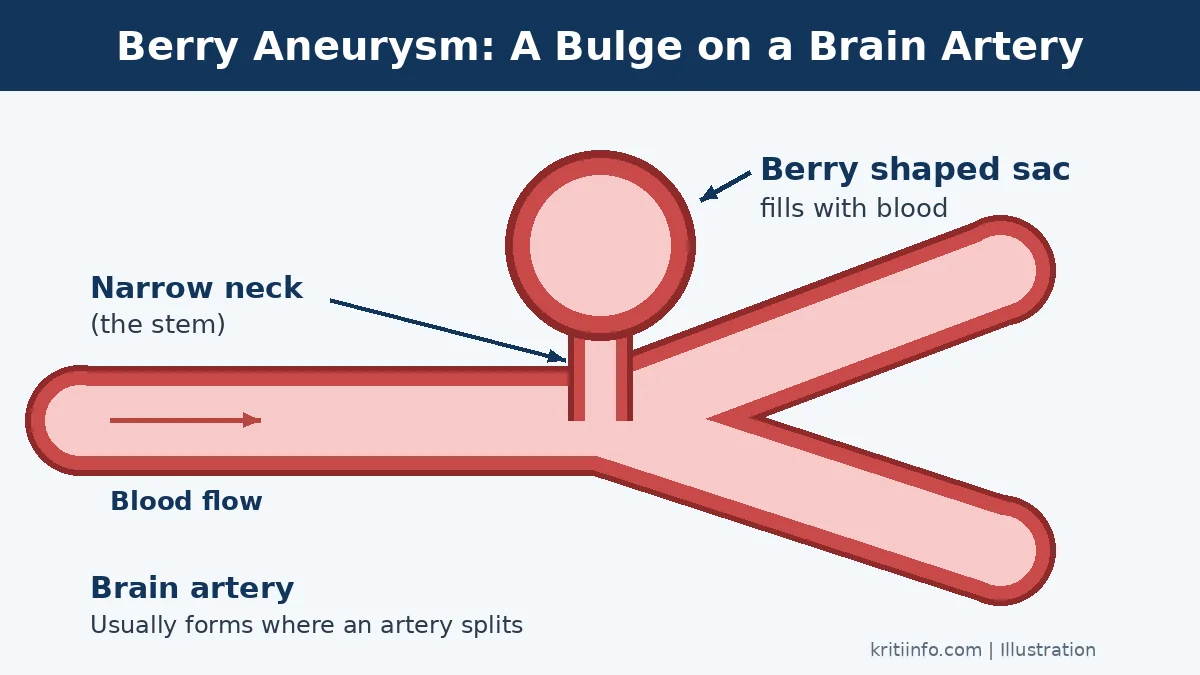
Illustration of a berry aneurysm on a brain artery
Table of Contents
What Is a Berry Aneurysm?
An artery is a tube that carries blood. An aneurysm is a weak spot in its wall that balloons out and fills with blood. It can press on nearby brain tissue and nerves, says the National Institute of Neurological Disorders and Stroke (NINDS).
A berry aneurysm, also called a saccular aneurysm, looks like a small round berry hanging from a stem. The stem is the narrow neck joining it to the artery. Harvard Health notes that most brain aneurysms look like this.
Think of an old garden hose. If one patch is thin, water pressure puffs it out like a bubble. A berry aneurysm usually forms where an artery splits into branches, because blood hits that fork with extra force. Most appear on large arteries at the base of the brain.
Other aneurysms look different. A fusiform aneurysm widens a whole stretch of artery, like a sausage. Rarer ones follow infection or injury. The berry shape, with its neck, sets this type apart.
How Does a Berry Aneurysm Develop?
Think of three players: the wall, the pressure and the body.
The wall. Some people are born with weaker artery walls. Yet the European Stroke Organisation guideline calls unruptured aneurysms acquired, meaning they form during life as a thin spot slowly gives way.
The pressure. High blood pressure pushes on that thin spot with every heartbeat. Smoking is another well established risk.
The body. Genes matter. Family history and some inherited conditions raise the chance. Scientists are still studying why women are affected more often, and what role inflammation plays. These are open questions.
Symptoms: When Should You Worry?
Unruptured berry aneurysm. Most cause no symptoms. A larger or growing one may press on nerves, and the NHS lists these possible signs:
- Headaches that keep coming or worsen
- Pain above or around one eye
- Double vision or other vision changes
- Numbness or weakness on one side of the face
- Trouble speaking or balancing
See a doctor soon.
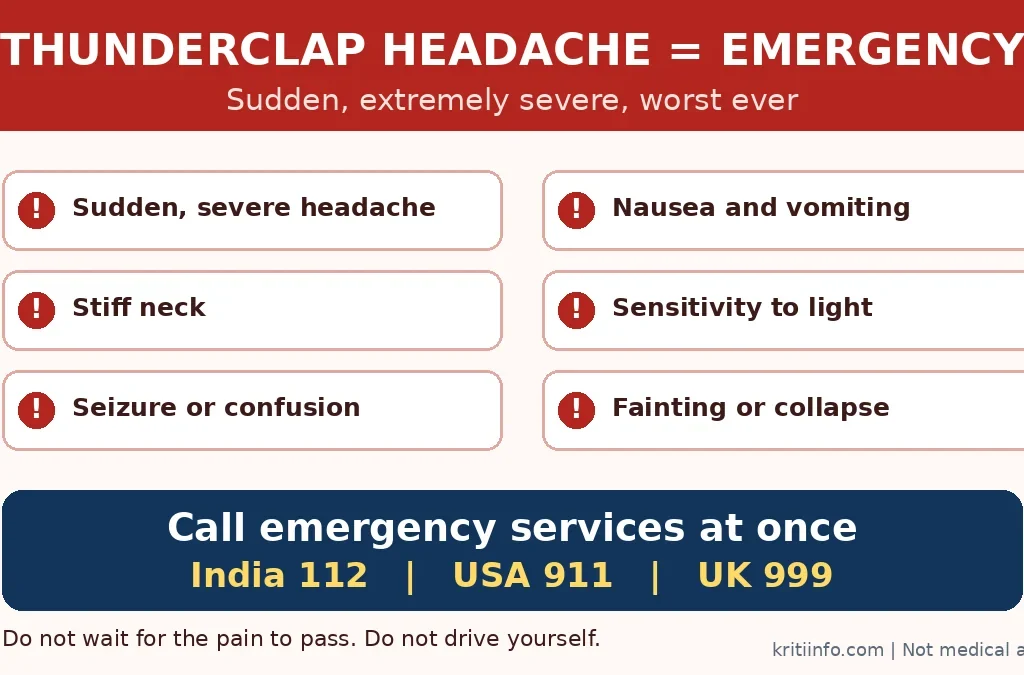
Ruptured berry aneurysm. When it bursts, blood spills around the brain, called a subarachnoid haemorrhage. Signs include:
- A sudden, extremely severe headache, often called a thunderclap headache
- Nausea and vomiting
- A stiff neck
- Sensitivity to light
- A seizure, confusion or fainting
A sudden, unusual headache days earlier can be a small leak. Treat it as urgent.
EMERGENCY RULE: A sudden, extremely severe headache, especially a thunderclap headache, needs emergency medical care at once. Call your local emergency number (112 in India, 911 in the US, 999 in the UK). A suspected ruptured aneurysm is a medical emergency. Do not wait for the pain to pass, treat it at home or drive yourself.
NINDS warns that delayed cerebral ischaemia, a lack of blood flow to part of the brain, can strike 3 to 14 days after a bleed, so patients stay under close watch.
Emergency warning signs of a ruptured brain aneurysm
Causes and Risk Factors
Well established:
- Smoking
- High blood pressure
- A close relative with a brain aneurysm
- Inherited conditions such as polycystic kidney disease (ADPKD) and Ehlers Danlos syndrome
- Injury to a brain blood vessel
- Cocaine use
The NHS lists all of these. NINDS adds that aneurysms are more common in adults than children, and in women than men.
Still being studied: stress, heavy alcohol use, hormones and sudden pressure spikes from straining. Evidence is mixed, so none is a proven cause.
A risk factor is a nudge, not a verdict. Many people with risk factors never develop one. Once one exists, its size, location and shape also affect rupture risk.
Diagnosis: Finding the Hidden Danger
Most are found by accident during scans for other reasons. Doctors may use:
- CT scan: Quick brain pictures, the usual first emergency test for bleeding.
- CT angiography: A CT with dye that lights up blood vessels.
- MRI and MR angiography: Magnets, no radiation. Often used for planned checks.
- Cerebral angiography: A thin tube guided from the groin or arm to the brain, with dye showing exact location, size and shape (NINDS). Very detailed, so used only when needed.
Doctors choose tests based on the patient’s condition and needs.
Treatment: What Can Modern Medicine Do?
- Regular monitoring. The NHS says small aneurysms without symptoms often need only follow up scans, because they have a low risk of bursting. It avoids procedure risk but needs years of checking.
- Surgical clipping. A surgeon opens a small window in the skull and clips the neck shut. It can be long lasting, but it is open surgery with a longer recovery.
- Endovascular coiling. A thin tube travels from the groin to the aneurysm, and tiny coils fill it so blood clots inside. No skull opening, but follow up scans are needed to confirm it stays closed.
- Other endovascular tools. Stents or flow diverters suit some shapes.
No treatment is best for everyone. The choice depends on size, location, shape, the person’s health and rupture risk. Preventive treatment has risk too. A review of 114 studies found about 5 in 100 patients had clinical complications within 30 days of endovascular treatment (4.96%). Guidelines advise experienced centres.
The Recognise, Respond, Recover Plan
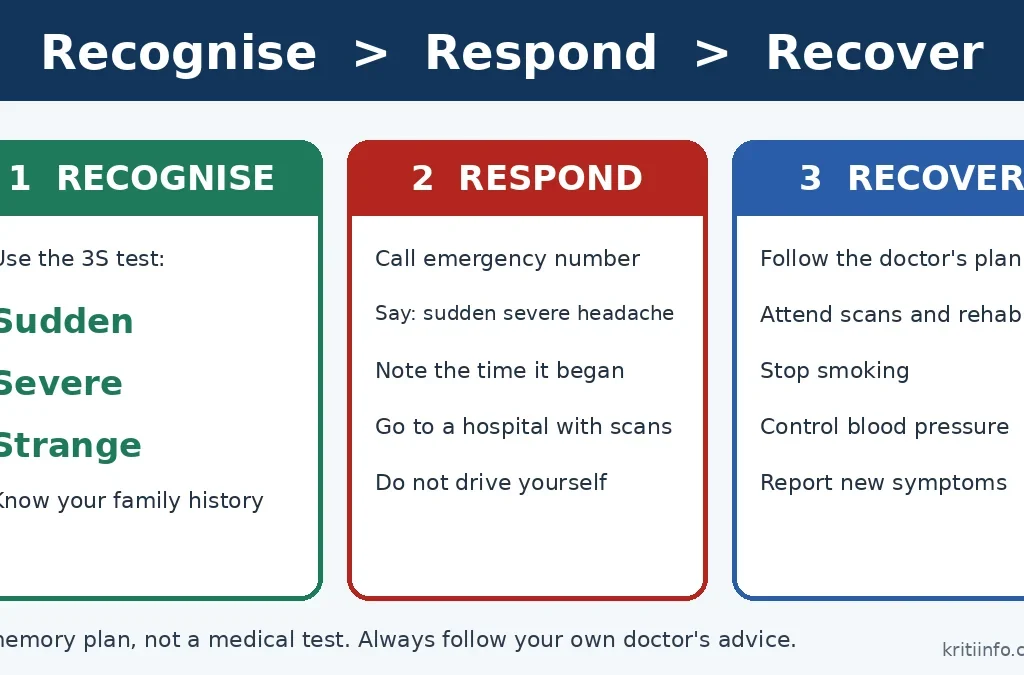
A memory plan, not a medical test.
Recognise. Ask the 3S question about any headache: is it Sudden, Severe and Strange? Sudden means it peaks within a minute. Severe means your worst ever. Strange means unlike your usual headaches, or with vomiting, a stiff neck, vision change or fainting. Also learn your family history.
Respond. If yes, call emergency services at once. Say “sudden severe headache” and note the start time. Go to a hospital with brain scans.
Recover. Follow the doctor’s plan: scans, rehabilitation and medicines. Stop smoking, control blood pressure, report new symptoms. The NHS says recovery can take months or years, yet most people improve and some recover fully.
The Recognise, Respond, Recover plan for berry aneurysm
A Hypothetical Example
This case is invented to teach. It is not a real patient and not medical evidence.
Meena is 52. She smokes, her blood pressure runs a little high, and her brother once had a ruptured aneurysm. A scan for frequent headaches accidentally finds a 4 millimetre berry aneurysm at an artery fork.
Her doctors do not rush to surgery. A specialist group reviews its size, location and shape. Since it is small and silent, they advise monitoring, blood pressure control, quitting tobacco and scheduled scans. A year later it is unchanged. Had it grown, treatment would be discussed.
The lesson: the same finding can mean different plans for different people.
Berry Aneurysm vs Other Brain Conditions
| Feature | Berry aneurysm | Other brain aneurysms | Ischaemic stroke | Haemorrhagic stroke |
|---|---|---|---|---|
| What happens | A berry shaped bulge on an artery wall | The artery widens along a stretch, or weakens after infection or injury | A clot blocks blood flow to the brain | Bleeding in or around the brain |
| Typical first sign | None, or a thunderclap headache if it bursts | None, or pressure symptoms | Face droop, arm weakness, speech trouble | Severe headache, vomiting, drowsiness |
| Common treatment | Monitoring, clipping or coiling | Depends on type and cause | Clot dissolving medicine or clot removal | Stop bleeding, control pressure, sometimes surgery |
A ruptured berry aneurysm is one cause of haemorrhagic stroke, so the two overlap. See also our guide to brain cancer.
What the Numbers Really Say
- About 3 in 100 adults have an unruptured aneurysm. A Lancet Neurology review of 68 studies and 94,912 people found 3.2%. A Norwegian study found 3.8% to 8.3%, depending on the definition (Tromsø study). Meaning: better scans and counting rules change the total.
- Few of them burst. The UK sees about 8 subarachnoid haemorrhages per 100,000 people yearly, reports a 2024 review in Nature Communications. Very roughly, that is 1 bleed per 400 people with an aneurysm, though the figures come from different studies.
- Risk varies a lot. The European guideline cites a model with 5 year rupture risk from 0.4% to 17.8%, depending on features.
- A burst is serious. The same review reports case fatality of 25 to 30 percent, though care is improving.
Limits: Population numbers describe groups, not you, like a weather forecast for a city, not your house. Coiling versus clipping comparisons can also mislead, because doctors choose them for different patients (Neurosurgery, 2018).
Early Detection: Gains and Limits
Advantages. Finding a risky aneurysm early gives time to plan and prompts better habits. For high risk families, a clear scan brings peace of mind.
Limitations. Harmless incidental findings can cause anxiety. Monitoring needs repeat scans, and preventive treatment carries risk. So routine screening for everyone is not recommended. Specialists may consider it for selected people, such as those with two or more close relatives affected, or polycystic kidney disease.
Common Misconceptions
- “Every brain aneurysm will burst.” No. Most never do.
- “Every aneurysm warns you.” No. Many stay silent until they rupture.
- “Any bad headache means a burst aneurysm.” No. Most are harmless. See our post on migraine triggers. But a thunderclap headache needs urgent care.
- “Surgery is always needed.” No. Small silent ones are often watched.
- “Only old or unhealthy people get them.” No. They can occur at any age.
- “Stress alone causes them.” Not proven. Stress may affect blood pressure and habits, which matter.
What Should You Do Next?
- Ask your family about brain aneurysms or strokes.
- Check your blood pressure. Our article on rising non communicable diseases explains why.
- Never use tobacco, or quit with help.
- See a doctor for lasting headaches, eye pain or vision changes.
- Memorise the 3S test and emergency number.
- Follow your own doctor’s advice.
Frequently Asked Questions
1. What exactly is a berry aneurysm? A small, berry shaped bulge on a brain artery wall.
2. Can a berry aneurysm exist without symptoms? Yes. Most do, and are found by chance on scans.
3. What happens when a berry aneurysm ruptures? Blood leaks around the brain, causing a thunderclap headache, vomiting or fainting. It needs emergency care.
4. Can stress cause a brain aneurysm? Not proven. Stress may raise blood pressure or lead to smoking, which are real risks.
5. How is a berry aneurysm diagnosed? With CT or MR angiography, and sometimes cerebral angiography, chosen to suit your situation.
6. Can a berry aneurysm heal without surgery? It does not usually vanish by itself. Small silent ones may only need monitoring. A ruptured one needs treatment.
7. Who is at greater risk? Smokers, people with high blood pressure, a close relative with an aneurysm or certain inherited conditions. Women are affected more often.
8. Can people live a normal life with an unruptured aneurysm? Many do, with regular checks and healthy habits.
Conclusion: Knowledge Can Save Time and Lives
A berry aneurysm can sit quietly for decades, yet one sudden headache can change everything. The good news is that knowledge works. Recognising the signs, calling fast and following medical advice can improve outcomes.
Seven facts to remember:
- A berry aneurysm is a berry shaped bulge on a brain artery.
- Most are silent and never burst.
- Smoking, high blood pressure and family history raise risk.
- A thunderclap headache is an emergency.
- Scans find aneurysms.
- Treatment is personal.
- Recognise, Respond, Recover.
Share this guide with someone you love. It may save a life.