
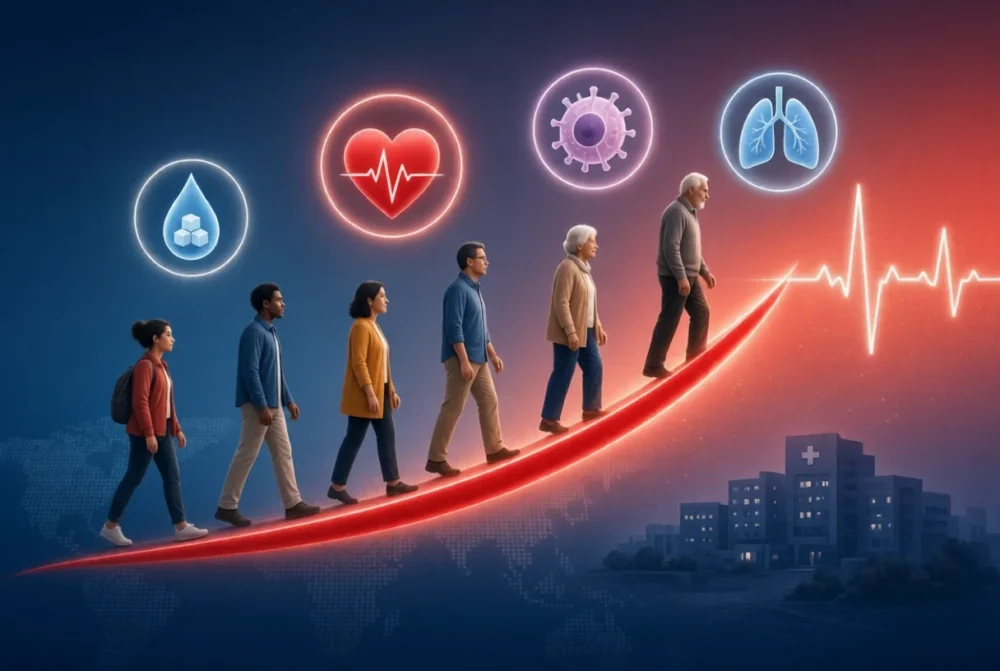
Maya’s alarm goes off at 6:45 a.m., same as always. She checks her phone before her feet touch the floor, makes instant coffee, skips breakfast because there isn’t time, and drives thirty minutes to an office where she’ll sit for the next nine hours. Lunch is whatever the delivery app suggests first. By 9 p.m. she’s on the couch, too tired to walk the dog properly, telling herself she’ll start exercising “next week.” Nothing about her day looks dangerous. Nothing hurts. Nothing feels urgent.
And that is exactly the problem.
Somewhere inside Maya’s arteries, blood pressure has been creeping upward for three years. Her fasting glucose sits just above normal, a number she has never actually checked. None of this shows up as a symptom yet. It shows up later, sometimes as a heart attack, sometimes as a diabetes diagnosis, sometimes as a cough that won’t go away. This quiet buildup is the real story behind rising non-communicable diseases, and it is playing out in millions of ordinary households right now.
Table of Contents
The Hidden Enemy Isn’t a Virus
Non-communicable diseases, often shortened to NCDs, are not caused by a pathogen you catch from another person. There is no outbreak, no quarantine, no single moment of infection to point to. Instead, NCDs develop through a slow accumulation of biological changes shaped by genetics, environment, daily habits, and social circumstances working together over years or even decades.
This is what makes rising non-communicable diseases so different from the health threats most people are trained to fear. There is no dramatic outbreak headline. The danger builds quietly inside ordinary bodies living ordinary lives, which is precisely why it so often goes unnoticed until a crisis forces attention.
According to the World Health Organization, noncommunicable diseases caused at least 43 million deaths in 2021, representing roughly 75% of all non pandemic related deaths worldwide. That scale places NCDs among the most significant public health challenges of our time, even though they rarely dominate the news cycle the way infectious outbreaks do.
The Big Four
Public health researchers generally group the leading noncommunicable diseases into four major categories.
Cardiovascular disease involves the heart and blood vessels, including conditions like heart attacks, stroke, and hypertension related damage. It remains the single largest contributor to NCD mortality worldwide.
Cancer encompasses a wide range of conditions where abnormal cells grow uncontrollably. Some cancers are strongly linked to lifestyle risk factors such as tobacco use, while others involve a more complex mix of genetic and environmental influences.
Diabetes, particularly type 2 diabetes, involves the body’s declining ability to regulate blood sugar effectively. It often develops silently for years before diagnosis, quietly damaging blood vessels, nerves, kidneys, and eyes.
Chronic respiratory disease, including conditions such as chronic obstructive pulmonary disease and asthma, affects the lungs’ ability to function properly, often worsened by tobacco exposure, air pollution, and occupational hazards.
Together, these four categories account for the overwhelming majority of NCD related deaths globally.
Why Are They Rising?
It would be easy, and inaccurate, to say rising non-communicable diseases are simply a matter of personal failure or weak willpower. The reality is far more layered.
Modern life has reshaped the environment around human bodies faster than our biology can adapt. Consider what has changed:
- Sedentary work has replaced physically demanding daily routines for huge portions of the global population
- Highly processed foods, engineered for convenience and shelf life, have displaced whole food diets in many communities
- Tobacco use and harmful alcohol consumption remain widespread despite decades of public health warnings
- Air pollution now affects billions of people, particularly in rapidly urbanizing regions
- Chronic stress and poor sleep quietly disrupt hormonal and metabolic regulation
- Aging populations mean more people live long enough for slow developing diseases to surface
- Access to preventive healthcare, screening, and early intervention remains limited or unaffordable in many regions
Socioeconomic conditions, food environments, urban design, and healthcare access all shape individual risk in ways that go far beyond personal choice. A person working two jobs with no safe place to walk and only fast food within reach faces a fundamentally different risk landscape than someone with time, resources, and green spaces available. Understanding rising non-communicable diseases requires holding both truths at once: individual habits matter, and so does the environment that shapes those habits.
The Body Keeps the Score Of Rising Non-Communicable Diseases
Here is where the story becomes almost cinematic, because the biology is genuinely dramatic once you understand it.
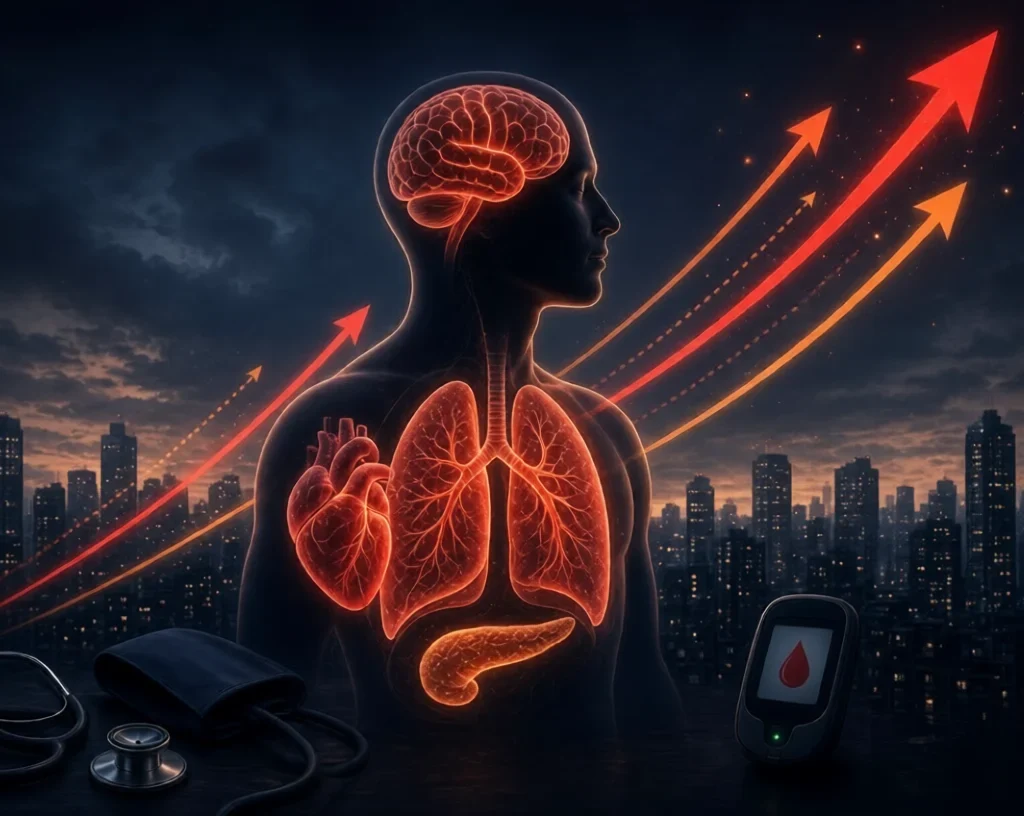
Years of elevated blood pressure slowly stiffen and damage artery walls, creating an environment where fatty deposits accumulate and narrow the vessels supplying blood to the heart and brain. Persistently high blood sugar behaves almost like a slow acid, gradually injuring the delicate blood vessels in the eyes, kidneys, and nerve endings. Chronic low grade inflammation, fueled by excess body fat, poor sleep, and ongoing stress, keeps the immune system in a constant state of low level alert, a condition increasingly linked to multiple NCDs at once.
None of this hurts on a Tuesday afternoon. That is the unsettling part. The damage is real, measurable, and progressive, yet largely invisible until it crosses a threshold the body can no longer compensate for.
Warning Signs People Overlook About Rising Non-Communicable Diseases
Certain symptoms deserve more attention than they typically receive, even though none of them confirm a diagnosis on their own:
- Persistent fatigue that doesn’t improve with rest
- Breathlessness during activities that used to feel easy
- Unexplained weight changes in either direction
- Increased thirst or more frequent urination
- A cough that lingers for weeks
- Chest discomfort, pressure, or tightness
- Blood pressure or cholesterol readings outside the normal range
- Blood sugar levels flagged as borderline during routine testing
These signs can have many causes, some serious and some completely benign. The point is never to self diagnose. It is to take overlooked symptoms seriously enough to bring them to a qualified healthcare professional for proper evaluation.
A Realistic Case Study
The following case is a fictionalized composite created for illustrative purposes and does not describe a real patient.
Before: Rohan, 42, considered himself reasonably healthy. He worked long hours at a desk job, ate out frequently, and hadn’t seen a doctor in nearly four years because nothing felt wrong.
Warning stage: During a company mandated health checkup, his blood pressure came back elevated and his fasting glucose sat in the prediabetic range. He felt fine, which made the numbers hard to take seriously at first.
Turning point: A follow up screening confirmed the pattern wasn’t a fluke. His physician explained that these were early, modifiable risk factors, not yet a diagnosis of heart disease or diabetes, but a clear signal worth acting on.
Action: Rohan began walking daily, gradually adjusted his diet with a nutritionist’s guidance, reduced alcohol intake, and scheduled regular follow up appointments to monitor his numbers.
Outcome: Eighteen months later, his blood pressure and glucose levels had improved significantly, though his doctor was clear this meant ongoing management, not a cure. Rohan describes it less as a health scare and more as a wake up call that arrived early enough to matter.
Prevention Is the Plot Twist
This is where the story shifts from unsettling to genuinely hopeful. Rising non-communicable diseases are, to a meaningful extent, preventable and manageable when addressed early.
Regular physical activity, a diet built around whole foods, avoiding tobacco, limiting harmful alcohol use, prioritizing sleep, and managing stress all measurably reduce risk over time. So does early detection through appropriate health screening, which allows risk factors like hypertension or elevated blood sugar to be identified and addressed long before they cause irreversible damage.
Prevention doesn’t demand perfection. It rewards consistency. Small, sustainable changes maintained over years tend to outperform dramatic short term efforts that fade after a few weeks.
What Families Can Do
- Schedule routine checkups even when nothing feels wrong
- Ask a healthcare provider which screenings are medically appropriate for your age and risk profile
- Build movement into daily routines rather than relying solely on scheduled workouts
- Cook at home more often, prioritizing vegetables, whole grains, and lean proteins
- Prioritize seven to nine hours of sleep as a genuine health priority, not a luxury
- Discuss family health history openly, since it shapes individual risk
What Governments and Communities Must Do
Individual action alone cannot solve a population level challenge. The WHO emphasizes that preventing and controlling noncommunicable diseases requires coordinated action across health systems and sectors beyond healthcare alone. This includes affordable primary healthcare and screening, tobacco control policies, cleaner air standards, healthier food environments, safe public spaces for physical activity, and stronger public health surveillance to track emerging risk patterns.
[Internal Link: related health article on preventive health screening guidelines] [Internal Link: related health article on managing blood pressure naturally]
For further authoritative reading, see the WHO Noncommunicable Diseases fact sheet and the WHO Global Health Observatory.
Frequently Asked Questions
What are noncommunicable diseases? Noncommunicable diseases are long term health conditions that are not spread from person to person, developing instead through a combination of genetic, environmental, and behavioral factors over time.
Why are noncommunicable diseases increasing? Rising non-communicable diseases are driven by factors including sedentary lifestyles, processed food consumption, tobacco and alcohol use, air pollution, aging populations, and limited access to preventive healthcare.
What are the four major noncommunicable diseases? The four leading categories are cardiovascular disease, cancer, diabetes, and chronic respiratory disease.
Can noncommunicable diseases be prevented? Many NCDs are preventable or delayable through modifiable lifestyle factors, though genetics and environment also play a role, and prevention should be discussed with a healthcare professional.
What lifestyle factors increase NCD risk? Key modifiable risk factors include tobacco use, physical inactivity, unhealthy diets, harmful alcohol use, chronic stress, poor sleep, and exposure to air pollution.
Why is early screening important? Early detection allows risk factors like hypertension or elevated blood sugar to be identified and managed before they cause serious, often irreversible organ damage.
When should someone speak with a healthcare professional? Anyone experiencing persistent symptoms such as unusual fatigue, breathlessness, unexplained weight change, or abnormal screening results should seek medically appropriate guidance rather than self diagnosing.
A Story Still Being Written
Maya, the woman from the beginning of this article, is fictional, but her routine is not. It belongs to millions of people navigating modern life without realizing the quiet risks accumulating in the background. The encouraging truth is that this story has room for a different ending. Noticing overlooked symptoms, prioritizing preventive healthcare, and making sustainable lifestyle adjustments genuinely change long term outcomes. Rising non-communicable diseases represent a serious global health challenge, but they are not an unstoppable one. The next chapter depends on the choices made today, starting with something as simple as scheduling a checkup.
This article is intended for general health education. It is not a substitute for professional medical advice, diagnosis, or treatment. Statistics are sourced from WHO reporting; the case study is a fictionalized composite created for illustrative purposes only.
1 thought on “How 5 Silent Warning Signs Reveal the Truth About Rising Non-Communicable Diseases”