
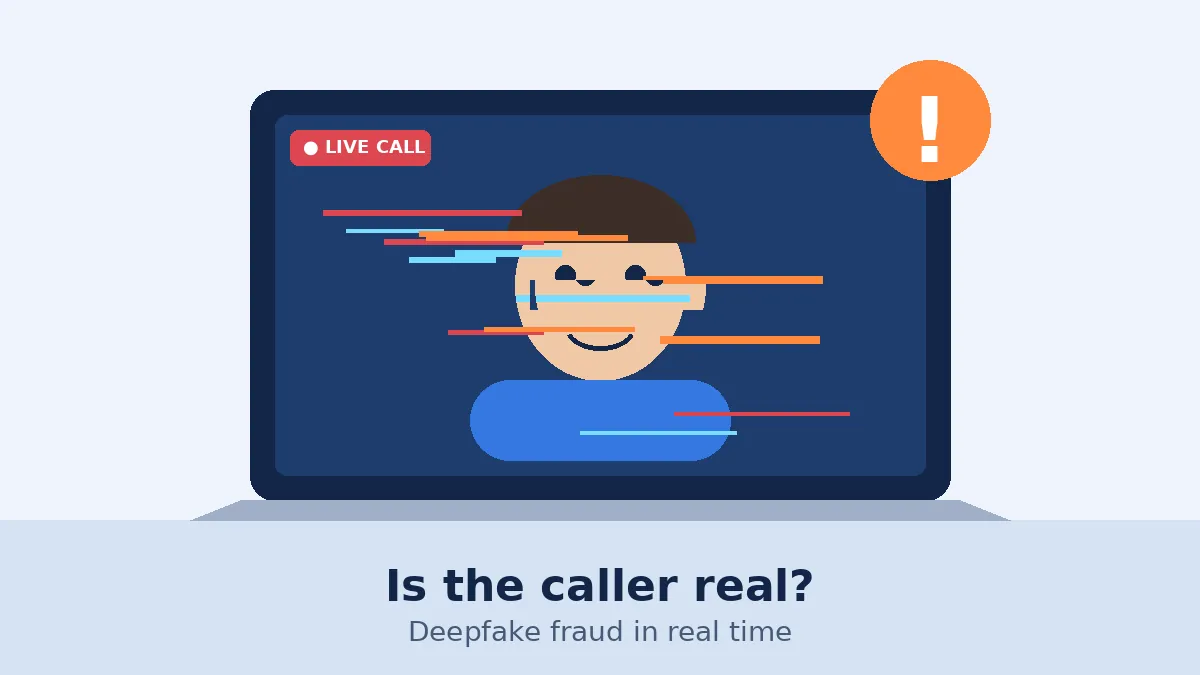
It is 6:40 pm. Meera, an accounts executive, gets a video call from her managing director. She sees his face. She hears his usual voice. He sounds rushed.
“A secret deal closes tonight,” he says. “Send the money now. Tell no one.”
Meera feels proud that he trusted her. She sends the payment. The next morning she learns her director was on a flight the whole evening.
Meera is not real. The trick is. In early 2024, a finance worker at the engineering firm Arup joined a video call with people who looked like the company’s chief financial officer and other staff. Police later said the others on the call were deepfake copies. The worker sent about HK$200 million, roughly US$25.6 million, in 15 transfers. CNN reported the details when Arup confirmed it was the victim in May 2024.
That is deepfake fraud in real time. The criminal does not send a fake recording. The criminal wears a fake face and voice while you talk. So how can an ordinary person tell a real human from an AI copy before the money is gone? The answer may surprise you.
Table of Contents
How Deepfake Fraud in Real Time Works
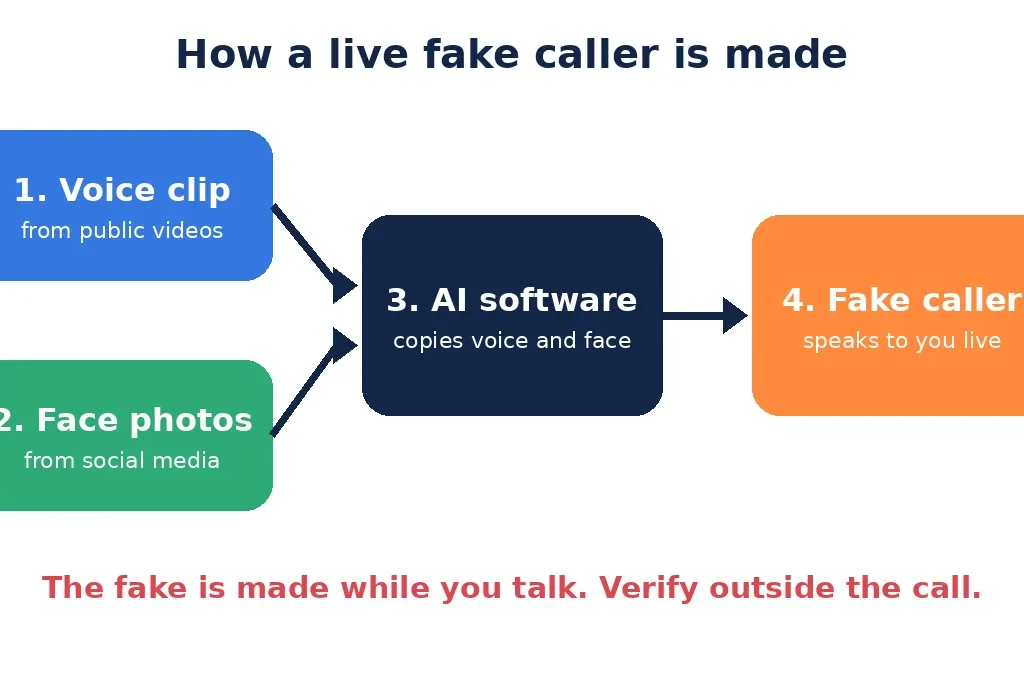
A deepfake is a fake voice, photo or video made with AI. “In real time” means the fake is made during the call, not recorded earlier. Here is the simple version, with no tool names and no instructions:
- Collect. Criminals find a person’s voice and face in interviews, webinars and social media. The FTC warns that a short audio clip can be enough for a voice cloning program.
- Copy the voice. AI voice cloning learns pitch, accent and rhythm.
- Swap the face. Software places one face over another and matches the lips to the speech.
- Run it live. The fake sound and picture appear as the criminal speaks.
- Add a fake identity. Some gangs build synthetic identities, mixing real and invented details.
Arup’s technology chief Rob Greig told the World Economic Forum that copying a voice, image or video now needs little technical skill. The more of your voice and face is online, the more material a criminal has.
Simple diagram showing a voice clip and a face photo going into AI software and coming out as a live fake caller
Why These Scams Are So Convincing
Technology is half the story. The other half is your brain.
We trust faces and voices without thinking. A familiar face feels like proof. Scammers add pressure: the matter is urgent, secret and important. They use authority too. Few employees question a managing director, and few parents doubt a crying child. The FTC notes scammers often demand secrecy, so nobody can warn the victim.
Here is how the old trick compares with the new one.
| Old impersonation scam | AI powered real time impersonation | |
|---|---|---|
| What you get | A claim: “I am your boss” | Apparent proof: his face and voice |
| Your first doubt | “This number is strange” | “But I can see and hear him” |
| Easy giveaway | Wrong accent, poor script | Often none you can rely on |
| Best defence | Listening for mistakes | Checking outside the call |
An old scam asked you to believe a claim. A new scam shows what looks like evidence. So “trust your eyes and ears” is no longer safe.
The Most Dangerous Real World Scenarios
1. The fake boss asks for an urgent transfer
Illustrative: A manager gets a message from a new number, then a call in the boss’s exact accent. “Do a deal today. Keep it quiet.”
Verified: In July 2024, a Ferrari executive got a call copying CEO Benedetto Vigna’s accent. He asked which book the CEO had just recommended. The caller could not answer and hung up, Fortune reported from Bloomberg.
Warning signs: a new number, a secret deal, money first.
2. The cloned family member
Illustrative: “Papa, I had an accident. Send ₹50,000 now. Don’t tell Mummy.” The voice sounds exactly like your child.
Verified: In July 2023, a retired official in Kozhikode, Kerala, got a short WhatsApp video call from a “former colleague” asking for hospital money. He sent ₹40,000. Kerala police later recovered it.
Warning signs: an emotional emergency, a new number and a request for secrecy.
3. The fake bank representative
Illustrative: A caller who sounds like your branch manager says your account will freeze unless you read out the OTP on your phone.
Warning signs: any request for an OTP, PIN or password. The FBI says never share a two factor code with anyone.
4. The fraudulent online interview
Illustrative: A “recruiter” praises your skills on video, then asks for a “security deposit” and a photo of your ID card.
Warning signs: payment demands, early ID requests and no official company email.
5. The manipulated video meeting
Illustrative: A sudden “board meeting” approves a confidential payment. Only one person on the call is real.
Warning signs: a rushed meeting, silent participants and a decision nobody may check. The Arup case shows the risk.
What the numbers say, and what they do not
The FBI’s 2025 Internet Crime Report, released in April 2026, tracked AI as its own category for the first time. It counted 22,364 complaints mentioning AI and about $893 million in losses, out of more than 1 million complaints and about $20.9 billion in total losses. By my own calculation, AI related losses are roughly 4% of the total.
What does this mean? Mind three limits. The data covers the United States only. Victims report it themselves. AI is counted only when someone noticed it, and the FBI has said the real figure may be higher. Treat it as a floor, not a ceiling, and not an Indian figure.
The Practical Framework to Detect Deepfake Fraud in Real Time
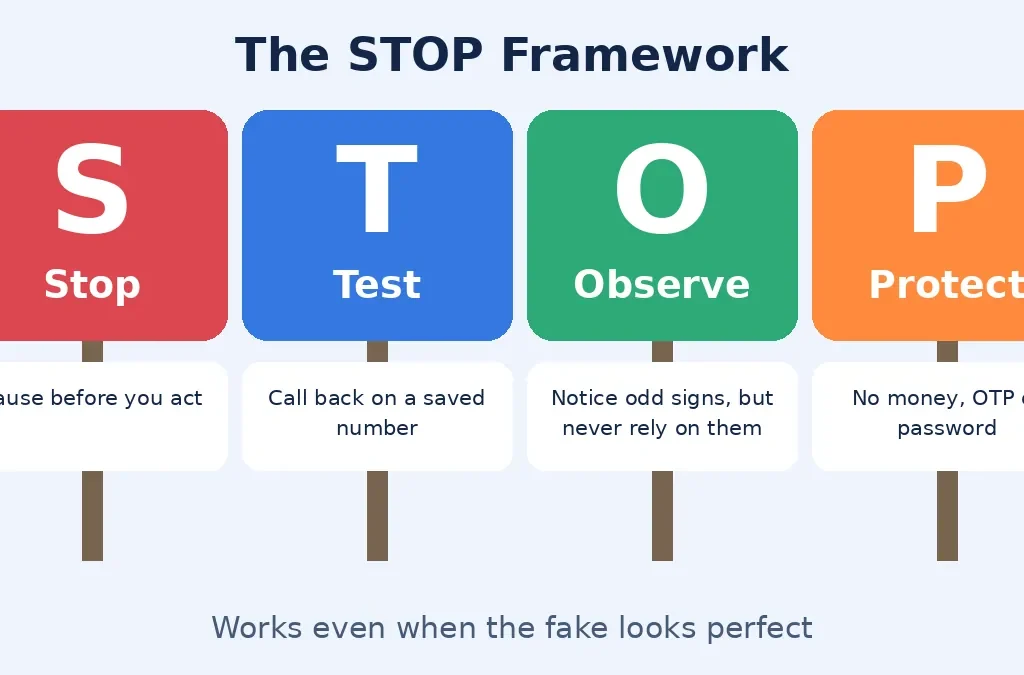
One habit works even when the fake is perfect. Remember one word: STOP.
S: Stop. Pause before acting on any urgent request for money, passwords or OTPs. Say, “Let me call you back in five minutes.” A real boss will accept it. One sentence could have saved Meera’s company.
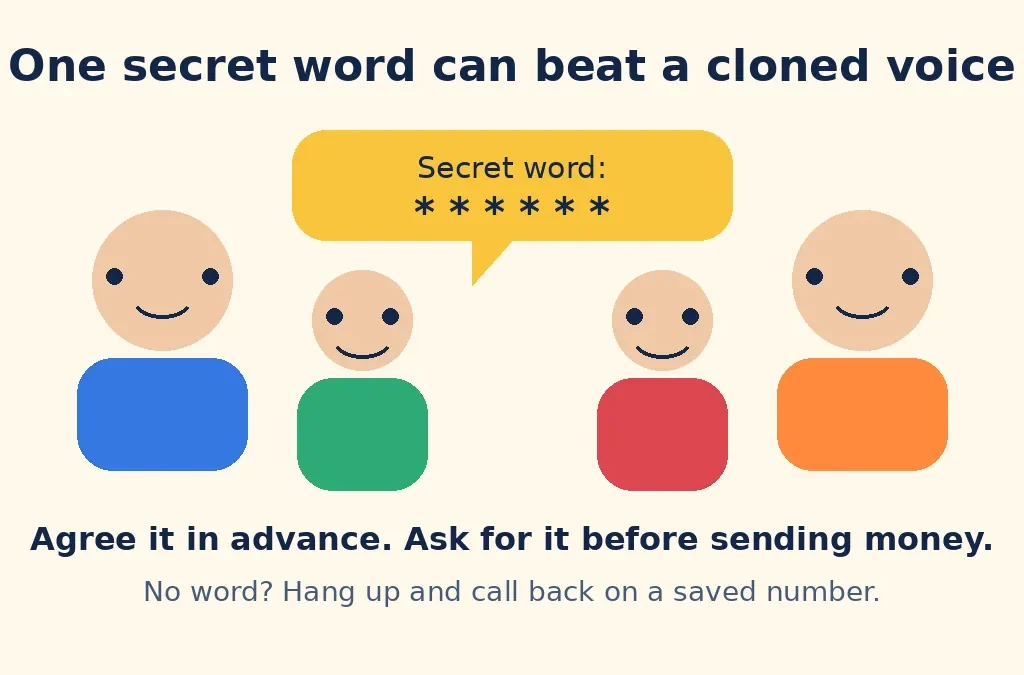
T: Test. Check the person through another channel. Call the number saved in your phone, never the number that called you. Families can agree on a secret word, which the FBI recommends. A personal question, like Ferrari’s book question, can help, but a callback is stronger because a prepared criminal may know shared facts.
O: Observe. Watch the voice, face, context and behaviour. Look for odd pauses, lips that do not match, strange word choices, a new number or an unusual request. But never depend on this step. The FBI’s December 2025 warning suggests listening to tone and word choice, yet admits cloned voices can sound nearly identical. Observation is a bonus, never proof.
P: Protect. Share no money, OTPs, passwords or documents until the person is verified.
Individuals: think before posting long voice or video clips in public. Families: set the secret word and teach grandparents the callback rule. Businesses: read on.
Four colourful signboards spelling STOP: Stop, Test, Observe, Protect
What Businesses Must Do to Build AI Security and Trust
A familiar face must never replace a proper check. The NSA, FBI and CISA joint guide on deepfake threats (September 2023) urges organisations to train staff, rehearse responses and consider real time verification tools. Start here:
- Two person approval for large or unusual payments.
- Callback rule: use a number from your own directory, never one in the request.
- Waiting period for any new or changed bank account.
- Strong logins: app or hardware based multifactor authentication is generally stronger than SMS codes.
- Written policy: no video call alone can approve a payment.
- Practice drills and an incident plan naming who calls the bank and police first.
See also our guides on AI security platforms and companies ignoring the AI threat.
Can Technology Defeat Deepfake Technology?
Technology helps, but it is no magic shield. NIST’s 2024 report on synthetic content risks reviews provenance, watermarking and detection, and each has limits.
| Tool | How it helps | Main limit | Fit |
|---|---|---|---|
| AI content detection | Looks for signs a file is machine made | Fakes keep improving; results can be wrong | Helpful extra signal |
| Liveness verification | Checks a real person is present, as in bank onboarding | Not built for ordinary calls | Strong in specific uses |
| Multifactor authentication | Adds a second proof beyond a voice or password | A tricked person can still hand over a code | Strong for logins |
| Content credentials (provenance) | Signed record of where content came from | Needs tools and platforms to use it; no label proves nothing | Growing |
| Cryptographic identity | A digital signature proves the sender holds a secret key | Needs setup on both sides | Strong where adopted |
| Human procedures | Callbacks and dual approval | Needs discipline and time | Strong when followed |
No single tool guarantees safety. Technology narrows the risk. Procedures catch the rest.
Common Misconceptions About Deepfake Fraud
“Every deepfake has visible errors.” No. The FBI’s 2025 report says AI made content is getting harder to detect and easier to make.
“A familiar voice proves identity.” No. The FTC says do not trust the voice, even if it sounds like your family member.
“Only celebrities and rich people are targeted.” No. The Kozhikode victim was a retired official who lost ₹40,000. Across all internet crime, adults over 60 reported the largest FBI losses.
“AI detection software finds every fake.” No. Detection is one tool among several, with limits.
What Should You Do After a Deepfake Fraud Attempt?
- Stop talking. End the call or chat.
- Send no money and share no password, OTP or document.
- Contact the real person on a trusted number.
- Tell your bank at once if money or card details are involved.
- Save evidence: screenshots, numbers and transaction details.
- Report it. In India, call 1930 and file on the National Cyber Crime Reporting Portal. A government page says to file the formal complaint within 24 hours using the acknowledgement number from the call. In the United States, use IC3.gov.
- Secure your accounts and change any password that may be exposed.
Speed matters. Early reports give the best chance of stopping the money.
The Future of AI Security and Digital Trust
Nobody can predict the exact path, but some signs are clear. Fake voices and faces are getting cheaper to make. Agencies now count AI in crime data, as the FBI did in 2025. NIST is working on provenance and labelling, and banks are adding stronger identity checks. Rules and tools will help, but unevenly. Meanwhile, habits matter most. Sixty seconds of slowing down is the cheapest security upgrade.
Conclusion: Trust Must Be Verified
In an age when AI can copy a familiar face and voice, trust must be supported by independent verification. Deepfake fraud in real time beats our eyes and ears. It cannot easily beat a calm pause and a callback.
Do one thing today: choose a secret word with your family, and agree that any money request, even from a loved voice, gets a callback first.
Frequently Asked Questions
1. What is deepfake fraud in real time? A scam where criminals use AI to fake a person’s face or voice during a live call, to steal money or data.
2. How do criminals clone someone’s voice during a live call? They train AI software on audio of the person, often from public videos. The FTC says a short clip can be enough.
3. How can I identify a deepfake video call? Watch for odd pauses, mismatched lips and unusual requests. But clues are unreliable, so verify through another channel.
4. How can businesses prevent real time deepfake fraud? Use two person approval, callbacks to known numbers, waiting periods for new accounts, training and an incident plan.
5. What should I do if someone impersonates my family member? Hang up, call the real person on a saved number, send no money, and report it (1930 and cybercrime.gov.in in India).
6. Is AI detection technology reliable enough? Not alone. It is a useful signal with limits, so pair it with verification procedures.