
The Day Meera Worked Hardest and Scored Lowest
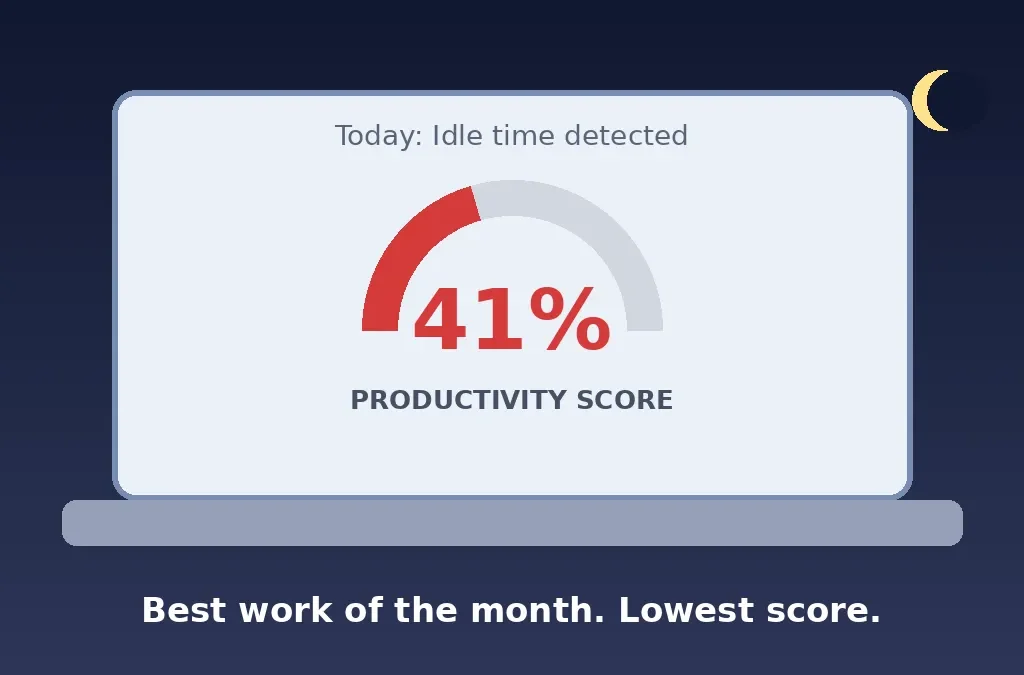
Meera (a made up name) sat at her desk at 11 pm. She was finishing a client report that was due at sunrise. It was the best work she had done all month.
Her laptop was quietly watching her. It counted her keystrokes. It took screenshots every few minutes. It tracked her mouse.
The next morning, her dashboard showed a score of 41 percent. Why? For two hours she had read client papers and thought hard. No typing, no clicking. The software marked it as “idle.”
Her client loved the report. The software did not.
So here is the big question. When a company measures every movement, does it improve performance, or does it destroy the trust that makes people perform well?
This is the heart of employee surveillance versus trust. Let us look at it step by step.
What Is Employee Surveillance?
Employee surveillance means an employer collecting data about what workers do, where they are, and how they work. It is also called employee monitoring.
Think of a school. A teacher who checks homework is practising accountability. A teacher who counts every pencil stroke is doing something else.
Here is how modern workplaces watch people:
- Computer activity tracking: keystrokes, mouse use, apps opened.
- Email and internet monitoring: messages scanned, websites logged.
- Screen recording and screenshots: pictures of your screen at set times.
- GPS and location tracking: where delivery staff or field teams are.
- Biometric attendance: fingerprint or face scans at the door.
- AI productivity scoring: software that turns activity into a score.
- Remote work monitoring: webcams, login timers, activity status lights.
Some of this is useful. A bank must know who opened a customer file. The trouble starts when watching replaces thinking.
Table of Contents
Trust, Autonomy and Accountability in Simple Words
- Organisational trust: people believe the company treats them fairly.
- Employee autonomy: people have some freedom in how they work.
- Psychological safety: people can ask questions or admit mistakes without fear.
- Workplace accountability: people answer for results and promises.
Trust says, “I believe you will do it.” Accountability says, “And we will both look at the result.” Good workplaces need both.
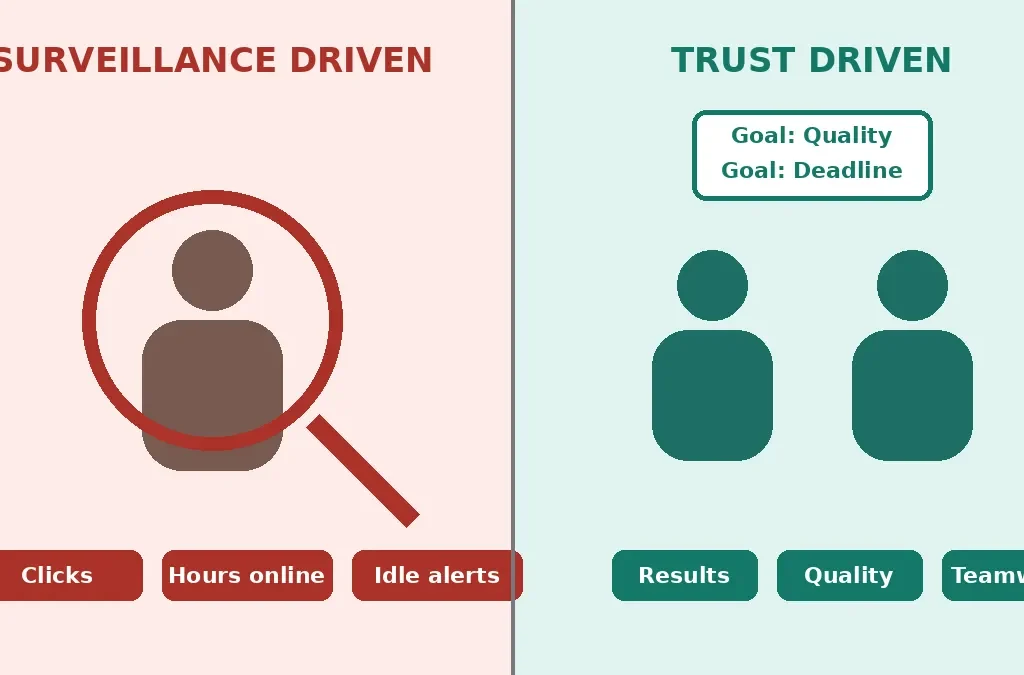
Surveillance Driven vs Trust Driven Management
| Area | Surveillance driven | Trust driven |
|---|---|---|
| Main question | “Are you busy?” | “Did the work get done well?” |
| What is measured | Activity: clicks, hours online | Results: quality, deadlines, teamwork |
| Employee feeling | Watched, nervous | Respected, responsible |
| Result | Compliance (doing the minimum safely) | Commitment (doing more willingly) |
| Motivation | Fear of a low score | Pride and purpose |
| Short term | Quick visibility | Slower to set up |
| Long term | Stress, hiding, quitting | Stronger loyalty and skills |
| Privacy | Often collected “just in case” | Collected only when needed |
| Manager style | Micromanagement | Clear goals, regular check ins |
Hours online do not prove good work. A programmer may solve a bug while walking. A person can wiggle a mouse all day and deliver nothing. Meera’s story shows the reverse: great work can look “idle.”
What Research Actually Says
Research shows patterns, not magic laws.
1. A large review (2022). Siegel, König and Lazar combined 70 samples and 233 results. Electronic monitoring slightly lowered job satisfaction (r = −0.10), slightly raised stress (r = 0.11), and showed no link with performance (r = −0.01). Meaning: effects are small, but the promised performance gain did not appear.
2. Another review (2023). Ravid and colleagues, in Personnel Psychology, found no evidence that monitoring improved performance and found it linked to more stress. Effects vary by context. Meaning: how monitoring is done matters.
3. A survey of 1,119 people (2024). Kalischko and Riedl found that feeling monitored went with more privacy worry, less trust, more stress and lower performance. Meaning: this measures perceptions, so it cannot prove cause.
4. How common is it? (2025). APA reported an ExpressVPN survey saying 78 percent of US employers use digital monitoring tools. Meaning: it is a vendor survey, so treat the number with care.
5. Managers have doubts (2025). An OECD study of over 6,000 firms in six countries found algorithmic management common, with worries about unclear accountability and worker health.
I found no reliable data proving that more monitoring means more output, so this article does not claim it.
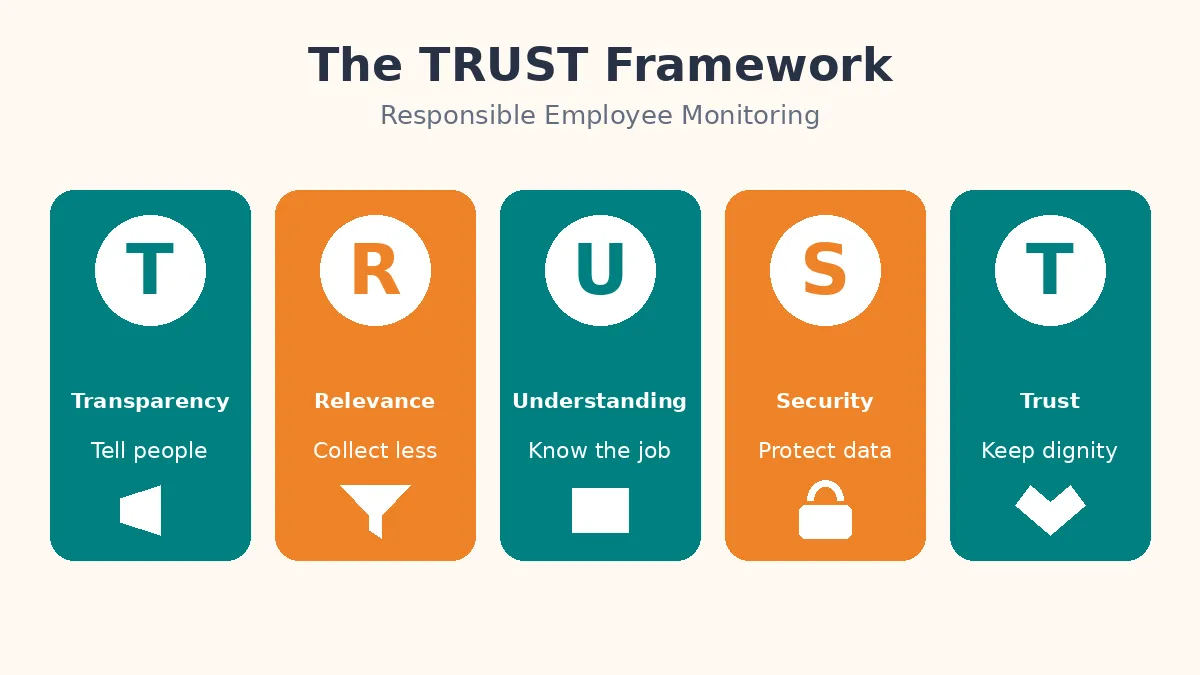
The TRUST Framework for Responsible Employee Monitoring
Use these five principles before you start any monitoring.
T: Transparency. Tell people what is tracked, why, and who can see it. Write it in plain words, not hidden in a long contract. How: hold a short meeting and share a one page summary.
R: Relevance. Collect only what you truly need. If you cannot name the business reason, do not collect it. How: list every data point and write one reason beside it. Delete the ones with no reason.
U: Understanding. Know the real nature of the job. A designer, a call agent and a machine operator create value differently. How: judge each role by its own outcomes, not one score for everyone.
S: Security. Employee data is sensitive. Limit who can open it, and protect it. How: give access only to named people, keep logs of who looked, and set a deletion date.
T: Trust. Keep dignity, fairness and open talk. How: let employees see their own data, challenge mistakes, and give feedback on the policy.
How it fits different places:
- Small business: a one page policy, monitor only cash, stock or customer data.
- Large organisation: a policy owner, yearly reviews, employee voices in the discussion.
- Remote team: deliverables and weekly check ins, not green status lights.
Three Illustrative Examples (Not Real Case Studies)
Example 1: The Overmonitored Employee. A company tracks every keystroke. A careful analyst who reads long documents scores low. A careless colleague who types constantly scores high. The wrong person gets promoted, and the good analyst starts job hunting. The failure: the company measured motion, not value.
Example 2: The Security Conscious Bank. A financial firm logs who opens customer accounts and flags unusual downloads. It does not record screens during lunch or read personal chats, and staff know the rules on day one. Why it can be justified: the purpose is clear, the watching is limited, and people are told. That is proportionate monitoring.
Example 3: The Trust Based Manager. A team lead sets weekly goals, agrees on quality standards, and holds a 20 minute check in. Work is judged by deliverables, deadlines and communication. Problems surface early because people feel safe to speak.
Why Surveillance Cannot Create Commitment
Extrinsic motivation comes from outside: scores, rewards, fear. Intrinsic motivation comes from inside: interest, pride, purpose. Heavy monitoring pushes people towards the first kind, so they work for the score.
Then employees optimise what is visible. They move the mouse and stay “green.” Visible activity rises while real thinking may fall. When a measure becomes a target, people learn to game it.
Balanced view: monitoring is not always bad, and findings are mixed. The damage seems greatest when it is secret, unfair, or used to punish.
Real World Uses by Setting
- Remote and hybrid teams: agree on deliverables and meeting rhythms. Skip webcam checks.
- Manufacturing: use sensors for safety, not to time toilet breaks.
- Banks and IT firms: access logs and fraud alerts are justified. Judge developers by reviewed work, not typing.
- Customer service and small shops: share call scores with agents. A cash counter camera is fine. Reading staff chats is not.
Advantages and Limits
Possible advantages: protects confidential data, helps stop fraud, supports compliance, and shows where work gets stuck.
Possible risks: lost trust, privacy worries, anxiety, micromanagement, biased scores, data leaks, disengagement, and legal trouble.
Acceptability depends on four things: purpose, proportion, transparency, and the law.
Five Common Misconceptions
- “More monitoring always means more productivity.” Not shown. Large reviews found no clear performance gain.
- “People who object have something to hide.” No. Wanting privacy is normal, like closing a bathroom door.
- “Online activity measures performance.” It measures activity. Meera’s story shows the gap.
- “Technology can replace management.” Software gives data. Judgement, coaching and fairness still need humans.
- “Trust means no accountability.” Trust with clear goals and honest reviews is the strongest form of accountability.
What To Do Next
Business owners: write a monitoring policy and justify every practice in one line.
Managers: judge quality, outcomes, deadlines and responsibility.
HR professionals: build transparent policies, ask employees for input, and set privacy safeguards.
Employees: read the policy, ask questions, and raise concerns through proper channels.
Quick checklist
- [ ] Written, plain language policy?
- [ ] Each data point tied to a business reason?
- [ ] Employees know what is collected?
- [ ] Access limited and logged?
- [ ] Judged by outcomes, not just activity?
Legal and Ethical Points (India)
Monitoring is not automatically lawful. Purpose, proportion and notice matter.
India’s Digital Personal Data Protection Act, 2023 was enacted on 11 August 2023, and the Digital Personal Data Protection Rules, 2025 were notified on 13 November 2025. Provisions are being brought in phases. Law firm commentary says the core processing provisions (Sections 3 to 17) are scheduled to start on 13 May 2027.
Section 7(i) recognises processing for employment purposes, or to protect an employer from loss or liability, as a “legitimate use.” That may mean consent is not needed for every case. But commentators warn it is not a blanket permission for unlimited surveillance. For example, monitoring a personal phone may expose private photos and messages that have nothing to do with work.
Other laws, sector rules and contracts may also apply. This is general information, not legal advice. Read the official texts on Government of India and MeitY websites, or ask a lawyer.
Frequently Asked Questions
1. What is employee surveillance? An employer collecting data about workers’ activity, location or online behaviour using software, cameras or GPS.
2. Is employee monitoring harmful to workplace trust? It can be, especially when secret or excessive. A 2024 survey linked feeling monitored with lower trust, though it cannot prove cause.
3. Can employers legally monitor employees? Sometimes, within limits. India’s DPDP Act has an employment related legitimate use, but it is not a blanket permission. Check official sources and a lawyer.
4. Does employee surveillance improve productivity? A 2022 meta analysis found no link with performance (r = −0.01).
5. How does excessive monitoring affect morale? Research links it with slightly lower job satisfaction and slightly higher stress.
6. What is the difference between monitoring and micromanagement? Monitoring collects information for a stated purpose. Micromanagement controls every small step.
7. How can managers balance privacy and accountability? Use the TRUST Framework: tell people, collect only what is needed, understand the job, protect data, keep dignity.
8. Is trust based management better than surveillance based management? Evidence suggests trust with clear goals gives better wellbeing and no worse performance. High security roles still need proportionate monitoring.
Conclusion: Do Not Choose Between Accountability and Trust
Remember Meera. Her best work scored her lowest. The fault was not her effort. The fault was a system that confused motion with value.
A workplace should not have to choose between accountability and trust. The real task of modern management is to build systems where responsible monitoring protects the company without treating people like suspects.
Practical takeaway: list everything you monitor and write the reason beside each item. Delete what you cannot justify, and tell your team the rest. Then ask: would I be comfortable being watched this way?