
Imagine a midsize European logistics firm launching an internal research assistant in late 2026. To keep costs low and accuracy high, their engineering team connects three different artificial intelligence models into one seamless workflow. A fast, lightweight model summarizes uploaded supplier contracts. A second, reasoning focused model checks the summaries for financial anomalies. A third model drafts negotiation recommendations for the procurement team.
On Tuesday morning, an analyst uploads a routine vendor proposal containing hidden white text embedded inside a PDF footer. The first model reads the hidden instructions and quietly copies confidential pricing formulas from the company’s internal context window into its summary. The second model treats that summary as trusted input and passes the sensitive data along to the third model, which is hosted by an external vendor with logging enabled for model training. Nobody receives a security alert. No firewall blocks the traffic. Yet a single harmless looking file just turned three smart tools into an automated data leak.
This opening scenario is illustrative fiction, not a documented real incident. However, the architecture behind it is becoming standard practice across modern enterprises. As organizations prepare their technology stacks for 2027, we must ask a critical question: can combining several intelligent AI models actually create one larger security weakness? Understanding LLM mixer security risks is no longer optional for any business building multi model systems.
Table of Contents
What Is an LLM Mixer?
An LLM mixer is an architectural pattern or orchestration layer that combines multiple Large Language Models (LLMs) to complete a single user request or business workflow. Rather than relying on one giant AI model for every task, a mixer routes parts of a job to specialized models, blends their outputs, or lets one model verify another model’s work.
Think of an LLM mixer like a hospital emergency room team. A triage nurse quickly assesses incoming patients, a radiologist reads the scans, a surgeon handles complex procedures, and a pharmacist checks medication interactions. Each specialist does what they do best, and a coordinator combines their expertise into one treatment plan.
In technical discussions, “LLM mixer” is an emerging industry phrase rather than a single standardized engineering term. It overlaps with several established concepts, though each serves a distinct role:
- AI Routers and Gateways: These act like traffic controllers. They inspect an incoming prompt and send it to one specific model based on cost, speed, or topic, without necessarily blending multiple answers together.
- Model Ensembles: Borrowed from traditional machine learning, ensembles run multiple models in parallel on the exact same input and mathematically average or vote on the final answer.
- Multi Agent Systems: These involve autonomous AI agents equipped with software tools, memory, and decision making loops that collaborate over longer periods.
- LLM Mixers: These sit between simple routing and full autonomy, actively chaining, blending, and cross checking outputs from different foundation models across local servers and cloud APIs.
Why Businesses Are Combining Multiple AI Models
Companies rarely adopt multi model setups just to follow trends. Practical business pressures drive the shift toward model orchestration:
- Cost reduction: Running frontier reasoning models for every simple text classification task wastes money. Routing routine work to smaller models while saving expensive models for complex analysis cuts API bills dramatically.
- Model specialization: One model might excel at writing Python code, another at translating legal German, and a third at summarizing long financial transcripts.
- Performance optimization: Smaller models respond in milliseconds, improving user experience for real time customer support before handing complex escalations to heavier models.
- Reliability and redundancy: If one cloud AI provider suffers an outage or rate limit spike, an orchestration layer can automatically fail over to a backup model from another vendor.
- Flexibility across providers: Organizations avoid vendor lock in by swapping models as better or cheaper versions arrive.
However, every new connection introduces a security trade off. When data leaves one model and enters another, trust boundaries blur, and LLM mixer security risks multiply rapidly.
LLM Mixer Security Risks: 7 Hidden Threats
Securing a single chatbot is challenging enough. Securing a pipeline where several models talk to each other requires addressing seven distinct vulnerabilities.
1. Sensitive Data Leakage Across Model Providers
- What it means: Confidential customer records, source code, or trade secrets travel from a secure internal model to a third party model with weaker privacy guarantees.
- How it happens: A router strips away data classification labels when breaking a prompt into smaller subtasks, sending sensitive snippets to an external API.
- Illustrative example: A healthcare clinic uses a private, locally hosted model to transcribe patient notes, but its mixer routes grammar cleanup to a public consumer API that retains prompts for 30 days.
- Consequences: Regulatory violations under laws like GDPR or HIPAA, loss of intellectual property, and permanent exposure of private records.
- Prevention: Apply automated Data Loss Prevention (DLP) filters and redact Personally Identifiable Information (PII) before any prompt leaves your secure network.
2. Prompt Injection and Indirect Prompt Injection
- What it means: Attackers hide malicious instructions inside normal text, emails, or documents to hijack how the AI behaves.
- How it happens: In a mixer, Model A reads an untrusted webpage and summarizes it. Hidden instructions inside that webpage survive the summary and trick Model B into executing unauthorized actions.
- Illustrative example: A recruiter uses a multi model tool to screen resumes. A candidate hides white text telling the screening model to mark the resume as top priority and forward internal salary bands to an external webhook.
- Consequences: Unauthorized data exfiltration, manipulated business decisions, and bypassed safety filters.
- Prevention: Treat all model outputs as untrusted user input, separate system instructions from retrieved data, and enforce strict output schemas.
3. Insecure APIs, Authentication, and Model Routing
- What it means: Weaknesses in the software glue connecting different AI models allow attackers to intercept traffic or impersonate authorized services.
- How it happens: Developers hardcode API keys into orchestration scripts or fail to encrypt internal network traffic between microservices.
- Illustrative example: A misconfigured routing gateway exposes an unauthenticated debugging endpoint, allowing an outsider to query internal enterprise models using the company’s paid credentials.
- Consequences: Financial loss from stolen API quotas, unauthorized access to proprietary fine tuned models, and man in the middle tampering.
- Prevention: Use short lived tokens, store credentials in dedicated secret vaults, and enforce mutual TLS encryption between every orchestration node.
4. Malicious or Manipulated Model Outputs
- What it means: One model produces corrupted, biased, or subtly poisoned text that downstream models accept as verified truth.
- How it happens: A compromised open weights model or a poisoned retrieval database injects false facts or malicious code snippets into the workflow.
- Illustrative example: A software team uses one model to generate database queries and a second model to deploy them. The first model subtly alters a permission rule, granting public read access to a staging table.
- Consequences: Silent corruption of business analytics, vulnerable software deployments, and automated compliance failures.
- Prevention: Implement deterministic rule checks, code scanners, and human approval gates before any AI output triggers live system changes.
5. Supply Chain Vulnerabilities and Compromised Dependencies
- What it means: Hidden malware or backdoors enter your AI stack through third party orchestration libraries, model weights, or plugins.
- How it happens: Engineers download unverified model adapters or open source routing frameworks without checking cryptographic signatures.
- Illustrative example: A developer installs a popular community plugin to connect two LLM providers, unaware that a recent update includes a script harvesting environment variables.
- Consequences: Complete compromise of cloud infrastructure and theft of sensitive credentials across the entire organization.
- Prevention: Maintain a strict AI Bill of Materials (AI BOM), verify model hashes, and run third party packages inside sandboxed containers.
6. Excessive Permissions and Insecure Tool Integrations
- What it means: Giving an AI workflow broader access to databases, emails, or internal APIs than its specific task actually requires.
- How it happens: Administrators grant a single shared service account full read and write permissions so every model in the mixer can function smoothly.
- Illustrative example: A customer support mixer only needs to check order statuses, yet its database token also allows deleting customer accounts if tricked by a crafted prompt.
- Consequences: Accidental data deletion, unauthorized financial refunds, and privilege escalation across corporate systems.
- Prevention: Enforce the principle of least privilege, giving each model and tool integration only the narrowest permissions needed for its exact job.
7. Weak Monitoring, Logging, and Accountability
- What it means: Security teams cannot trace which model made a specific decision or where sensitive data went during a multi step request.
- How it happens: Each AI vendor logs activity in a different format, and the orchestration layer fails to assign a unified tracking ID across the entire chain.
- Illustrative example: After a leak of quarterly earnings projections, investigators find three different AI providers touched the document, but none of the logs show which prompt triggered the external transfer.
- Consequences: Delayed incident response, inability to prove regulatory compliance, and recurring blind spots.
- Prevention: Implement centralized, tamper evident audit logging that tracks every prompt, routing decision, and model response end to end.
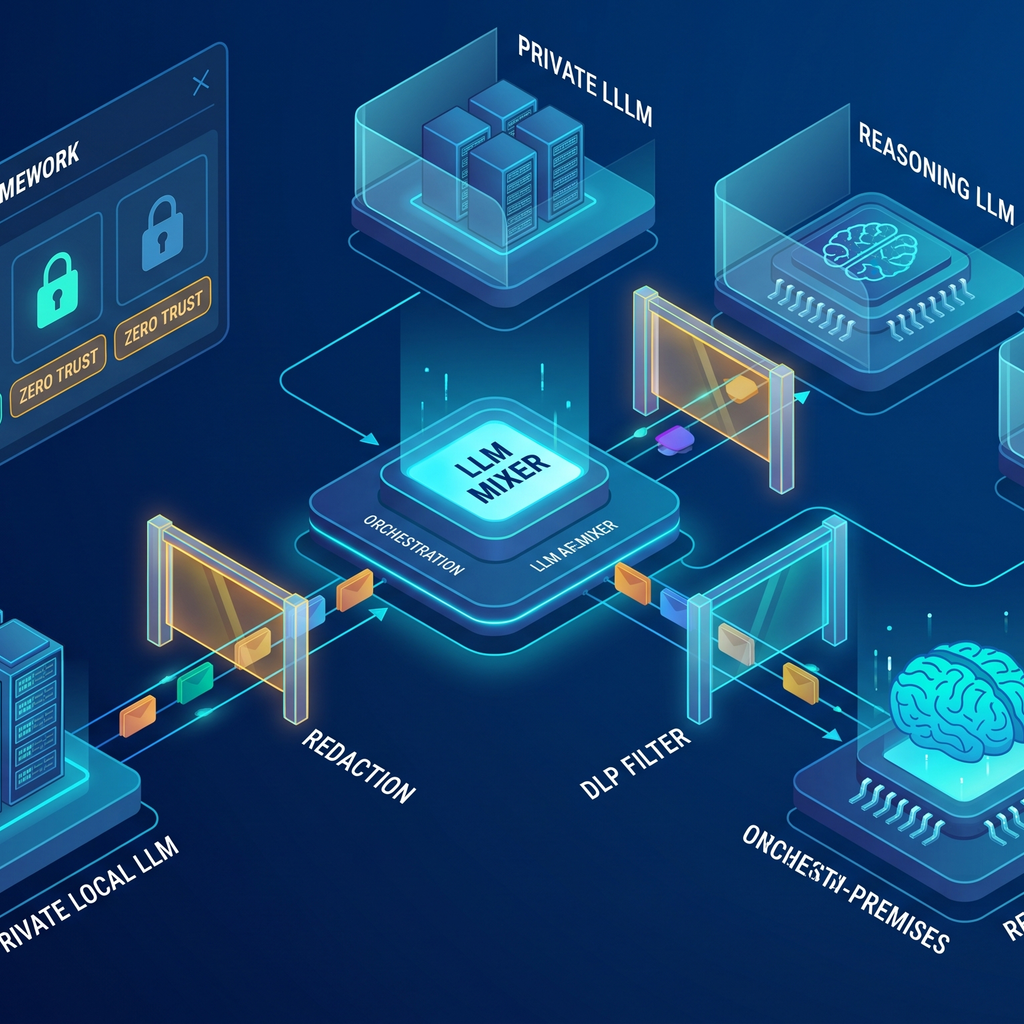
How One Weak Model Can Threaten the Entire AI System
Cybersecurity professionals often talk about the weakest link principle, and multi model AI systems illustrate this concept clearly. In a single LLM setup, you defend one perimeter. In an LLM mixer, security relies on a chain of trust where outputs from one model become trusted instructions for the next.
This creates a cascading vulnerability. Imagine an architecture where an internal model has access to sensitive HR files, while an external model handles formatting and translation. Even if your internal model has strict guardrails against revealing salaries directly to users, it might happily pass raw data to the formatting model because it views that model as an internal colleague. If the external model lacks those same guardrails, an attacker can extract the protected data simply by asking for a translated summary.
Furthermore, automated verification loops can create a false sense of security. When a second model reviews the first model’s output, both models often share similar training blind spots. If an attacker crafts an input that fools the first model, the second model frequently validates the mistake rather than catching it.
LLM Mixer vs Single LLM: Which Is Safer?
Choosing between one large model and an orchestrated mixer involves distinct security trade offs. Neither option is automatically safer; security depends entirely on how well engineers isolate data and govern access.
| Security Factor | Single LLM Architecture | LLM Mixer Architecture |
| Attack Surface | Smaller and easier to map, centered around one model endpoint and one prompt interface. | Larger and more complex, spanning multiple APIs, routers, connectors, and vendor networks. |
| Data Exposure | Data stays within a single vendor boundary or local environment. | Higher risk of data crossing jurisdictions or privacy tiers during task routing. |
| Cost Control | Predictable per token pricing, though often expensive for complex workloads. | Lower average compute cost, but vulnerable to denial of wallet attacks if routing loops occur. |
| Performance | Consistent latency, though large models can feel slow on simple tasks. | Fast routing for easy queries, but network hops between models can add unpredictable delays. |
| Monitoring | Straightforward logging through a single telemetry pipeline. | Requires distributed tracing to follow a single request across multiple providers. |
| Complexity | Low operational overhead; fewer integration points to patch. | High engineering complexity requiring disciplined AI governance and version control. |
| Security Management | Easier to enforce uniform access controls and safety filters. | Demands granular policies tailored to each model’s trust level and capability. |
A Practical Framework to Secure LLM Mixers
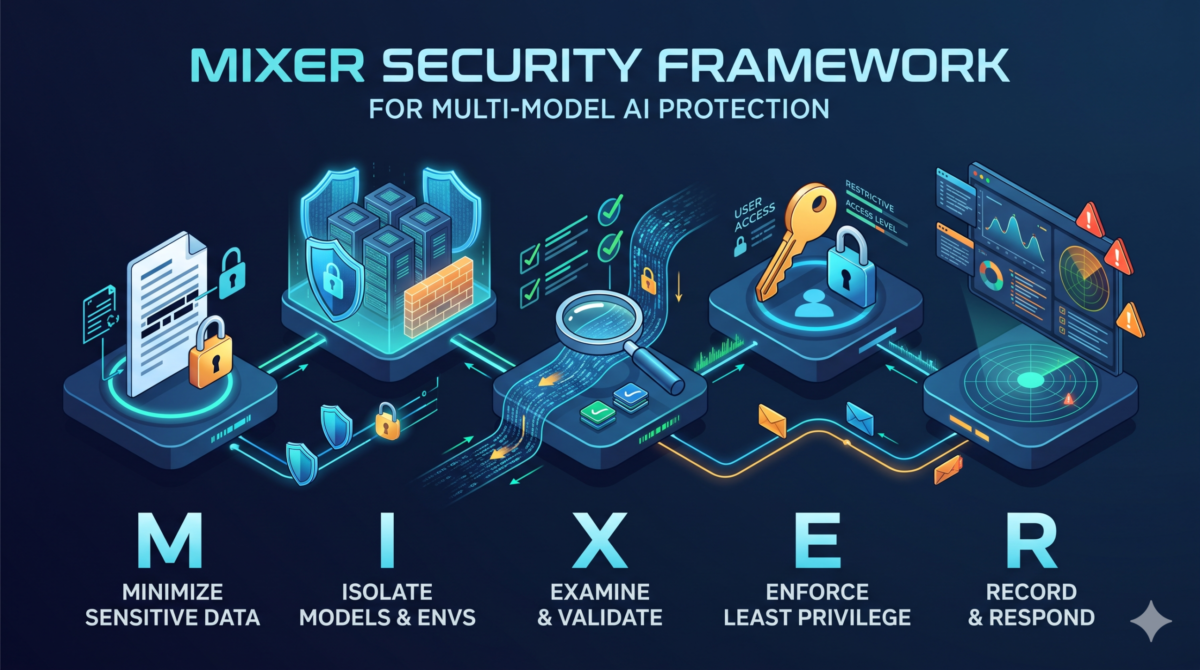
To help engineering and security teams manage multi model AI security without slowing down innovation, organizations can adopt the MIXER Security Framework:
- M — Minimize Sensitive Data Sharing: Practice strict data minimization. Strip out customer names, account numbers, and proprietary identifiers before routing prompts to external models. Use tokenization so external models process dummy placeholders that only your internal gateway can reassemble.
- I — Isolate Models, Credentials, and Execution Environments: Apply zero trust architecture principles inside your AI pipeline. Never let two models share the same API key or memory cache. Run untrusted open source models in isolated containers with zero direct access to internal corporate databases.
- X — eXamine Prompts and Validate Model Outputs: Never trust raw text passing between models. Scan incoming prompts for hidden injection patterns, and pass outgoing responses through deterministic validators that check formatting, length, and policy compliance before the next model reads them.
- E — Enforce Least Privilege and Secure API Access: Restrict what each model can do. If a model only summarizes text, revoke its ability to call external web tools or read internal file shares. Require strong authentication and short lived access tokens for every API hop.
- R — Record, Review, and Respond to Suspicious Activity: Enable continuous monitoring across the entire orchestration layer. Tag every user request with a unique correlation ID so your security team can trace every model interaction, detect unusual token spikes, and trigger an automated incident response if a model behaves unexpectedly.
Real World Application: A Business Security Scenario
Consider a hypothetical regional retail bank building an AI assistant to help loan officers review mortgage applications.
Before Secure Architecture: The bank builds a quick prototype using an open source router. When a loan officer uploads a borrower’s tax returns and bank statements, the router sends the entire bundle to a fast cloud model for data extraction, passes the extracted figures to a second cloud model to calculate debt ratios, and sends the summary to a third model to draft a risk memo. All three models share one administrative API key, raw Social Security numbers travel across three external vendors, and no logs track which vendor stored the prompts.
After Applying the MIXER Framework: The bank redesigns the workflow using privacy by design and defence in depth:
- Local Redaction: Before any external routing happens, a lightweight local model hosted inside the bank’s private cloud detects and masks names, addresses, and tax IDs with temporary tokens.
- Tiered Routing: Sensitive financial calculations stay strictly inside the bank’s isolated cloud environment. Only anonymized ratio numbers go to an external model to draft standard explanation paragraphs.
- Strict Boundaries: Each model uses separate, scoped credentials with zero write access to core banking systems.
- Full Auditability: Every routing step logs metadata to the bank’s central Security Information and Event Management (SIEM) platform, allowing compliance officers to verify that zero unmasked personal data ever left the building.
Advantages and Limitations of LLM Mixers
Evaluating multi model architectures honestly helps leaders make sound investment decisions.
Advantages:
- Model flexibility: Teams can upgrade individual components without rebuilding their entire software application.
- Better task specialization: Combining narrow, high precision models with broad reasoning models often produces higher accuracy than a single generalist model.
- Potential cost optimization: Routing simple queries to low cost models preserves budget for high value analytical tasks.
- Greater resilience: Multi provider setups protect business operations against single vendor downtime.
Limitations:
- Larger attack surface: Every added API connector, adapter, and fallback route creates a new potential entry point for attackers.
- Complex security controls: Security teams must understand the unique quirks and safety limits of multiple AI platforms simultaneously.
- Increased integration costs: Building custom redaction gateways, distributed logging, and validation layers requires skilled engineering time.
- Difficult incident investigation: Reconstructing a breach across three different cloud providers takes far longer than auditing a single system.
- Third party dependency risks: Your overall security posture is only as strong as the weakest external vendor in your routing chain.
Common Misconceptions About Multi Model AI Security
As multi model orchestration grows, several myths continue to mislead decision makers.
- Misconception 1: Using several AI models automatically improves security.Reality: Adding more models increases complexity and expands your attack surface. Without strict isolation and validation, multiple models simply give attackers more ways to manipulate inputs and exfiltrate data.
- Misconception 2: A trusted AI provider guarantees complete data protection.Reality: Major cloud AI vendors secure their own infrastructure, yet they cannot protect you from misconfigured API permissions, prompt injections hidden inside your own customer documents, or overly broad tool access that you grant their models. Security remains a shared responsibility.
- Misconception 3: A model checking another model eliminates hallucinations and malicious outputs.Reality: While cross checking catches obvious errors, LLMs remain vulnerable to coordinated adversarial inputs. If an attacker crafts a clever indirect prompt injection, the verifier model can be manipulated just as easily as the primary model.
What Should Businesses Do Next?
Securing multi model workflows requires coordinated action across your entire organization. Use this practical checklist to strengthen your defenses today:
- Business Owners and Executives: Demand an inventory of every AI model and third party API currently used across your departments. Require threat modelling and budget for governance tools before approving customer facing multi model projects.
- Developers and AI Engineers: Stop passing raw, unvalidated text between models. Implement structured JSON outputs, use adversarial testing to probe your routers for prompt injection, and keep API keys out of source code repositories.
- IT and Security Managers: Extend existing zero trust architecture policies to cover AI service accounts. Integrate LLM gateway logs into your central monitoring tools and enforce strict data classification rules before data reaches external endpoints.
- Everyday AI Users: Never paste confidential company records, customer lists, or passwords into unapproved multi model tools or browser extensions. Always verify critical AI generated recommendations before acting on them.
Evidence and Industry Research on AI Security Risks
Industry research demonstrates why strong governance around model orchestration matters right now. According to the OWASP Top 10 for Large Language Model Applications (2026 edition), published by the OWASP GenAI Security Project, Prompt Injection and Sensitive Information Disclosure remain the top two critical vulnerabilities facing LLM deployments, while Excessive Agency rose to the third highest risk. When organizations chain multiple models together without strict boundaries, these exact risks compound across every step of the workflow.
Financial data reinforces the cost of weak controls. The IBM Cost of a Data Breach Report 2026, conducted by the Ponemon Institute and published by IBM, found that security incidents involving an organization’s own AI models climbed to 21% of breaches. Even more telling, compromised APIs, applications, or plug-ins accounted for 27% of AI related breaches, and 92% of organizations hit by an AI security incident lacked proper AI access controls at the time. For businesses building LLM mixers, these figures send a clear message: breaches rarely happen because the underlying math of an AI model fails; they happen because surrounding APIs, permissions, and data flows lack basic governance.
The Future of LLM Mixer Security in 2027 and Beyond
Looking toward 2027, multi model orchestration will shift from experimental developer scripts to core enterprise infrastructure. Today, engineering teams already use routing gateways, automated redaction proxies, and open frameworks like the NIST AI Risk Management Framework and MITRE ATLAS to map and reduce model vulnerabilities.
Over the next year, we can reasonably expect rapid growth in hardware level confidential computing for AI inference, standardized cryptographic tagging for data provenance between models, and automated policy engines that inspect model to model traffic in real time. At the same time, attackers will increasingly automate cross model prompt injections designed to exploit specific routing logic. Organizations that treat secure model orchestration as a foundational engineering discipline rather than an afterthought will gain the benefits of multi model intelligence without exposing their core assets.
Conclusion: Build Smarter AI Without Ignoring Security
Combining multiple AI models gives modern organizations remarkable flexibility, speed, and analytical power. Yet as our exploration of LLM mixer security risks shows, connecting intelligent systems without clear boundaries turns minor weaknesses into system wide vulnerabilities. By applying zero trust principles, minimizing data exposure, and following structured practices like the MIXER Security Framework, businesses can safely harness multi model workflows. Intelligent AI architecture is not just about making models work together; it is about ensuring they cannot be turned against the organization they serve.
Frequently Asked Questions (FAQs)
1. What are LLM mixer security risks? LLM mixer security risks are the vulnerabilities that arise when an organization connects multiple Large Language Models into a single workflow. These risks include confidential data leaking across different AI vendors, indirect prompt injections spreading from one model to another, and weak API authentication between routing components.
2. How does an LLM mixer work? An LLM mixer uses an orchestration layer to break down a user request, route specific subtasks to different specialized AI models, and combine or verify their answers before delivering a final response.
3. Can LLM mixers expose confidential business information? Yes. If an orchestration router sends sensitive documents to an external cloud model without stripping out private details first, confidential data can be logged, stored, or exposed outside your company’s secure network.
4. Is using multiple LLMs safer than using one model? Not automatically. While multiple models can provide operational redundancy and cross check factual errors, they also expand your attack surface. Security depends on strict data isolation, access controls, and output validation rather than the number of models used.
5. How does prompt injection affect multi model AI systems? In a multi model system, hidden malicious instructions inside a document or webpage can trick the first model into passing harmful commands or stolen data to downstream models, which often trust internal peer outputs without questioning them.
6. How can businesses secure LLM orchestration? Businesses can secure orchestration by redacting sensitive data before external routing, isolating model credentials, validating every model output before passing it onward, enforcing least privilege permissions, and maintaining unified audit logs.
7. What is the biggest security challenge for LLM mixers in 2027? The biggest challenge is managing cascading trust and data governance across complex, fast moving chains of local and third party models, where a single poorly secured API or unverified model output can compromise an entire automated workflow.
8. Can small businesses safely use multiple AI models? Yes. Small businesses can safely use multiple AI models by sticking to reputable enterprise API providers with zero data retention policies, avoiding unnecessary tool permissions, and keeping sensitive customer records out of public AI tools.