
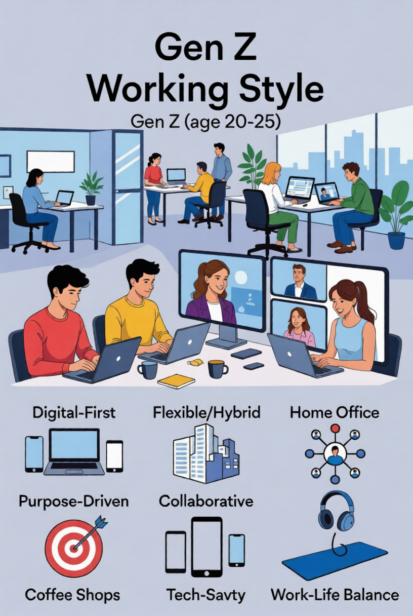
Working Style:Picture this. It is Monday morning. A 58-year-old senior manager walks into the office at 8:45 AM sharp, coffee in hand, ready to review printed reports and run a full-team stand-up meeting. Meanwhile, a 24-year-old team member logs in remotely at 9:15, earphones in, already three tasks deep on Notion, completely in flow — and sees zero reason to attend a meeting that “could have been an email.”
The generational clash between Gen Z (born 1997–2012) and Baby Boomers (born 1946–1964) is no longer background noise. It has moved front and center into boardrooms, HR conversations, and management training programs. And at the heart of it all is one fundamental issue — a deeply different working style.
Understanding this clash is not just valuable for managers. It is essential for any organization that wants to survive, grow, and build a culture where talent actually stays.
1. Communication Gaps That Create Stressful Daily Friction
One of the most frustrating points of tension between Gen Z and Boomers is how they communicate — or more accurately, how differently they expect communication to happen.
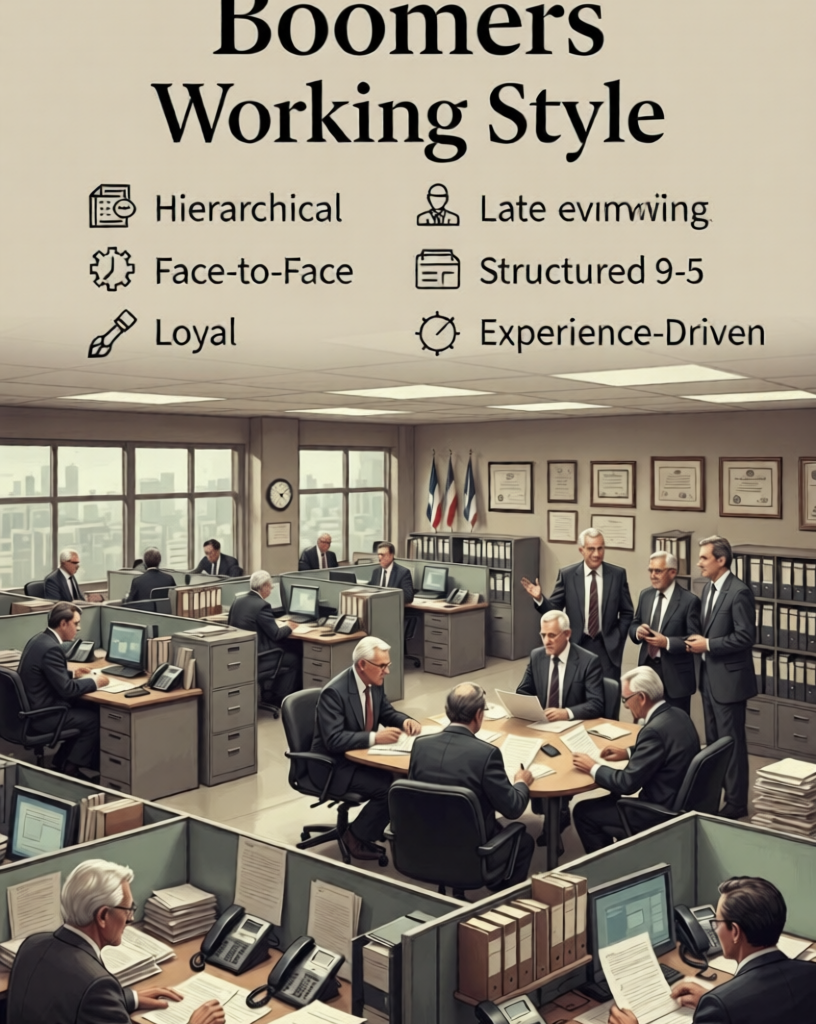
Boomers were shaped by a workplace culture that prized formal communication. Phone calls, face-to-face meetings, detailed memos, and scheduled one-on-ones were the trusted tools of professional exchange. Clear hierarchy in communication was not just expected — it was respected.
Gen Z, on the other hand, grew up texting before they could type properly. Their working style is built around quick, direct, asynchronous messaging. A Slack message, a voice note, or even a well-crafted emoji thread feels completely professional to them. Waiting two business days for an email reply feels like being stuck in the Stone Age.
This creates a daily collision that both sides experience as disrespectful — when neither party actually intends any disrespect at all.
Practical tip for companies: Establish a communication charter that defines when to use email versus instant messaging versus meetings. Make this a team-level agreement, not a top-down mandate.
2. Leadership Expectations That Collide Powerfully Every Quarter
Boomers grew up climbing a ladder. You earned authority through tenure, titles, and demonstrated loyalty. Leadership, in their worldview, meant having the experience to direct and the seniority to be heard.
Gen Z does not romanticize the ladder. They want mentorship, not micromanagement. They are drawn to leaders who are transparent, emotionally intelligent, and willing to explain the “why” behind decisions. A research-backed report by Deloitte found that Gen Z consistently ranks having a good manager — one who listens — as a top priority for staying in a role.
This is not entitlement. It is a generational shift in what leadership means. And companies that fail to adapt their leadership working style risk losing their youngest, most digitally capable talent within the first eighteen months of hiring them.
3. A Real Workplace Case Study Worth Paying Attention To
Company: A mid-size logistics firm in Pune, India (name changed for privacy) Situation: The company hired six Gen Z employees as part of a digital transformation push. Within three months, four had resigned.
The exit interviews revealed a pattern. The Boomer leadership team held weekly mandatory in-office Monday meetings starting at 9 AM. Gen Z employees felt this clashed with their most productive working hours — two of them had mentioned they did their best strategic thinking between 11 AM and 2 PM.
Additionally, the Gen Z hires preferred asynchronous project updates through shared dashboards. The Boomer managers felt “out of the loop” without verbal check-ins and began micromanaging to compensate — a behavior Gen Z employees found deeply demoralizing.
The turning point came when an HR consultant introduced structured “hybrid rhythm” agreements — where each team agreed on core collaboration hours, left the rest of the schedule flexible, and moved status updates to a shared Notion board everyone could check on their own time.
The result? Within two quarters, team retention improved, project completion rates rose by 34%, and even the senior Boomer managers admitted the new working style felt less chaotic — and oddly, more productive.
This is not a unique story. It is playing out in thousands of organizations right now.
4. Technology Adoption Habits That Reveal a Surprising Truth
Here is something that might seem shocking at first: Boomers are not anti-technology. Many of them were the ones who built the digital infrastructure Gen Z takes for granted. But their relationship with technology in the workplace is fundamentally different.
Boomers tend to adopt tools deliberately and systematically. They want training, documentation, and a clear process before integrating a new platform into their working style. Gen Z, by contrast, is what researchers call “digital natives.” They explore by doing. They will figure out a new SaaS tool in twenty minutes by clicking through menus, watching a YouTube video, and reading a Reddit thread.
This difference creates tension when companies roll out new technologies. Boomers can feel rushed and disrespected when adoption timelines are too aggressive. Gen Z can feel held back and bored when rollouts drag on for months.
The effective, proven approach is a tiered onboarding strategy — where early adopters (often younger employees) help pilot tools and create internal guides that make adoption easier for colleagues who prefer a more structured path.
5. Work-Life Balance Values That Redefine What “Professional” Even Means
This is perhaps the most emotionally charged area of the generational working style debate.
Boomers built careers on sacrifice. Working late was not a burden — it was a badge of honor. Loyalty to a company was genuine, long-term, and often emotionally tied to personal identity. Asking for a mental health day or declining after-hours calls would have felt, in that era, professionally risky.
Gen Z watched their parents burn out. Many grew up during economic crashes, a global pandemic, and a mental health crisis that has been well-documented by the World Health Organization. They are not lazy. They are protective of their energy in a way previous generations simply were not raised to be.
When a 22-year-old says “I need work-life boundaries,” a 58-year-old may instinctively hear “I am not committed.” But what that young employee is actually saying is closer to: “I will give you my best work when I am not running on empty.”
Both perspectives are authentic. Both come from real experience. The rewarding breakthrough happens when organizations stop judging one through the lens of the other.
6. Actionable Strategies to Bridge the Working Style Gap and Build a Thriving Culture
Companies that genuinely want to grow past the generational clash need to move beyond awareness and into strategic action. Here is what effective, trusted organizations are doing right now:
- Run reverse mentoring programs — pair younger employees with senior leaders so each generation teaches the other something genuinely valuable
- Create flexible working style agreements at the team level, not just company-wide policies that feel impersonal
- Train managers at every level in generational intelligence — not as a one-day workshop, but as an ongoing, embedded part of leadership development
- Measure outcomes, not hours — shift performance metrics toward deliverables and results, which naturally accommodates different productive rhythms
- Build psychological safety into team culture so that both a 55-year-old and a 23-year-old feel equally comfortable raising concerns
(For more on building inclusive management systems, read our related article: “How to Build a High-Performance Team Culture That Actually Lasts” on kritiinfo.com)
(Also explore: “Effective Remote Work Strategies for Modern Indian Workplaces” on kritiinfo.com)
FAQ
Q1. What is the main working style difference between Gen Z and Baby Boomers? The core difference lies in flexibility versus structure. Boomers tend to prefer defined hierarchies, scheduled communication, and in-person presence as a sign of professionalism. Gen Z prefers outcome-based accountability, asynchronous communication, and flexible scheduling. Neither approach is objectively superior — but the mismatch creates real tension unless companies proactively address it.
Q2. Why do Gen Z employees clash with Boomer managers in the workplace? The clash usually stems from misaligned expectations around leadership style, communication channels, and work-life balance values. Gen Z wants transparency and autonomy. Boomers often associate leadership with clear authority structures and in-person accountability. Without structured dialogue and generational training, these differences escalate into disengagement and attrition.
Q3. How can companies improve working style compatibility between generations? The most effective strategies include creating team-level communication agreements, investing in reverse mentorship programs, shifting performance metrics from hours to outcomes, and training managers in generational intelligence. Companies that treat this as a structural challenge — not a personality problem — see the strongest results.
Q4. Is the Gen Z and Boomer conflict making workplaces less productive? It absolutely can — but it does not have to. Research consistently shows that generationally diverse teams, when managed strategically, outperform homogeneous ones in creativity and problem-solving. The tension itself is not the problem. Ignoring the tension without building bridges is where productivity suffers.
Q5. What do Gen Z employees want most from their workplace? According to multiple workforce studies, Gen Z’s top workplace priorities include meaningful work with clear purpose, a manager who listens and coaches rather than controls, mental health support and flexibility, fast access to modern tools and technology, and transparent communication about organizational decisions. Companies that deliver on these priorities see dramatically better engagement and retention among their youngest talent.
Final Thoughts : The Clash Is Not the Ending ,It Is the Beginning
The generational tension between Gen Z and Boomers is not a problem to be solved and forgotten. It is an ongoing, evolving conversation that every forward-thinking organization needs to actively manage.
The truth is that both generations have something genuinely irreplaceable to offer. Boomers bring decades of institutional knowledge, resilience built through economic cycles, and a disciplined work ethic that still has enormous value. Gen Z brings digital fluency, a hunger for purpose-driven work, and an emotional literacy around mental health that is quietly making workplaces more human.
When their working styles are allowed to complement rather than compete with each other, the results are powerful. Not in a theoretical, leadership-conference kind of way — but in real quarterly numbers, in employee satisfaction scores, in the kind of culture where people actually want to come to work.
The organizations that will win the next decade are not the ones that pick one generation’s working style over the other. They are the ones that learn to hold both with strategic intelligence and genuine respect.
What has your experience been with generational working styles in your workplace? Share your thoughts in the comments below ,your perspective might be exactly what someone else needs to read today.
Published on kritiinfo.com | For more expert workplace culture insights, management strategies, and career growth guides, explore our full library at kritiinfo.com.
1 thought on “How 5 Shocking Working Style Differences Between Gen Z and Boomers Are Powerfully Transforming Every Workplace”