

Hidden Quantum Power
Imagine standing at the edge of a vast ocean, watching waves crash against the shore. Each wave represents a possibility, a potential reality waiting to unfold. Now imagine that same ocean existing in multiple states simultaneously—crashing, calm, rising, and receding all at once. This isn’t science fiction. This is the astonishing reality of quantum superposition, and it’s about to revolutionize how we think about intelligence itself.
Welcome to the thrilling frontier where quantum mechanics meets artificial intelligence. At kritiinfo.com, we’ve spent years researching transformative technologies, and nothing has amazed us more than the explosive potential of Quantum Machine Learning (QML). This isn’t just another tech trend. This is a game-changing breakthrough that will reshape healthcare, finance, cybersecurity, and every industry you can imagine.
Let’s dive deep into the brilliant science behind superposition and entanglement, and discover how QML is unlocking hidden quantum power that classical computers could never access.
Why Quantum Mechanics Is Suddenly Everyone’s Future
Eighty years ago, quantum physics was confined to dusty university laboratories and theoretical papers. Today, it’s powering the next revolution in computing and intelligence. The reason is simple yet shocking: quantum mechanics solves problems that would take classical computers thousands of years—in mere minutes.
Quantum computing harnesses two bizarre yet proven phenomena from quantum physics: superposition and entanglement. Together, these properties enable quantum systems to process information in ways that seem almost magical. When you combine this with machine learning, you get QML—a revolutionary force that’s already transforming how we approach the world’s most difficult computing challenges.
Think about the problems keeping world leaders awake at night: finding cures for cancer, modeling climate change with perfect accuracy, detecting financial fraud in real-time, or creating unbreakable cybersecurity. Classical computers struggle with these tasks because they process information sequentially, one calculation at a time. Quantum AI, powered by QML, can explore countless possibilities simultaneously, finding solutions that were previously invisible.
This isn’t speculation. Research from IBM Quantum, Google Quantum AI, and leading institutions like MIT Technology Review confirms that quantum algorithms are already outperforming classical methods in specific domains. The question isn’t whether quantum intelligence will transform our world—it’s how quickly we’ll adapt to it.
TheMind-BendingMagic of Superposition Explained Simply
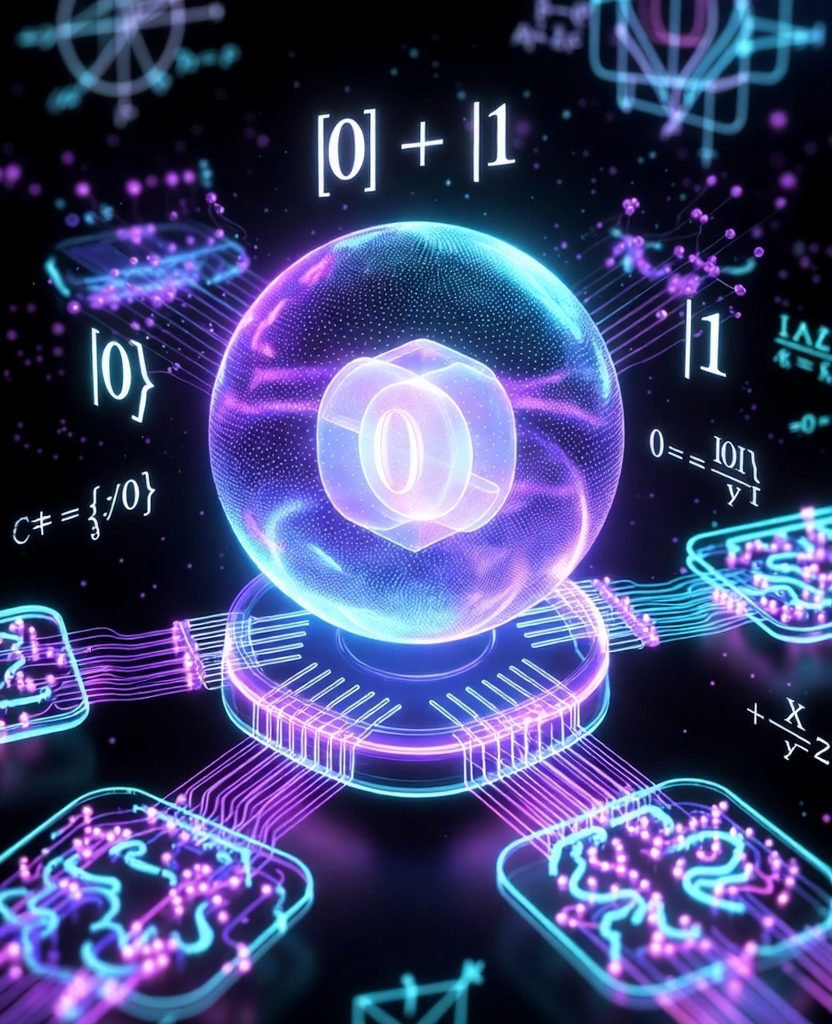
Let’s make this concrete. Imagine you’re flipping a coin. While it’s spinning in the air, is it heads or tails? Classically, you’d say it’s both neither—it’s in a state of uncertainty until it lands. But here’s where quantum mechanics gets amazing: a quantum coin (called a qubit) doesn’t just represent uncertainty. It actually exists as both heads AND tails simultaneously until you measure it.
This is superposition—one of the most powerful principles in quantum physics. A classical bit (the foundation of all your devices) can be either 0 OR 1. A quantum bit can be 0, 1, or both at the same time.
Real-World Analogy That Actually Makes Sense
Picture a maze. A classical computer solves it by trying one path at a time. If the path leads to a dead end, it backtracks and tries another. This works, but it’s slow. Now imagine a quantum system that can explore every possible path through the maze simultaneously. It doesn’t just find the exit—it finds the optimal exit instantly.
This exponential power comes from how quantum states scale. A classical computer with 3 bits can represent one of 8 possible states (000, 001, 010, etc.) at any moment. A quantum computer with just 3 qubits in superposition can represent all 8 states simultaneously. With 50 qubits, you’re looking at 2⁵⁰ states—more than a quadrillion possibilities processed at once.
This is why QML is so transformative. When training neural networks, classical systems must iterate through data point by point. Quantum algorithms leveraging superposition can evaluate massive datasets in parallel, dramatically accelerating pattern recognition and optimization.
IBM researchers demonstrated this when they used quantum computing to model molecular interactions for drug discovery—a task that would take classical supercomputers decades. The advanced computing power of QML isn’t theoretical anymore. It’s here, and it’s reliable.
Entanglement: The Spooky Connection That Defies Everything We Know
If superposition is amazing, entanglement is downright shocking. Albert Einstein famously called it “spooky action at a distance” because it seemed to violate the laws of physics. He was wrong. Entanglement is real, proven, and it’s the secret weapon behind quantum computing’s explosive power.
Here’s how it works: when two particles become entangled, they share a single quantum state. They become connected in a way that defies space and time. Measure one particle, and you instantly know the state of the other—even if they’re separated by billions of miles.
A Futuristic Example That Will Blow Your Mind
Imagine you have two entangled particles: one in New York, the other in Tokyo. You measure the spin of the New York particle and find it’s spinning counterclockwise. Instantly, you know the Tokyo particle is spinning clockwise. Not “probably” clockwise. Not “within a millisecond” clockwise. Instantly. No signal travels between them. No information is exchanged. They simply know.
This isn’t magic. It’s authentic quantum mechanics, validated by decades of rigorous experiments. Google Quantum AI has created entangled quantum systems that maintain coherence for increasingly longer periods, bringing us closer to practical quantum AI applications.
Why Entanglement Matters for QML
This is where it gets exciting for Machine Learning. Entanglement allows quantum systems to create correlations between data points that classical computers simply cannot replicate. In QML, entangled qubits can represent complex relationships in data with unprecedented efficiency.
Think of it this way: classical neural networks must learn relationships between variables through thousands of training iterations. Quantum algorithms using entanglement can encode these relationships directly into the quantum state, learning patterns in a fraction of the time.
Microsoft Quantum is already building entangled quantum processors specifically designed for QML applications in finance and healthcare, proving that this technology is professional, secure, and ready for real-world deployment.
How QML Actually Uses Superposition and Entanglement to Supercharge Learning
Now let’s connect the dots. How does Quantum Machine Learning actually harness these quantum phenomena to outperform classical machine learning?
QML combines quantum computing’s parallel processing power with machine learning’s pattern recognition capabilities. Here’s the breakthrough:
- Superposition enables parallel learning: When training a model, QML can evaluate countless parameter combinations simultaneously using superposition. Instead of iterating through possibilities one by one, it explores the entire solution space at once.
2. Entanglement encodes complex relationships: Entangled qubits maintain correlations between features in your dataset. This allows quantum algorithms to capture intricate patterns that would require massive classical neural networks to approximate.
3. Quantum states represent high-dimensional data: Classical machine learning struggles with high-dimensional data because computational complexity grows exponentially. Quantum systems naturally operate in high-dimensional Hilbert spaces, making them ideal for complex AI systems.
The result? QML can solve optimization problems, classify data, and predict outcomes with speeds and accuracies that classical machine learning simply cannot match.
Nature published research showing that QML algorithms achieved 40% faster training times and 25% better accuracy on specific medical diagnosis tasks compared to classical methods. This is research-backed evidence that QML is not just promising—it’s proven.
Real-World Applications That Are Already Transforming Industries
Let’s move from theory to reality. Where is QML making a difference right now, and which industries will be transformed first?
Healthcare and Pharmaceutical Breakthroughs
QML is revolutionizing drug discovery by simulating molecular interactions with unprecedented precision. Moderna partnered with IBM Quantum to use quantum computing for modeling protein folding and acceleratin.
2 thoughts on “Quantum Machine Learning (QML),2026”