

What if your next teammate is not human?
Imagine walking into your office or factory floor tomorrow morning. You grab your coffee, say hello to your colleagues, and then give a quick nod to a quiet, tireless assistant working right beside you. This assistant never complains, never takes a sick day, and handles all the boring heavy lifting so you can focus on the creative work you actually enjoy.
This is not a scene from a science fiction movie. It is happening right now in warehouses, hospitals, and manufacturing plants across the globe. We are talking about the remarkable rise of the Co-Bot.
If you want to master the future of work and boost your career, you need to understand this technology. Let us explore exactly how a Co-Bot is reshaping our daily jobs and why it might just be the most empowering colleague you ever have.
Table of Contents
What is a Co-Bot?
A Co-Bot is a collaborative robot designed to work physically alongside humans in a shared workspace.
Unlike traditional industrial robots that are locked away in giant metal cages for safety, a Co-Bot is smart, safe, and highly aware of its surroundings. If a person bumps into it, the machine instantly stops. They are built for teamwork.
Think of them as smart power tools. You provide the brainpower, the strategy, and the quality control. The machine provides the endless stamina for repetitive tasks.
Key Takeaway: A Co-Bot is built to assist humans, not replace them. They handle the physical strain so human workers can handle the critical thinking.
Why the Modern Workforce Needs Co-Bot Technology
Today, businesses face incredible pressure. Customers demand faster deliveries, flawless quality, and lower prices. Meanwhile, employees are dealing with serious burnout from performing repetitive manual tasks day after day.
The modern workforce needs a reliable solution. Companies need a verified way to increase output without pushing their staff to the breaking point. This is where automation steps in as a trusted partner.
When a facility implements this transformative technology, they instantly solve two problems. They boost their production capacity and they protect their human workers from exhausting physical labor. It is a strategic move that builds a fearless and hopeful company culture.
How Co-Bot Improves Productivity
The secret to amazing productivity is not working harder. It is working smarter.
When you add a Co-Bot to a production line, you unlock a new level of efficiency. These machines can assemble tiny electronic parts, package boxes, or inspect products for defects with absolute precision.
Let us look at a practical comparison of traditional workflow versus a modernized workflow.
| Feature | Traditional Workflow | Co-Bot Enhanced Workflow |
|---|---|---|
| Speed | Slows down as workers fatigue | Consistent speed all day |
| Accuracy | Prone to human error | Verified precision every time |
| Safety | High risk of repetitive strain | Drastically reduced physical injury |
| Focus | Humans stuck doing boring tasks | Humans focus on complex problem solving |
Key Takeaway: True productivity happens when you assign the repetitive work to machines and the creative work to humans.
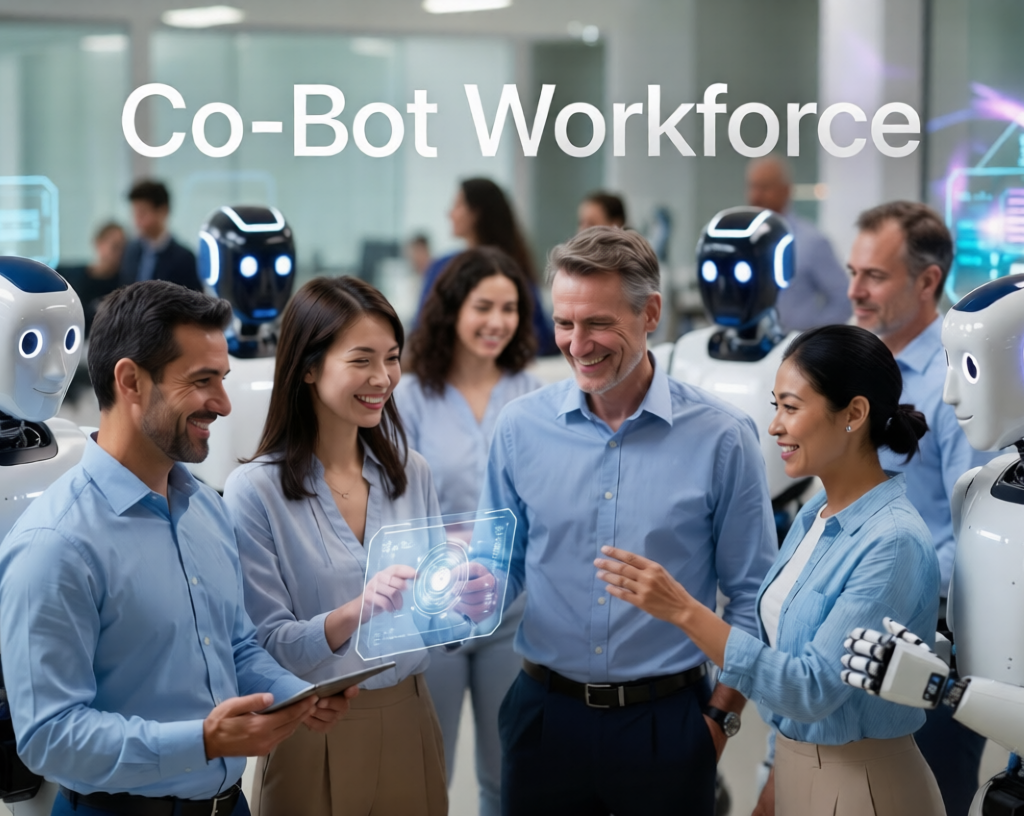
Human Workers and Co-Bot Collaboration
There is a common fear that automation will steal jobs. In my professional experience visiting smart factories, the exact opposite often happens.
When humans and machines collaborate, magic happens. I recently watched a skilled welder using a Co-Bot arm. The welder programmed the machine by physically guiding it through the desired path once. From then on, the machine repeated the perfect weld a hundred times. The human worker became a supervisor and programmer, stepping into a much higher value role.
This collaboration is effective because it leverages the best traits of both. The technology brings accurate repetition. The human brings authentic judgment and adaptability.
Industries Benefiting from Co-Bot Integration
You might think these collaborative machines belong only in car factories. That is a myth.
- Healthcare: Assisting nurses by delivering medications and lifting heavy lab samples.
- Agriculture: Harvesting delicate fruits with soft robotic grippers.
- Logistics: Sorting packages and managing inventory in massive warehouses.
- Food Service: Flipping burgers, mixing drinks, and ensuring strict hygiene standards.
Any industry that relies on repetitive physical tasks is a perfect candidate for this exciting technology.
Key Takeaway: Collaborative robotics is a flexible technology capable of transforming nearly every physical industry.
Surprising Benefits for Employees
The conversation around automation usually focuses on corporate profits. However, the benefits for everyday workers are life changing.
- Enhanced Safety: The machine takes over the dangerous jobs.
- Skill Development: Workers learn to manage and program advanced technology.
- Reduced Fatigue: Less heavy lifting means employees go home with more energy.
- Career Growth: Operating advanced machinery makes an employee far more valuable in the job market.
Discovering that a robot can actually make your job easier is a surprising and empowering realization for many skeptical workers.
Strategic Benefits for Businesses
For business leaders, the advantages are clear and research based.
Implementing a Co-Bot offers a rapid return on investment. They are much cheaper than massive industrial robots. They require zero special infrastructure. You can literally unbox one, plug it into a standard wall outlet, and start training it within an hour.
This agility allows small businesses to compete with giant corporations. It is a proven and credible way to scale operations without taking on massive financial risk.
Key Takeaway: Collaborative robots offer an affordable, scalable, and highly profitable path for businesses of all sizes to modernize.
Common Challenges and Mistakes
No technology is perfect. There are common mistakes companies make during implementation.
- Lack of Communication: Management surprises the team with a new robot, causing immediate panic and fear of job loss.
- Poor Training: Expecting workers to operate the machine without comprehensive training.
- Choosing the Wrong Task: Assigning tasks that require complex human judgment to a machine that only understands repetition.
To achieve successful integration, leaders must be transparent. Talk to your team early. Explain the goals and ensure everyone understands this is a tool to help them, not replace them.
Myth versus Reality
Let us clear up some of the most persistent misinformation regarding workplace automation.
- Myth: You need a computer science degree to operate them.
- Reality: Most modern collaborative robots use simple drag and drop touchscreen interfaces.
- Myth: They are too expensive for small businesses.
- Reality: Prices have dropped significantly, and many companies offer flexible rental models.
- Myth: They work entirely on their own.
- Reality: They require human oversight, maintenance, and strategic direction to function properly.
Expert Tips for Success
If you plan to implement this technology, follow these industry leading best practices.
- Start Small: Choose one simple, highly repetitive task for your first automation project.
- Involve Your Team: Ask your workers which specific tasks they hate doing the most. Automate those tasks first.
- Focus on Safety: Even though they are safe by design, always conduct a thorough workplace risk assessment.
- Measure Everything: Track your production numbers before and after implementation to prove the actual ROI.
Key Takeaway: Thoughtful planning and open communication are the true secrets to a successful automation rollout.
Real World Case Study: Smart Packaging Solutions
Let us examine a practical, evidence based scenario based on typical manufacturing challenges.
The Problem: A medium sized packaging company struggled with high employee turnover. Workers spent eight hours a day lifting heavy boxes onto shipping pallets. It was exhausting work, leading to frequent back injuries and low morale.
The Implementation: Management decided to invest in two Co-Bot units equipped with vacuum grippers. They placed the units at the end of the packaging line. They also held an open meeting to guarantee no human worker would lose their job. Instead, the lifting crew was retrained to operate the machines and manage quality control.
The Results: Within three months, daily shipping output increased by forty percent. Workplace injuries dropped to zero. Because the physical strain was gone, employee retention skyrocketed.
Lessons Learned: The company realized that the true value of the technology was not just speed, but the dramatic improvement in employee well being. When workers feel physically safe and mentally engaged, the entire business thrives.
Future Workforce Trends
The future of work is incredibly exciting. We are moving toward an era of seamless digital transformation.
Soon, a Co-Bot will feature advanced artificial intelligence. They will learn from their mistakes and optimize their own movements. We will see increased mobility, allowing these machines to walk or roll freely around a busy factory floor to assist wherever they are needed most.
The companies that explore and adopt these tools today will be the undisputed industry leaders of tomorrow.
Frequently Asked Questions
What exactly does a Co-Bot do? It performs repetitive, physically demanding, or highly precise tasks alongside a human worker to improve overall efficiency and safety.
Are they safe to work next to? Yes. They are equipped with advanced sensors. If they detect unexpected physical contact with a human, they stop moving instantly to prevent injury.
Will a Co-Bot steal my job? No. They are designed to take over tasks, not entire jobs. They handle the boring parts of your work so you can focus on more valuable and creative responsibilities.
How hard is it to program one? It is surprisingly easy. Most modern models use simple tablet interfaces or allow you to literally grab the robotic arm and guide it through the desired motions to teach it.
How much does it cost? Prices vary based on size and capability, but they are significantly cheaper than traditional industrial robots. Many companies see a complete return on investment within one year.
Can small businesses afford them? Absolutely. Because they require no safety cages or complex installation, they are highly accessible for small and medium businesses.
What industries use them the most? While manufacturing and logistics lead the way, they are rapidly expanding into healthcare, agriculture, and even commercial kitchens.
How do I prepare my staff for automation? Be completely transparent. Involve them in the planning process, provide excellent training, and show them how the technology will make their daily work easier.
Final Conclusion
The integration of Co-Bot technology is not just a passing trend. It is a fundamental shift in how we approach workplace productivity and employee well being.
By taking away the dangerous and repetitive tasks, businesses can unlock the true potential of their human workforce. We stop treating people like machines, and we start letting machines do the mechanical work.
Embrace this change. Explore the possibilities. The future belongs to those who adapt and build collaborative, confident teams.
If you are ready to learn more about the future of work, enhance your business strategies, and discover expert insights, join our growing community of tech leaders. Read more proven technology and business management articles right here on kritiinfo.com today!