
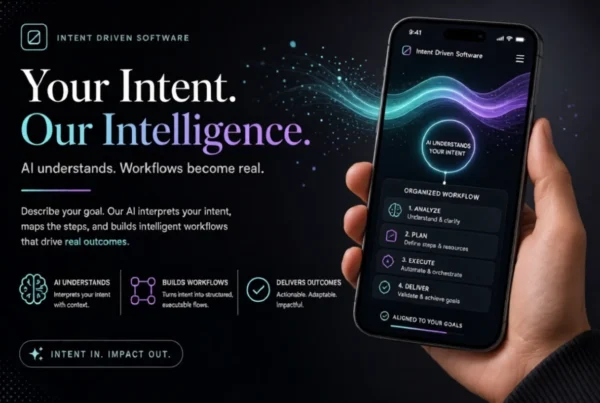
Sarah typed one line into the platform her company had paid six figures for: “Reduce customer churn this quarter.”
The system did exactly what she asked. It flagged every account with declining usage and fired off a wave of automated discount emails. Technically flawless. Instruction followed to the letter.
Three weeks later, her best client called to cancel. Not because the product had failed them. Because a bot had just offered their finance director a coupon on the same day their account manager had promised a strategic review call. The discount looked less like care and more like a warning sign that something was wrong. It planted doubt where there had been trust.
The software had not misunderstood the words. It had misunderstood the outcome. Sarah wanted retention. The system delivered discounts. Those are not the same thing, and the gap between them nearly cost her company a seven figure account.
This is the quiet failure happening inside thousands of businesses right now, and it is exactly the problem Intent driven software was built to solve.
Table of Contents
The Moment Software Stops Understanding You
Every professional has lived a version of Sarah’s story. A spreadsheet macro that technically ran but pulled the wrong quarter. A chatbot that answered the literal question while missing the actual concern behind it. A workflow tool that executed a rule perfectly, at precisely the wrong moment.
Traditional software is obedient. It is rarely wise. It waits for a command, parses the syntax, and executes. If the command is incomplete, ambiguous, or shaped by unstated context, the software has no way to notice. It simply does the wrong thing with total confidence.
That confidence is the dangerous part. A system that fails loudly gets caught. A system that fails quietly, while appearing to succeed, erodes trust one small decision at a time.
What Are Desired Outcomes?
A desired outcome is the actual result a person is trying to achieve, as opposed to the literal instruction they typed to get there.
When Sarah asked her platform to reduce churn, her real desired outcome was something closer to: protect revenue from at risk accounts without damaging the relationships that make those accounts valuable in the first place. The command captured a fragment of that goal. It missed the nuance entirely.
Desired outcomes are rarely written down in full. They live in context: what happened last quarter, what the client said in the last meeting, what “success” would look like six months from now. Humans fill in these gaps instinctively. Most software cannot, unless it is specifically designed to.
This is the foundational shift behind Intent driven software. Instead of asking “what did the user type,” it asks “what is the user actually trying to accomplish, and what does the surrounding context tell me about it.”
Why Commands Are Not Enough
Commands are efficient, but they are also brittle. A command based system treats every instruction as complete and self contained, which is rarely true in real business situations.
Consider three quiet failure points that show up constantly in operations teams:
A support ticket that says “close this out” when the customer actually wants a callback, not a closed case.
A marketing brief that says “increase signups” without specifying that quality matters more than raw volume this quarter.
A finance query that says “pull last month’s numbers” when the analyst actually needs a comparison against forecast, not a raw export.
None of these are user error. They are the natural way people communicate, full of shorthand and shared context. Software that cannot read that context will keep producing technically correct, practically useless results. Over time, that gap becomes expensive, both in wasted hours and in the slow erosion of user trust in the tools meant to help them.
How Intent Driven Software Works
Intent driven software combines several layers of interpretation that traditional command based tools skip entirely.
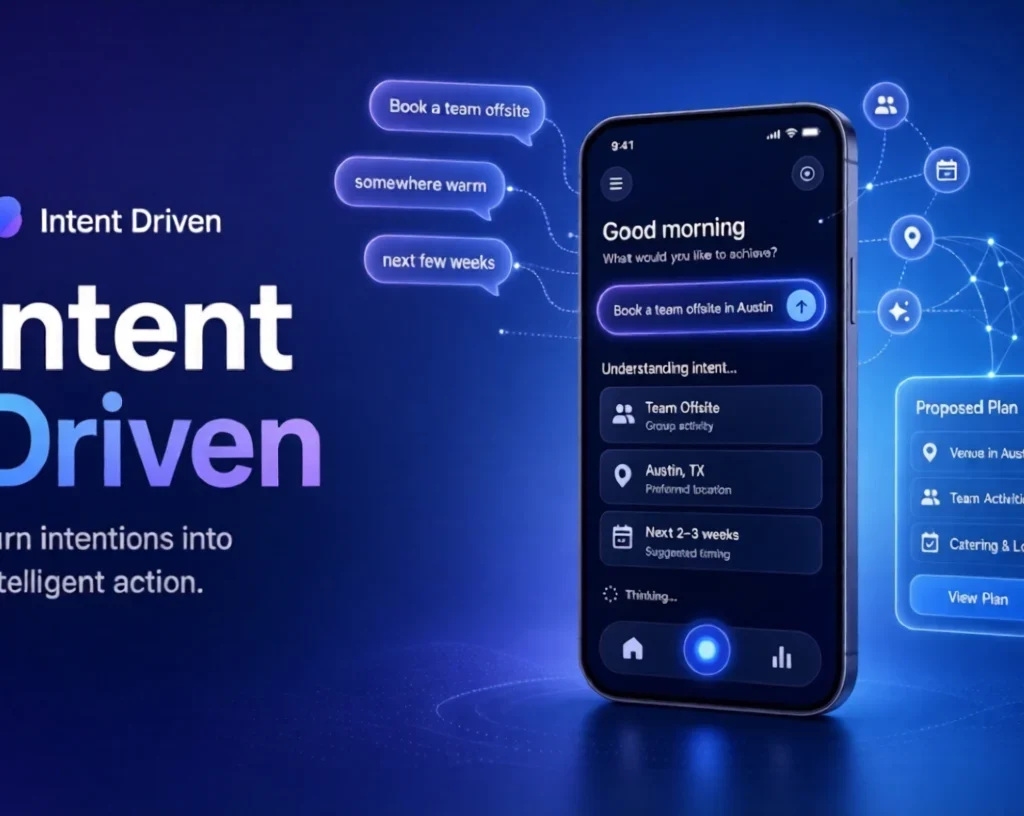
It starts with natural language understanding, which parses not just keywords but structure and implication. It layers in behavioral and historical context, drawing on prior actions, patterns, and preferences to infer what “success” typically looks like for that specific user or account. It applies predictive modeling to weigh several plausible interpretations of a request and rank them by likely relevance. Finally, it builds in feedback loops, so the system can learn when its interpretation was right or wrong and adjust the next time.
The result is software that behaves less like a tool waiting for perfect instructions and more like a capable colleague who asks the right clarifying question, or quietly fills in a sensible default, before acting.
None of this requires the system to guess blindly. Responsible implementations of Intent driven software are built on transparency and accountability, meaning the reasoning behind an inferred outcome should be visible and reviewable, not a black box decision users are simply expected to trust.
The Hidden Intelligence Behind User Intent
The most underappreciated part of this shift is where the intelligence actually comes from. It is not one clever algorithm. It is the accumulation of small signals: what a user corrected last time, which suggestions they accepted, which ones they ignored, how long they hesitated before confirming an action.
Gartner has projected that task specific AI agents, capable of exactly this kind of contextual, goal aware execution, will be embedded in roughly 40 percent of enterprise applications by the end of 2026, a sharp rise from under 5 percent in 2025. That is not a marginal trend. It is a structural shift in how software is expected to behave.
This matters because intent detection improves with use. A system a business adopts today will likely be noticeably sharper in outcome recognition a year from now, provided the data feeding it is accurate and the feedback loop is genuinely closed.
7 Powerful Ways Intent Driven Software Can Change Business
1. Sharper personalization. Recommendations and messaging align with what a customer is actually trying to accomplish, not just their last click.
2. Faster, more confident decision making. Leaders get options framed around outcomes, not raw data dumps they have to interpret themselves.
3. Genuine automation, not brittle scripting. Workflows adapt when context changes instead of breaking the moment a variable shifts.
4. Reduced operational waste. Fewer wrong actions taken with full confidence means fewer costly corrections downstream.
5. Stronger customer experience. Support and sales tools that grasp underlying need, not just literal requests, feel dramatically more responsive.
6. Better cross team alignment. When systems interpret goals consistently, marketing, sales, and product stop working from conflicting assumptions.
7. Measurable performance gains. McKinsey has estimated that generative and outcome aware AI applications could add between 2.6 and 4.4 trillion dollars in annual value to the global economy, concentrated heavily in functions like customer operations, marketing, and product development, exactly where intent recognition has the most leverage.
A Realistic Case Study
The scenario below is an illustrative composite built from common patterns seen across mid sized SaaS and e commerce operations. It is not a documented case tied to a named company, and any figures are presented as reasonable estimates, not verified statistics.
A mid sized e commerce retailer relied on a traditional command based inventory tool. Staff typed instructions like “restock top sellers” at the end of each week. The system pulled raw sales volume and reordered accordingly.
The original problem: seasonal spikes kept distorting the data. A product that sold well for one holiday weekend would get massively overstocked for the following month, tying up warehouse capacity and cash the business needed elsewhere.
What the organization actually wanted was not “reorder top sellers.” It was maintain healthy stock of products likely to keep selling, based on trend, not a temporary spike.
After introducing an outcome aware layer that factored in seasonality, return rates, and category trend data alongside raw sales figures, the reordering logic shifted from reactive to genuinely predictive. Staff reported noticeably fewer emergency markdowns on overstocked seasonal items, and warehouse teams described the restocking pattern as far more aligned with actual demand shape rather than last week’s spike.
The lesson for other businesses: the instruction people give a system is often a proxy for a deeper goal. Building software, or selecting a vendor, that can recognize that proxy for what it is tends to produce compounding value over time, not just a one time efficiency win.
Where Things Can Go Wrong
Intent driven software is not magic, and treating it that way is where implementations fail.
Misread context is a real risk. If a system infers the wrong outcome and acts on it without a clear review step, it can compound a small misunderstanding into a large operational mistake, faster than a human would have.
Over automation is another risk. Handing a system too much autonomy before it has proven reliable in lower stakes scenarios removes the human checkpoints that catch edge cases.
Bias in historical data is a subtler but serious concern. If the patterns a system learns from reflect past mistakes or blind spots, it will confidently repeat them, dressed up as an “intelligent” recommendation.
None of these risks are reasons to avoid the technology. They are reasons to demand evidence, testing, and accountability from any vendor or internal team building it.
Privacy, Trust, and Human Control
Understanding intent requires context, and context often means data: behavioral history, preferences, prior corrections, sometimes sensitive business information. That creates a genuine tension between capability and privacy that businesses cannot wave away.
Responsible implementation rests on a few non negotiable principles. Security and data handling practices need to meet recognized standards, such as those outlined by NIST’s AI risk management framework, rather than ad hoc internal policy. Users deserve visibility into why a system inferred a particular outcome, not just the result it produced. And critically, a human should always retain the ability to override, correct, or pause automated action, especially in high stakes decisions.
Trust is not a feature businesses can bolt on later. It has to be designed in from the first architectural decision, or it never really exists at all.
What Businesses Should Ask Before Adoption
Before adopting any Intent driven software, a business should evaluate a short but serious list of questions.
Does the vendor provide clear evidence, not just marketing claims, that the system improves outcome accuracy over time. Can the reasoning behind an inferred outcome be reviewed by a person, on demand. What happens when the system misreads intent, and how quickly can a human step in. How is training data sourced, secured, and audited for bias. Does adoption require a full platform replacement, or can it integrate with existing workflows.
Businesses that skip this evaluation tend to either over trust an unproven system or under use a genuinely capable one, both of which waste the investment.
The Future of Outcome Oriented Software
The trajectory here is not speculative anymore. Enterprise software is visibly shifting from static command interfaces toward systems that negotiate, clarify, and adapt around a stated goal. Research institutions including MIT and Stanford have both published extensively on goal directed and context aware AI systems, and that research is steadily working its way into commercial products rather than staying confined to academic papers.
What comes next will likely blur the line between “using software” and “collaborating with it.” The businesses that build genuine expertise in evaluating and implementing this shift responsibly, rather than chasing it reactively, will hold a meaningful advantage over competitors still issuing commands into systems that only pretend to understand them.
Frequently Asked Questions
What does Intent driven software actually mean? It refers to software designed to interpret the outcome a user wants to achieve, rather than only executing the literal command they typed, using context, history, and pattern recognition to close that gap.
How is Intent driven software different from traditional software? Traditional software executes instructions exactly as written. Intent driven software interprets the goal behind the instruction and can adjust its response when the literal request would not actually serve that goal.
How does software detect user intent? Through a combination of natural language understanding, behavioral history, contextual signals, and predictive modeling, refined continuously through feedback on whether its interpretations were accurate.
What business benefits does Intent driven software offer? Sharper personalization, faster decision making, more resilient automation, reduced operational waste, and stronger customer experience are among the most consistently reported benefits.
Are there privacy concerns with Intent driven software? Yes. Because interpreting intent relies on behavioral and contextual data, businesses need clear data governance, transparency about how inferences are made, and compliance with recognized security frameworks.
What are the biggest implementation challenges? Misread context, over automation without adequate human checkpoints, and bias inherited from historical training data are the three challenges that come up most often.
Is Intent driven software only useful for large enterprises? No. Mid sized and smaller businesses often see faster, more visible gains, since a single misread instruction can carry proportionally more weight in a leaner operation.
What does the future of outcome oriented software look like? Expect deeper integration between human goals and system behavior, with software increasingly able to clarify ambiguous requests in real time rather than executing them blindly.
Final Takeaway
Sarah’s near disaster was never really about a discount email. It was about a system that could follow instructions perfectly while completely missing the point. That is the quiet cost of command based software, and it is exactly the gap Intent driven software exists to close.
The businesses that will pull ahead over the next few years will not simply be the ones with the most automation. They will be the ones whose software actually understands what they are trying to achieve. Evaluate the tools already inside your organization. Test whether they respond to outcomes or only to instructions. Strengthen the ones that can learn, and be honest about replacing the ones that cannot. That single shift in expectation, from commands to desired outcomes, may be the most valuable software decision a business makes this decade.