
It is 2:17 in the morning, and a company’s fraud detection system just flagged something strange. A transaction pattern nobody wrote a rule for. In the old world, this would sit in a queue until a tired analyst opened it at nine the next morning. Not anymore.
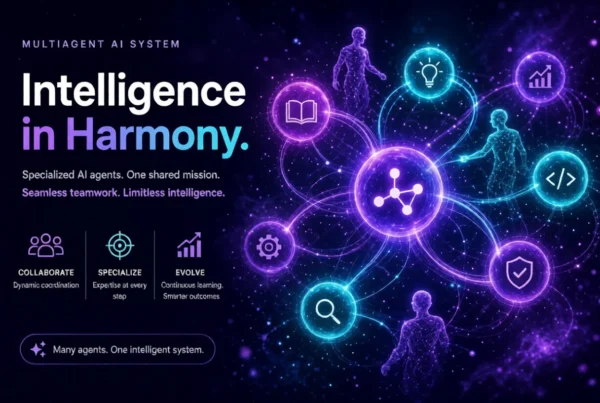
Instead, five separate AI agents wake up almost at once. One agent pulls the transaction history and account data. A second checks that data for gaps or errors. A third scores the risk, comparing the pattern against known fraud signatures. A fourth drafts a recommended action, maybe a temporary hold. A fifth agent, acting almost like a skeptical colleague, challenges that recommendation and asks whether the evidence really supports it.
No human typed a single prompt during any of this. By the time someone checks their phone at breakfast, the case has already been investigated, debated, and resolved, or escalated with a clear explanation of why.
This is not a scene from a science fiction script. It is a real and rapidly spreading pattern in how modern AI systems are built, and it has a name: multiagent systems. If you want to understand what is really happening behind the AI revolution right now, this is the architecture to watch.
Table of Contents
What Is Happening Behind the Screen?
For years, most people’s mental model of AI was simple. You type something, one model thinks, one model answers. That picture is quietly becoming outdated.
Behind many of today’s more capable AI products, there is no longer a single model doing everything. There is a small team. One part of the system gathers information. Another verifies it. Another reasons about what to do. Another checks the reasoning before anything happens.
It feels less like talking to a calculator and more like watching a newsroom, a hospital ward, or a mission control room, each person or agent doing one job well, then handing off to the next.
That shift, from one generalist model to several specialized ones working in concert, is the real story. And it is happening faster than most casual observers realize.
What Is Default AI Architecture?
For a long time, the default architecture for AI applications was refreshingly simple: one large model, one prompt, one response. It worked because early models were mostly used for straightforward tasks, drafting text, answering questions, summarizing documents.
But as businesses started asking AI to do more, book a flight, investigate a security incident, manage a multi step workflow, that single model approach started showing cracks. One model trying to plan, research, verify facts, and make a final call all at once tends to make more mistakes, and there is no built in mechanism to catch them.
Default AI architecture is now shifting toward something more distributed. Instead of one model wearing every hat, a system of agents is coordinated by an orchestration layer that breaks a task apart, assigns pieces to specialists, and reassembles the result. Traditional single model setups have not disappeared, and for simple tasks they still make sense, but for anything with real complexity or real stakes, agent based architecture is becoming the practical, and increasingly expected, choice.
Why Multiagent Systems Matter
Here is the part worth sitting with for a second. Multiagent systems matter because they change what AI can be trusted to do.
A single model has no built in way to catch its own blind spots. It can hallucinate, misread a request, or confidently produce something wrong, and there is nobody in the loop to say “wait, check that again.” Multiagent systems introduce internal checks. One agent’s output becomes another agent’s input to verify, question, or improve.
This matters enormously for enterprise AI, where a wrong answer is not just embarrassing, it can be expensive or unsafe. It matters for developers building AI automation into products where reliability is the whole pitch. And it matters for everyday users who increasingly expect AI tools to just work, without seeing the mechanics behind the curtain.
In short, multiagent systems represent a move from AI that guesses well to AI that reasons, checks, and coordinates. That is a meaningful difference, and it is one worth understanding before you build on top of it or trust it with something important.
How the Agents Work Together
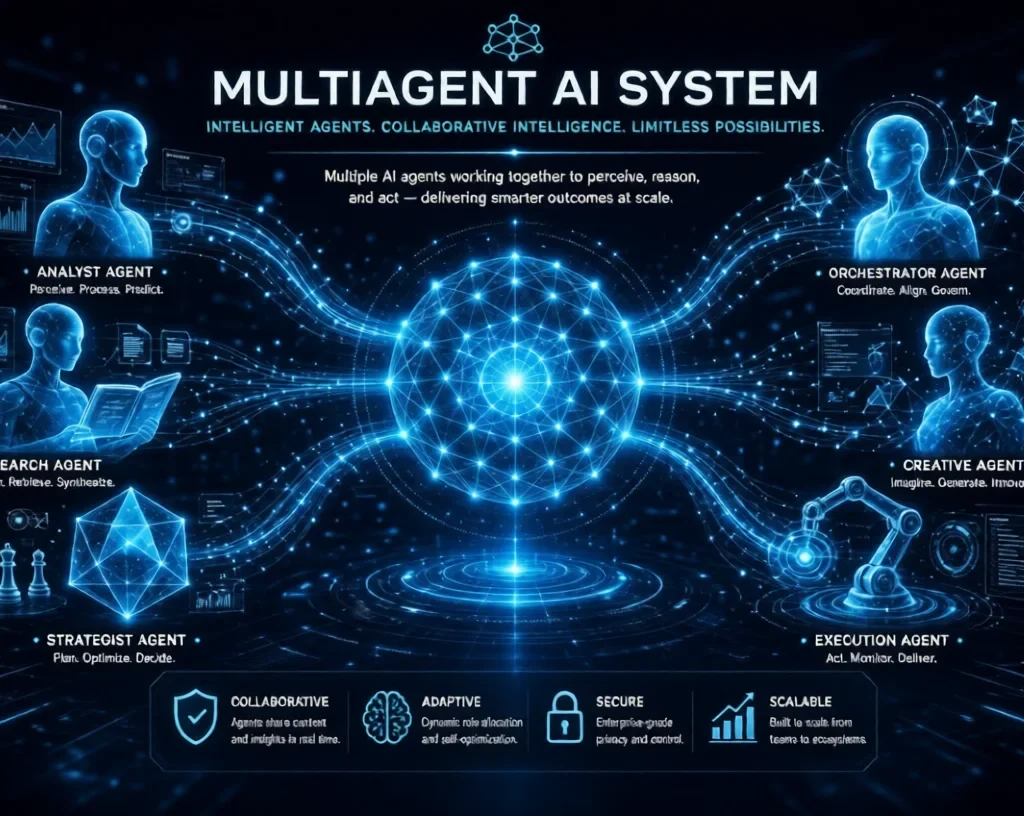
So how does a group of AI agents actually get anything done together? A few core mechanics show up again and again. First comes task decomposition: a complex request, like “handle this customer complaint,” gets broken into smaller pieces such as understanding the issue, checking account history, and drafting a resolution. Each piece is then delegated to the agent best suited for it, a research heavy sub task to an agent with strong retrieval tools, a calculation to one wired into a code execution environment.
From there, agents communicate through structured handoffs rather than vague chat: here is what I found, here is what I still need, here is my confidence level. Each one applies machine reasoning within its own narrow domain, which tends to be more accurate than one model reasoning broadly across everything at once. A separate agent, sometimes literally called a critic or validator, then verifies the output against the original request and known facts. When two agents disagree, and they do, a supervising agent or rule based tiebreaker resolves the conflict, and somewhere in the chain a final decision gets made, ideally with a clear record of how the system got there.
None of this is exotic engineering fantasy. It closely mirrors how modern AI orchestration frameworks are already being described in production guidance from major AI labs and cloud providers.
One AI Is Powerful. A Team Can Be Different.
Think about a hospital. A brilliant diagnostician is genuinely valuable, but a hospital does not run on one person. It runs on a team: a nurse taking vitals, a radiologist reading scans, a pharmacist checking drug interactions, a surgeon making the final call, and often a second surgeon offering a second opinion before anything irreversible happens. That is not inefficiency, that is how complex, high stakes work actually gets done safely.
A single AI model is like that diagnostician working entirely alone at 3 a.m., with nobody to double check the chart. Impressive most of the time, occasionally dangerously wrong. Multiagent systems build the rest of the hospital around that diagnostician: specialists, checks, second opinions, and a clear chain of accountability.
The Hidden Strength of Multiagent Systems
The advantages compound in ways that are easy to underestimate. Agents fine tuned for a narrow role tend to outperform a generalist on that specific task, and scaling up simply means adding more agent instances rather than squeezing more out of one model. If one agent fails or produces something implausible, the system has a chance to catch it before it ever reaches the user, and because several agents can work on different pieces of a problem at once, complex requests resolve faster. Verification stops being an afterthought and becomes a built in habit, which is exactly what genuinely complex, multi step workflows require.
This is where the real, measurable value of distributed intelligence shows up. Not in flashy demos, but in the boring, practical reliability that businesses actually need.
The Risks Nobody Should Ignore
None of this makes multiagent systems magically reliable, and anyone telling you otherwise is selling something. Hallucinations do not disappear just because you added more agents. If verification is weak, a confident wrong answer can pass right through the chain. Agent conflicts can create loops where agents disagree indefinitely, wasting time and compute, and security vulnerabilities multiply with more moving parts, since every agent, tool connection, and handoff is a potential entry point for something to go wrong.
Excessive autonomy is a real concern too. Giving agents too much freedom to act, especially with access to real systems, real money, or real customer data, without human checkpoints is asking for trouble. Cost can climb quickly, since running several coordinated agents is more expensive than running one model. Data privacy gets harder to guarantee as information passes between agents and possibly multiple vendors, incorrect delegation can route a task to the wrong specialist and produce a confidently wrong result nobody flags, and lack of human oversight ties all of these risks together. Automation without accountability is not innovation, it is exposure.
Responsible teams treat these risks as engineering requirements, not footnotes. Governance, oversight, and clear escalation paths to a human are not optional extras.
A Realistic Case Study
To make this concrete, imagine a fictional logistics company we will call Northbridge Freight. This scenario is entirely illustrative, not a real event or company, and exists purely to show how the pieces fit together.
Northbridge receives around four thousand delivery requests a day. Under a multiagent architecture, a customer service agent handles incoming questions, a routing agent calculates optimal delivery paths from live traffic and driver availability, an inventory agent checks stock at the nearest warehouse, and a fraud detection agent watches for suspicious patterns, like the same address repeatedly ordering unusually high value items. A supervisor agent reviews anything flagged by the others before it reaches a human manager’s dashboard.
Instead of one overloaded system trying to do all five jobs badly, each part does its job well, and problems get surfaced with context attached, not just a vague alert.
What Businesses Should Learn
If you are evaluating whether to adopt agent based AI, a few practical lessons are worth internalizing. Start by mapping your workflow into distinct, well defined tasks, since multiagent systems work best when responsibilities are clear, not blurred. Build verification in from day one rather than treating it as something to add later. Test extensively before granting agents access to real customer data or real transactions, and prepare for edge cases you have not thought of yet, because they will show up. Compare vendors and frameworks on their track record for reliability and transparent behavior, not just on flashy capability demos, and adopt responsibly by rolling out agent autonomy in stages, with humans reviewing decisions until the system has earned trust through evidence, not assumption.
The Human Role Is Not Disappearing
It is tempting, watching agents coordinate and decide things on their own, to assume humans are being written out of the picture. That is not accurate, and it is worth saying clearly.
Human judgment, accountability, and governance remain essential. Someone has to decide what the agents are allowed to do, someone has to own the outcome when something goes wrong, and someone has to keep asking whether the system’s decisions still make sense as circumstances change.
The most credible teams building multiagent systems today are not trying to remove people from the loop. They are trying to put people at the right point in the loop, reviewing outcomes and edge cases instead of manually doing every repetitive step.
What Comes Next?
It is reasonable to expect multiagent systems to keep expanding into more categories of software, from customer support and finance to research and scientific discovery. Expect more standardized ways for agents to communicate, more mature tooling for monitoring what agents are actually doing, and more attention to the security and governance questions that come with letting software make decisions on its own.
It is also fair to acknowledge real uncertainty here. Nobody has a complete, proven playbook for multiagent systems at massive scale yet. The research is active, the tooling is still maturing, and best practices are being written in real time by the teams building these systems today.
What does seem clear is this: the direction of travel is away from one model trying to do everything, and toward coordinated teams of specialized agents. Understanding that shift now, before it becomes the unquestioned default everywhere, puts you ahead of the curve rather than reacting to it later.
Frequently Asked Questions
What are multiagent systems? Multiagent systems are AI architectures where multiple specialized AI agents work together, each handling a distinct part of a task, communicating with one another, and often checking each other’s work before a final decision is made.
How do multiagent systems differ from traditional AI? Traditional AI setups typically rely on a single model to understand a request, reason about it, and respond, all in one pass. Multiagent systems split that work across several agents, each with a narrower job, which allows for built in verification and specialization.
Why are businesses interested in multiagent systems? Because complex workflows, customer service, fraud detection, logistics, research, often involve multiple distinct steps that benefit from specialized handling, parallel processing, and internal checks that a single model cannot easily provide on its own.
Can multiple AI agents work together safely? They can, but safety depends entirely on design choices: clear task boundaries, verification steps, human oversight at meaningful checkpoints, and strong security around how agents access data and tools. Safety is not automatic just because a system uses multiple agents.
What are the biggest risks of multiagent AI? Hallucinations that slip past weak verification, agent conflicts, security exposure from more moving parts, rising costs, data privacy concerns, and the risk of excessive autonomy without human oversight.
Will multiagent systems replace human decision makers? Not in any credible near term scenario. These systems are being designed to reduce repetitive manual work and surface better information, while humans retain responsibility for judgment calls, accountability, and governance.
What could become the default AI architecture in the future? Many researchers and engineers expect coordinated, multiagent architectures to become far more common as a default for complex tasks, while simpler single model setups likely remain appropriate for straightforward, low stakes requests.
A Closing Thought
The architecture behind AI is changing quietly, one coordinated agent at a time. You may never see the handoffs happening between agents, the verification checks, the internal disagreements getting resolved, but they are increasingly there, shaping the answers and decisions you interact with every day.
Before you adopt increasingly autonomous systems for anything that matters, take the time to understand how they actually work. Explore the architecture, evaluate the evidence behind a vendor’s claims, verify how oversight is built in, and protect the parts of your workflow where a mistake would genuinely hurt. The businesses and builders who rethink their approach now, with eyes open to both the strength and the risk, will be the ones who benefit most as multiagent systems keep becoming the practical default.
1 thought on “How 5 AI Agents Make Multiagent Systems the New & Important Default”