
Imagine walking into a meeting where no one speaks up, ideas die unspoken, and one wrong word could end your career. That’s the fear‑based workplace—draining, stagnant, and all too common. Now picture the opposite: a fearless team where breakthroughs happen daily, laughter fills the air, and everyone thrives. The secret? Psychological safety.
Psychological safety is the belief that you can speak up, share ideas, or admit mistakes without risking your status or job. In today’s fast‑paced work world, it’s not just a “nice‑to‑have”—it’s the main driver of high‑performance teams. When employees feel safe, they experiment, collaborate, and innovate without the weight of fear.
At kritiinfo.com, we help leaders build cultures where psychological safety is the norm, not the exception. This guide reveals 7 proven stages to create a fearless team—and shows you exactly how to embed psychological safety into your day‑to‑day leadership.
What Is Psychological Safety?
Psychological safety means people can challenge ideas, ask questions, or voice concerns without expecting ridicule, punishment, or social exclusion. It’s not about being “nice” all the time; it’s about feeling safe to be honest and imperfect.
Teams with strong psychological safety:
- Innovate more freely and experiment without fear of blame.
- Report mistakes early, which prevents larger failures.
- Trust each other enough to disagree and still move forward.
A great example comes from Google’s Project Aristotle, which studied 180+ teams and found that psychological safety was the single strongest predictor of team performance. In one team, an engineer shared a “too obvious” idea that ended up sparking a major product improvement. The team’s culture of psychological safety turned that moment into a breakthrough.
Why Fearless Teams Outperform Others
Psychological safety isn’t fluffy—it’s backed by data. Research from McKinsey and Harvard‑affiliated studies shows that teams with high psychological safety:
- Are around 50% more likely to outperform peers in productivity and innovation.
- Report higher engagement and job satisfaction, reducing burnout.
- Are more resilient in crises, because people speak up instead of hiding problems.
Emotionally, psychological safety flips the script from “survival mode” to “growth mode.” When fear dominates, people shut down, avoid risks, and protect their image. When trust dominates, they lean in, collaborate, and see mistakes as learning opportunities.
The key difference is simple:
- Fear‑based teams: Silence, blame, blame‑shifting.
- Fearless, psychologically safe teams: Open debate, shared accountability, and rapid learning.
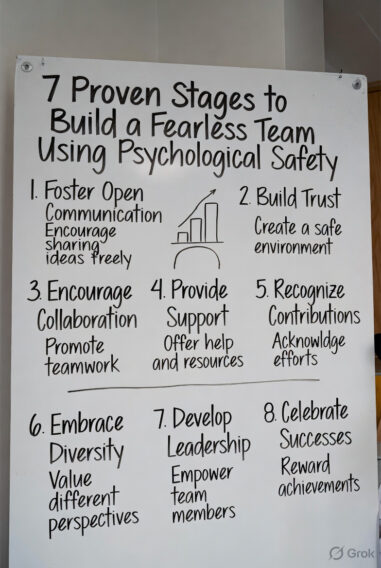
The 7 Stages to Build a Fearless Team Using Psychological Safety
Creating psychological safety is a step‑by‑step process, not a one‑time initiative. Treat these 7 stages as a roadmap, and revisit them regularly as your team grows.
Stage 1: Awareness – Spot the Fear in Your Team
Start by noticing where fear shows up:
- People hesitate to speak in meetings.
- Critical feedback is whispered, never shared openly.
- High‑performers rarely challenge the boss.
Actionable steps:
- Run a short, anonymous survey asking: “On a scale of 1–10, how safe do you feel to speak up?”
- Observe body language: crossed arms, silence, eye‑avoidance.
- Share a brief story from your own experience (e.g., “I once worked in a culture where failure was punished, and ideas dried up”).
When leaders become aware, the first layer of fear starts to dissolve.
Stage 2: Trust Building – Create Open Communication
Psychological safety grows on a foundation of trust. Build it by:
- Making space for honest conversations (e.g., “no agenda” check‑ins).
- Actively listening without interrupting.
- Following through on promises and commitments.
Actionable steps:
- Start meetings with a simple “What’s one thing you’re excited about and one concern you have?”
- Invite input from quieter team members by name: “Alex, what’s your take on this?”
- Share a small vulnerability first (e.g., “I’m still learning how to give feedback well”).
This stage signals: “Speaking up is welcome here.”
Stage 3: Encouraging Voice – Make Everyone’s Voice Matter
Many teams have “experts” and “silents.” Psychological safety means flipping that dynamic so everyone feels they belong.
Actionable steps:
- Use round‑robin formats in meetings so each person gets a turn.
- Create safe channels for input (e.g., Slack threads labelled “Bold Ideas”).
- Acknowledge contributions promptly: “That’s a great point—let’s explore it.”
Real‑world example: Pixar’s “Braintrust” meetings are designed so that directors critique each other’s work openly, without hierarchy. This culture of psychological safety has helped produce some of the most innovative films in animation history.

Stage 4: Accepting Mistakes – Build a No‑Blame Culture
If people fear punishment for mistakes, they hide them. A psychologically safe team treats errors as data, not drama.
Actionable steps:
- Run “blameless” post‑mortems: focus on “What happened?” and “How can we improve?”, not “Who messed up?”
- Celebrate calculated risks, even when they fail.
- Normalise statements like, “I made a mistake, and here’s what I learned.”
Etsy’s engineering teams famously used blameless post‑mortems to improve system reliability, turning outages into structured learning that boosted uptime and trust.
Stage 5: Constructive Feedback – Cultivate a Growth Mindset
Psychological safety thrives when feedback is specific, kind, and useful—not vague or harsh.
Actionable steps:
- Use the SBI model (Situation-Behaviour-Impact): “In yesterday’s client call, your concise summary helped the team align quickly.”
- Balance “positive” and “development” feedback (aim for roughly 3:1 or 5:1).
- Train your team on how to receive feedback with curiosity, not defensiveness.
When feedback feels safe and growth‑oriented, psychological safety deepens.
Stage 6: Leadership Modelling – Leaders Show Vulnerability First
Psychological safety starts at the top. When leaders admit they don’t know, ask for help, or share their own mistakes, the message is clear: “It’s safe to be human.”
Actionable steps:
- Start a meeting with, “I messed up X last week—here’s how I plan to improve.”
- Ask for feedback from your team regularly.
- Publicly credit others and avoid taking all the credit.
Leaders who model vulnerability unlock psychological safety faster than those who try to “protect” their image.
Stage 7: Continuous Reinforcement – Sustain Psychological Safety Over Time
Psychological safety erodes if it’s not maintained. Make it a habit, not a one‑off workshop.
Actionable steps:
- Measure psychological safety quarterly using a short survey.
- Create rituals like “appreciation circles” or “lessons‑learned” sessions.
- Tie team goals to behaviours that support safety (e.g., “By Q3, we want 90% of the team to report feeling safe to speak up”).
For deeper practical guidance, read our related article on building trust in high‑performing teams at kritiinfo.com.
Common Mistakes That Kill Psychological Safety
Even well‑intentioned leaders sabotage psychological safety with common mistakes:
- Ignoring silent employees: Letting a few people dominate conversations.
- Punishing failure publicly: Calling out mistakes in a way that humiliates.
- Lack of leadership transparency: Making decisions behind closed doors.
- Fake openness: Claiming “you can tell me anything” but reacting negatively when someone does.
The key is consistency: if psychological safety is your goal, every word and action must reinforce it.
5 Actionable Strategies to Build Psychological Safety
Use these strategies as repeatable habits to keep psychological safety high:
- Daily team check‑ins:
- 5‑minute huddles: “What’s one win and one worry?”
- Forces everyone to speak and builds routine safety.
- Feedback frameworks:
- SBI (Situation-Behaviour-Impact).
- STAR (Situation‑Task‑Action‑Result) for performance reviews.
- Team exercises:
- “Fear‑sharing” anonymous note‑passing.
- Role‑play tough conversations in a safe space.
- Communication norms:
- “Assume positive intent” as a team rule.
- No mobile phones in meetings to show full attention.
- Leadership rituals:
- Weekly “open Q&A” with leaders.
- Public recognition of people who speak up.
These small, consistent actions accumulate into a fearless team culture powered by psychological safety.
Case Study: How Psychological Safety Transformed a Team
A mid‑sized tech company struggled with missed deadlines, low morale, and finger‑pointing. Turnover was high, and psychological safety was nearly non‑existent—employees dreaded speaking up in meetings.
After implementing the 7 stages above:
- Before: 30% of employees strongly agreed they felt safe to speak up; errors were hidden.
- After (12 months): 78% of employees felt safe to share concerns; error reporting tripled and innovation increased as teams collaborated more freely.
The project delivery rate improved by more than 40%, and the company became a top‑rated place to work in its region. This case shows how deeply psychological safety can impact both culture and business outcomes.
Conclusion – Build Your Fearless Team Today
Psychological safety isn’t magic—it’s a deliberate, doable practice. When leaders commit to the 7 stages above, teams become fearless, adaptive, and resilient. They innovate faster, retain talent longer, and weather stress better.
Start today:
- Pick one stage (e.g., awareness) and run a quick survey.
- Commit to one small behaviour change (like asking more questions or sharing your own mistake).
- Use resources from kritiinfo.com to deepen your understanding of psychologically safe leadership.
For more practical guides, explore our post on psychological safety in remote teams at kritiinfo.com.
FAQ Section
What is psychological safety in teams?
Psychological safety in teams means people feel safe to speak up, challenge ideas, and admit mistakes without fear of punishment or humiliation. It’s the foundation of high‑performance collaboration.
How do you measure psychological safety?
You can use short surveys inspired by Harvard researcher Amy Edmondson’s 7‑question scale (e.g., “If I make a mistake, it is held against me”). Averaging scores above ~4–5 out of 7 indicates strong psychological safety.
Why is psychological safety important for leadership?
Leadership that fosters psychological safety unlocks innovation, trust, and accountability. Studies show that psychologically safe teams outperform others in engagement, productivity, and retention.
Can psychological safety improve productivity?
Yes. Teams with high psychological safety are more likely to experiment, share ideas, and fix problems early, which directly boosts productivity and reduces costly rework.
What are the signs of a fearless team?
- Open, honest debates.
- Willingness to admit mistakes.
- High participation from all members.
- Shared laughter and low defensiveness.
1 thought on “7 Proven Stages to Build a Fearless Team Using Psychological Safety”