
The Strange Battery With No Chemicals
A remote electrical substation sits beneath a pitch-black midnight sky. The surrounding city is sleeping, but thousands of heaters, hospital monitors, and server racks are quietly drawing current. The wind died down three hours ago, and the sun will not rise for another four. Yet, nearby power lines hum with steady voltage.
If you step inside this storage facility expecting rows of chemical cells humming with cooling fans, you will find none. There are no lithium packs, no toxic electrolyte reservoirs, and no chemical fire suppression gear.
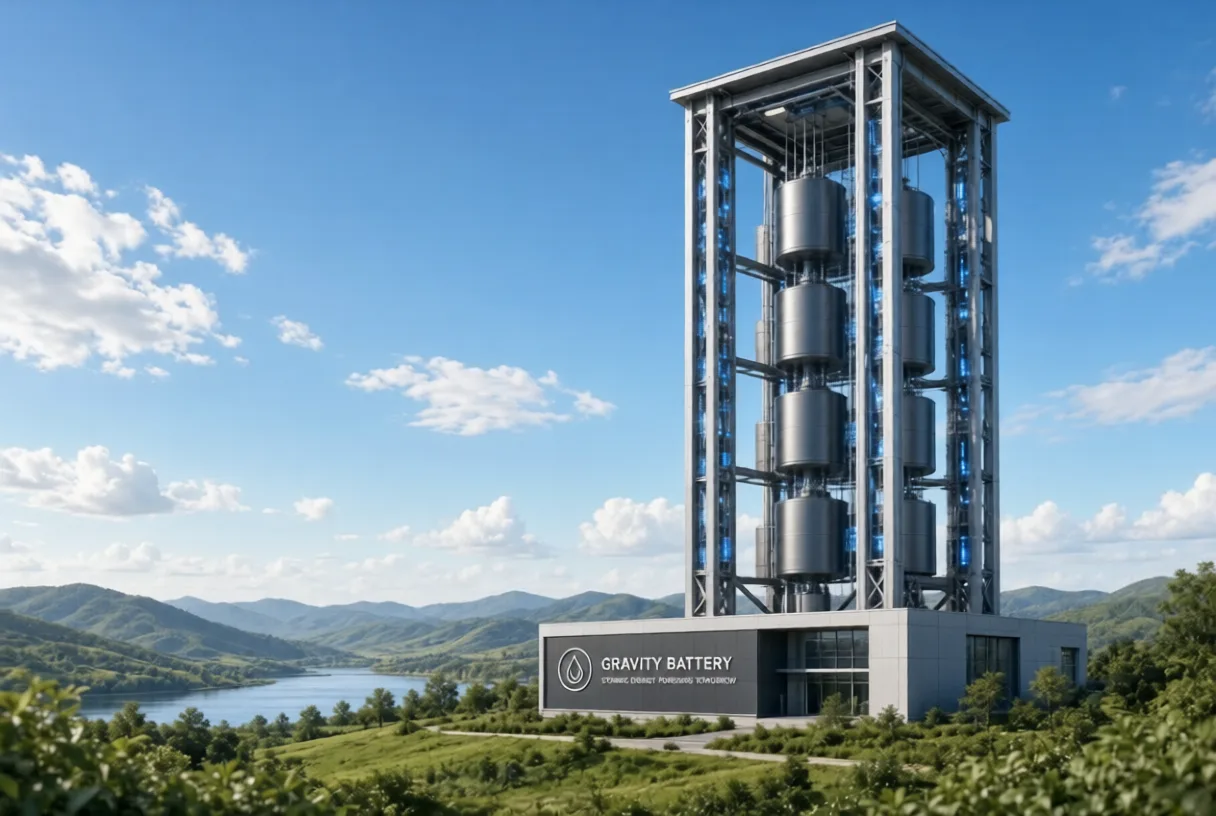
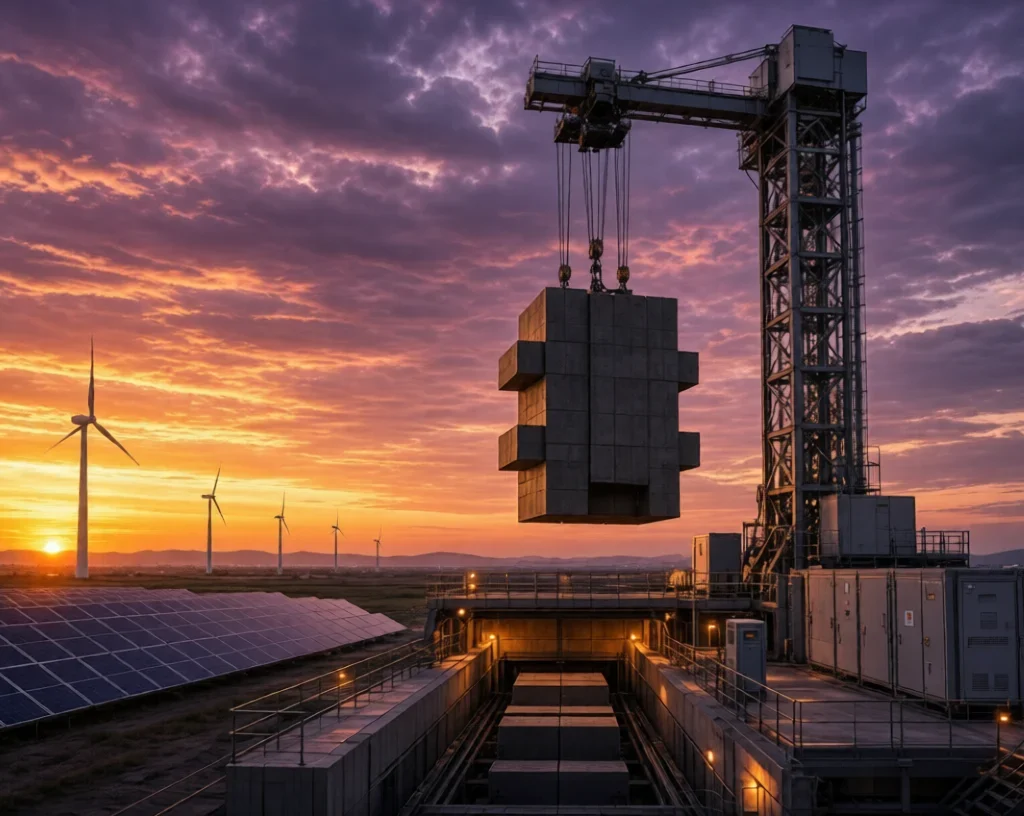
Instead, a mechanical apparatus suspends concrete blocks weighing dozens of metric tons high above the ground.
As peak demand spikes, a heavy latch releases. The massive weight descends steadily under computerized control. As gravity pulls the mass toward Earth, cables spin an electric generator. Kinetic force becomes electrical current. The city never blinks.
This is not science fiction. It is the realization of an ancient scientific principle repurposed for the 21st-century clean grid: kinetic potential converted on demand.
Table of Contents
What Is Gravity Battery?
To put it plainly: what is Gravity Battery?
A gravity battery is a mechanical energy storage system that stores electrical energy as gravitational potential energy. When surplus electricity is available—such as during peak sunshine on a solar farm—the system runs an electric motor to hoist a heavy mass upward. When the grid needs power later, the mass is lowered slowly. The descending weight turns the motor in reverse, transforming it into an electric generator that feeds power back into the grid.
[Surplus Electricity]
       │
       ▼
[Electric Motor Hoists Heavy Mass]
       │
       ▼
[Gravitational Potential Energy Stored at Height (h)]
       │
       ▼ (Mass Lowers via Gravity on Demand)
[Cables Spin Generator]
       │
       ▼
[Electricity Dispatched to Grid]
Engineers treat “gravity battery” as an informal umbrella term. In academic and technical circles, it is formally known as gravitational energy storage or mechanical energy storage. The concept does not rely on a single rigid blueprint. It can take the form of:
- Massive composite blocks lifted inside specialized multi-arm towers.
- Heavy rail cars loaded with gravel pushed up steep mountain grades.
- Massive weights lowered into decommissioned, vertical mine shafts.
- Dense piston systems displacing pressurized water deep underground.
Unlike lithium-ion packs, this storage medium relies on mass and elevation rather than chemical bonding.
The Physics Is Surprisingly Simple
The fundamental science behind gravitational energy storage requires no advanced quantum mechanics. It hinges on high school Newtonian physics:
$$\mathbf{E = mgh}$$
Where:
- $E$ is the stored gravitational potential energy (measured in Joules).
- $m$ is the mass of the object (in kilograms).
- $g$ is the acceleration due to Earth’s gravity ($\approx 9.81\text{ m/s}^2$).
- $h$ is the vertical height or elevation distance (in meters).
The equation reveals an immediate engineering constraint: to store meaningful amounts of utility-scale electricity, you need either an immense mass ($m$) or an extreme vertical drop ($h$).
The U.S. Department of Energy notes that energy storage fundamentally bridges the mismatch between primary generation and consumer loads. If you lift a 1,000 kg weight (roughly the weight of a compact car) up 10 meters, you store roughly 98 kilojoules of theoretical potential energy—or about 0.027 kilowatt-hours. That is barely enough to run a modern LED television for 20 minutes.
To power a town for eight hours, the engineering changes entirely. You must elevate thousands of metric tons across hundreds of meters of vertical space. The math explains why gravity storage facilities look like industrial heavy-crane yards rather than sleek electronics labs.
How Does a Gravity Battery Work?
The operational cycle of a gravitational energy storage plant proceeds through six distinct stages:
- Surplus Generation: Solar panels or wind turbines produce more kilowatt-hours than the local grid can absorb.
- Motor Engagement: The surplus current routes to high-torque electric motors hooked to heavy-duty winches, hoists, or gear trains.
- Ascent: The motors lift solid masses (concrete blocks, compacted earth, or iron ore) to an elevated position.
- Static Storage: The weight locks into place using mechanical brakes or physical racks. While locked, zero energy leaks out. It can remain suspended for hours, days, or months without losing charge.
- Controlled Descent: When evening electricity demand surges, the brakes release. Computerized winches regulate the speed of the mass’s descent.
- Regeneration: As cables unwind, the spinning drums drive high-efficiency generators, transforming kinetic motion into grid-synchronized alternating current (AC).
The National Renewable Energy Laboratory (NREL) documents that mechanical storage systems of this type seek to capture energy during low-marginal-cost intervals and discharge it during high-value peak periods. By controlling descent speeds, operators can choose to release power rapidly in a burst or meter it out slowly over multiple hours.
Why Does This Technology Matter?
Modern clean power grids face an intermittency dilemma. The sun shines brightly at noon when demand is modest, then sets just as millions of households turn on cooking ranges, entertainment systems, and HVAC units.
The International Energy Agency (IEA) highlights that battery storage deployment is accelerating at record pace, but long-duration energy storage (LDES)—systems capable of discharging steady power for six to twenty-four continuous hours—remains a missing link in complete decarbonization.
Chemical batteries excel at delivering rapid bursts of energy over two to four hours. However, holding large chemical reserves for multi-day energy shifting carries high capital costs and degradation penalties. Gravitational systems offer a non-degrading physical reservoir, ensuring excess wind power generated at 2:00 AM is not curtailed or wasted.
For a broader look at how distributed infrastructure balances these dynamics, explore our breakdown of smart grid architecture and clean energy delivery.
7 Powerful Advantages of Gravity Energy Storage
Advocates of mechanical potential storage highlight several key benefits over traditional chemical chemistries:
- Zero Capacity Degradation: Lithium-ion cells degrade with every charge cycle due to internal chemical side-reactions, dendrite formation, and electrode fatigue. A concrete weight stores the exact same potential energy on cycle 10,000 as it does on cycle one.
- Abundant, Non-Toxic Materials: Many gravity designs use compacted dirt, mine tailings, scrap steel, or recycled industrial sludge encased in basic structures. This reduces dependence on nickel, cobalt, and lithium mining supply chains.
- Multi-Decade Operational Lifespan: While utility battery facilities often require partial cell replacement after 10 to 15 years, heavy mechanical cranes, steel cables, and electric winches can operate for 30 to 50 years with routine mechanical servicing.
- No Thermal Runaway Risk: Concrete and steel weights cannot short-circuit, catch fire, or enter explosive thermal runaway states, simplifying safety zoning near municipal areas.
- Negligible Self-Discharge: Leave a lithium or flow battery idle for six months, and parasitic chemical reactions or pump energy will bleed off stored power. A suspended weight retains 100% of its stored potential energy indefinitely.
- High Round-Trip Efficiency Potential: Motor-generator equipment and modern variable-frequency drives routinely achieve mechanical-to-electrical efficiencies between 75% and 85%, rivaling pumped hydro systems.
- Repurposing Legacy Infrastructure: Systems built inside abandoned vertical mine shafts or exhausted quarry walls turn legacy industrial hazards into grid-balancing assets.
But Gravity Has a Catch
Despite the elegant physics, gravity-based energy storage faces substantial engineering and economic hurdles.
       CHALLENGES AT A GLANCE
┌────────────────────────────────────────┐
│ Low Energy Density                    │
│ Requires massive tonnage for modest MWh│
├────────────────────────────────────────┤
│ Mechanical Wear & Tear                 │
│ Cables, gearboxes, and winches fatigue │
├────────────────────────────────────────┤
│ Footprint & Permitting                 │
│ Tall towers or deep shafts needed      │
├────────────────────────────────────────┤
│ Capex vs. Falling Battery Costs       │
│ Civil engineering is rarely cheap      │
└────────────────────────────────────────┘
Extreme Low Energy Density
The biggest obstacle is physics. Compared to the energy stored within atomic chemical bonds, gravitational potential energy is remarkably diffuse. Storing just 10 megawatt-hours of electricity using a 100-meter drop requires hoisting approximately 36,700 metric tons—equivalent to thousands of loaded concrete trucks.
Mechanical Wear and Friction Losses
Moving thousands of tons creates significant strain. Steel cables experience tensile fatigue, gearboxes generate heat, and guide rails suffer mechanical friction. Routine maintenance costs for mechanical machinery can accumulate over decades.
Civil Engineering Costs
Building 100-meter-tall reinforced towers or drilling deep, structurally stable underground shafts involves substantial upfront capital expenditure. Local zoning, seismic safety codes, and environmental permitting present real friction for prospective developers.
A comprehensive peer-reviewed study on mechanical energy storage technologies confirms that while gravitational systems show operational promise, their levelized cost of storage (LCOS) varies widely depending on design typology, geographic access, and local material costs.
Gravity Battery vs. Lithium Battery
To understand where gravity storage fits into modern grid architecture, compare its operational profile directly against market-dominant lithium-ion installations:
| Operational Metric | Gravity Energy Storage | Lithium-Ion (LFP / NMC) |
| Storage Principle | Gravitational potential (E = mgh) | Electrochemical intercalation |
| Energy Density | Extremely low (requires large physical mass) | High (compact footprint per MWh) |
| Typical Discharge Duration | 4 to 24+ hours (Long-Duration) | 1 to 4 hours (Short-to-Medium Duration) |
| Degradation Over Time | Zero loss of storage capacity | 2% to 5% loss per year (cycle-dependent) |
| Asset Lifetime | 30 to 50+ years (mechanical components) | 10 to 15 years before cell replacement |
| Response Time | Milliseconds to seconds (grid sync) | Sub-second (near-instantaneous) |
| Core Materials | Concrete, iron, gravel, steel | Lithium, iron phosphate, nickel, cobalt |
| Footprint Requirements | Significant vertical space or deep shaft | Modular containers, flat industrial footprint |
| Safety Considerations | Structural/mechanical load failure | Thermal runaway, chemical fire risks |
Neither technology is an outright replacement for the other. Lithium-ion excels at rapid frequency response and short-duration evening peaks, whereas gravity storage targets steady, long-duration energy shifting.
Real-World Case Study: Gravity in the Field
The theoretical benefits of gravity batteries have transitioned to full-scale commercial testing grounds.
One prominent player, Energy Vault, developed grid-scale architectures that hoist and lower heavy composite blocks using automated crane and trolley systems. Their commercial platform, the EVx, is an enclosed multi-story structure resembling an industrial warehouse. Inside, thousands of composite blocks made from locally sourced soil, concrete, and recycled industrial waste are moved along tracks by electric motor-hoists.
       ENERGY VAULT EVx ARCHITECTURE (CONCEPT)

       ┌─────────────────────────────────┐
       │     Automated Overhead Cranes    │
       │    ▲                         ▼   │
       │  [Lift]                    [Drop]│
       │    │                         │   │
       │ ┌─────┐                   ┌─────┐│
       │ │Block│ Surplus Power     │Block││ Generates
       │ └─────┘ (Charging)        └─────┘│ Current
       │    ▲                         ▼   │
       │    └────── Ground Level ─────┘   │
       └─────────────────────────────────┘
In Rudong, Jiangsu Province, China, Energy Vault completed commissioning a 25 MW / 100 MWh utility-scale gravitational system adjacent to wind farms and an interconnected power grid. The facility was designed to absorb surplus wind generation and discharge steady power to stabilize local grid infrastructure.
Note on performance verification: While the commercial deployment shows that automated, multi-ton block handling functions at grid scale, independent verification of long-term operational costs, levelized maintenance budgets, and full-cycle round-trip efficiency across decades remains an ongoing subject of evaluation by independent grid monitors.
For further analysis of real-world energy transformations, check out our guide on sustainable energy innovations reshaping global infrastructure.
The Hidden Question: Is It Really a Battery?
Technically speaking, no.
A true battery, by strict chemical definition, is a device consisting of one or more electrochemical cells that convert stored chemical energy directly into electrical energy via reduction-oxidation reactions.
The phrase “gravity battery” is a semantic shortcut adopted by journalists, investors, and marketers. Because modern culture associates the word “battery” with any device that absorbs electricity, stores it quietly, and discharges it later on command, the label stuck.
In engineering reality, a gravity storage facility functions as a closed-loop, dry-land variant of pumped-storage hydropower—which itself accounts for over 90% of global grid storage capacity today. Pumped hydro pumps water uphill into a reservoir and lets it fall through turbines later. Gravity batteries simply replace fluid water with dense, solid weights.
Where Could Gravity Batteries Be Used?
Commercial gravity systems require precise geographical or industrial conditions to pencil out economically:
- Decommissioned Underground Mines: Deep, vertical shafts in retired coal and metal mines offer ready-made vertical drops ($h$) hundreds of meters deep, slashing civil excavation costs.
- Desert Solar Fields: Arid, sunny regions where utility-scale solar is abundant, but water scarcity rules out traditional pumped hydro facilities.
- Mountainous Terrain: Rail-based systems that pull heavily weighted train cars up mountain inclines during peak sun and roll them back down to power isolated communities at night.
- Industrial Microgrids: Heavy manufacturing hubs with available footprint that require dependable long-duration backup without hazardous chemical storage permits.
The Future Could Be Heavier Than We Think
The energy transition is moving away from the hunt for a single, universal storage panacea. Instead, resilient grids will rely on diverse, complementary systems: lithium for rapid frequency balancing, flow batteries for medium storage, hydrogen for seasonal reserves, and mechanical gravity storage for dependable, long-duration energy shifting.
There is a quiet irony at the heart of this technology. As scientists develop complex artificial intelligence algorithms to manage power distribution, the solution to grid storage might not rely on rare-earth minerals or complex chemistry.
Instead, the future of energy resilience may depend on the very first fundamental force humanity ever observed: hoisting a heavy stone, letting it fall, and turning gravity into clean light.
Frequently Asked Questions
What is Gravity Battery?
A gravity battery is a mechanical energy storage installation that uses electricity to hoist heavy weights (such as concrete blocks, gravel, or steel) upward to store gravitational potential energy. When power is needed, the weights descend, driving an electric generator that feeds electricity back into the grid.
How does a gravity battery work?
It operates in a closed cycle: when surplus solar or wind electricity is available, an electric motor hoists a massive weight. When demand rises or renewable output drops, the mass is lowered in a controlled descent. This downward motion turns an electrical generator, producing grid-ready electricity.
Is a gravity battery better than lithium-ion?
Neither is universally better. Gravity batteries do not suffer chemical degradation, pose no fire risks, and last 30 to 50 years, making them strong candidates for long-duration storage. However, lithium-ion has a far higher energy density, requires a much smaller physical footprint, and responds faster to instantaneous grid fluctuations.
How long can gravity energy storage last?
Because gravitational potential energy does not leak over time, a gravity battery can store energy indefinitely while the weight remains suspended. In terms of discharge duration, commercial systems are typically engineered to output power continuously for anywhere from 4 to 24 hours.
Are gravity batteries environmentally friendly?
Generally, yes. Most designs avoid toxic chemicals, heavy metals, or scarce minerals. The main environmental considerations involve the embodied carbon footprint of the concrete, steel, and structural materials used during construction, as well as land-use footprint.
Can gravity batteries store solar energy?
Yes. Gravity batteries are well-suited for solar integration. During mid-day hours of peak solar production, excess electricity powers the hoists to lift weights. In the evening, when solar output drops to zero, the weights descend to supply power throughout the night.
How much electricity can a gravity battery store?
Capacity depends entirely on total mass and drop height (E = mgh). Commercial utility-scale pilot projects range from small 5 MWh installations up to 100 MWh facilities capable of powering thousands of homes for several hours.
Are gravity batteries commercially available today?
Yes, early commercial systems are active. Companies like Energy Vault and Gravitricity have built full-scale grid-connected demonstration projects and commercial facilities in Europe, China, and North America, with broader commercial rollout ongoing.