
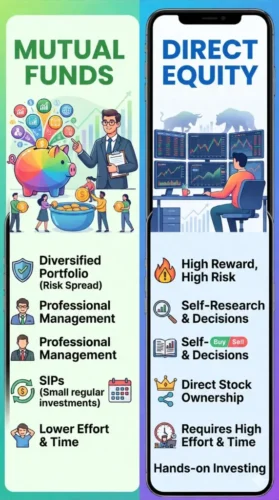
Asha and Ravi are invented investors. Each starts with ₹1,00,000. Asha chooses a diversified equity mutual fund. Ravi reads bold market predictions online and buys shares of three companies.
For a few months, both feel clever. Then the market falls sharply. Ravi’s biggest holding drops after weak results. Asha’s fund falls too, because markets can hurt almost everything. At midnight, both stare at their phones. One feels the urge to sell everything. The other has a plan.
So here is the real question: does successful investing depend more on what you pick, or on how well you understand the risks behind it? This guide compares Mutual Funds vs. Direct Equity in simple words, so you can choose with a clear head. Asha, Ravi and every figure in their story are made up for learning.
Table of Contents
Understand Both Investment Choices
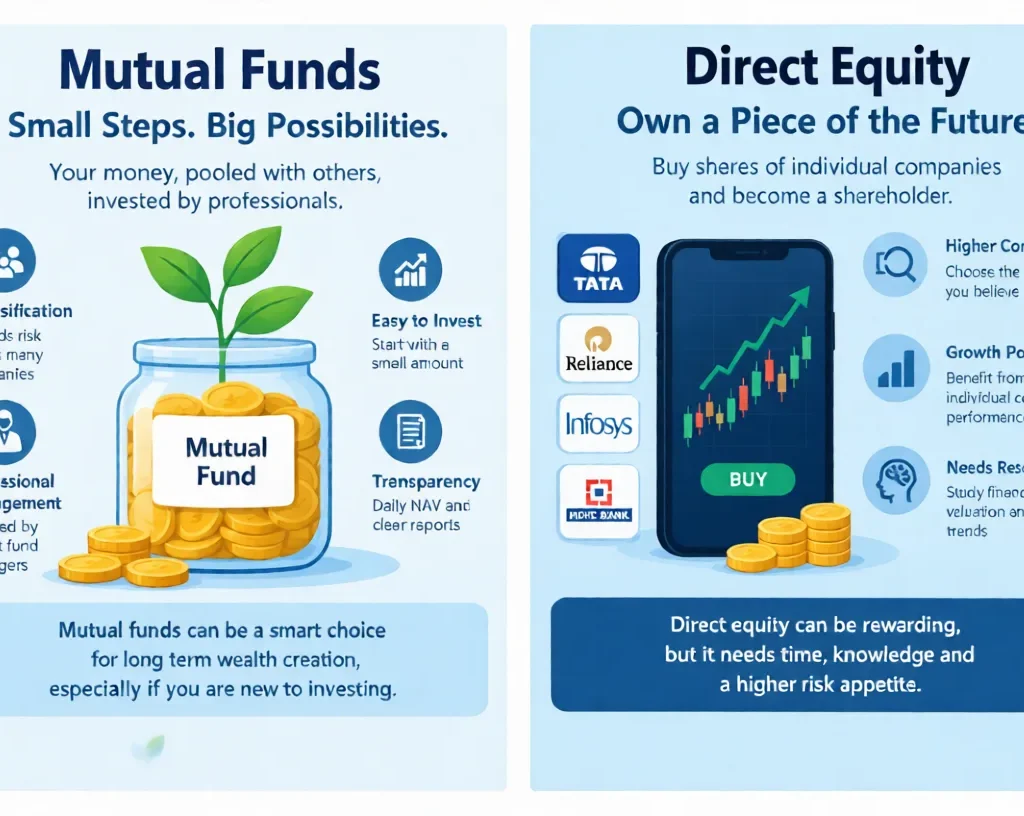
Mutual funds. Many investors put money into one pool. A fund manager invests it according to the fund’s objective. You get units. The price of one unit is the NAV (net asset value). The expense ratio is the yearly fee, shown as a percentage of fund assets, and it is already built into the NAV.
Direct equity. You buy shares of specific companies through a demat and trading account, and become a part owner. You decide what to buy and when to sell. That means studying profits, debt, business quality and valuation, which is the price you pay compared with what the business is worth.
Neither route produces good returns automatically. Both can lose money.
A common confusion. A direct plan of a mutual fund is not direct equity. It is still a mutual fund, bought without a distributor, so its expense ratio is usually lower than the regular plan. You still do not pick the individual shares.
Mutual Funds vs. Direct Equity: The Real Differences
| Area | Mutual funds | Direct equity |
|---|---|---|
| Ownership | You own units; the fund owns the shares | You own company shares |
| Diversification | Usually many companies | Only what you buy |
| Risk concentration | Spread out, varies by fund type | Higher with few shares |
| Research | You choose the fund; a manager picks shares | You pick and track each company |
| Time and effort | Lower | Higher |
| Costs | Expense ratio, sometimes exit load | Brokerage, taxes, charges per trade |
| Transparency and control | Holdings disclosed periodically; no say in picks | Full control |
| Beginners | Often easier, still needs care | Needs learning first |
| Potential returns | Vary by fund, not guaranteed | Vary widely by share, not guaranteed |
| Pressure in falls | Real, with fewer single company shocks | Strong, as each share is your choice |
| Liquidity and horizon | Redeemable on business days; equity needs a long horizon | Sellable on market days if buyers exist; same horizon rule |
| Tax in India | Equity oriented funds follow the share rates below | Listed shares follow the rates below |
Three differences matter most. Concentration: a few shares can behave very differently from the overall market, while a fund spreads money across many holdings. Workload: a fund moves research to a manager, but you must still choose a suitable fund, and funds vary in strategy, cost and results. Emotion: owning single shares makes every fall feel personal. Neither approach is better for everyone.
Costs, Risks, and Returns
Mutual funds offer diversification, convenience and professional management. The limits: no control over holdings, a running expense ratio, the task of choosing a fund, and real chance of loss. Professional management does not guarantee better results.
Direct equity offers ownership, control and the chance to gain from one company’s growth. The limits: heavy research, concentration risk, valuation mistakes, volatility and emotional trading.
Diversification softens the damage when one company fails. It cannot remove market risk, which hits most shares together.
How to judge performance. Absolute return is the total gain over a period. Annualised return converts it into a yearly rate, so different periods compare fairly. Volatility shows how sharply value swings. A benchmark, such as a market index, is a yardstick over the same period. Always check the expense ratio too.
A fund’s recent high return proves little, because one lucky year can hide weak quality. A rising share price alone does not prove a strong business. This article uses no market return data. Every number below is hypothetical.
A ₹1 Lakh Example That Makes the Difference Clear
Hypothetical numbers chosen for learning. Not real data and not a forecast.
Simple arithmetic first: a 20% fall turns ₹1,00,000 into ₹80,000 before costs and taxes.
Investor A holds a diversified fund. Assume its holdings fall 12% in a year: ₹88,000. Assume a 1% expense ratio, about ₹880. Value: roughly ₹87,120.
Investor B buys four shares at ₹25,000 each. Assume Share 1 falls 40%, Share 2 falls 10%, Share 3 rises 15% and Share 4 falls 25%. Values: ₹15,000 + ₹22,500 + ₹28,750 + ₹18,750 = ₹85,000. Assume ₹500 of charges: ₹84,500.
Now change one assumption. If Share 1 had risen 40% instead, B would hold ₹35,000 + ₹22,500 + ₹28,750 + ₹18,750 = ₹1,05,000 before charges.
What this shows: with few holdings, one share can swing the result either way, and costs reduce what you keep. What it cannot show: that funds fall less, that stock picking is worse, or what happens next.
Which Choice Fits Your Situation?
Ask seven questions before investing:
- What is the money for?
- When will you need it? Money needed soon needs special care, because equity can be down on the day you withdraw.
- Can you accept a large temporary loss without panic selling?
- How many hours a month can you give to research?
- Can you read a company’s accounts and judge its valuation?
- Are emergency savings and essential bills covered? [Internal Link Opportunity: emergency fund article on kritiinfo.com, URL to be verified]
- Do you understand the costs, tax rules and risks?
Little time for questions 4 and 5 may point toward a suitable diversified fund. A real interest in analysing businesses may support some direct equity inside a wider plan. Many people use both. No fixed split is given here, because it depends on personal facts.
Illustrative situations (fictional):
- A busy salaried employee cannot study companies. Regular contributions to a diversified fund may suit. Mistake to avoid: choosing a fund only because last year’s return looked high.
- A knowledgeable investor who enjoys annual reports may hold a few shares alongside funds. Mistake to avoid: too much money in one sector.
- A beginner sees a social media post about a share that doubled. Checking the business, valuation and personal risk capacity beats rushing in. Mistake to avoid: buying from fear of missing out.
So what matters more, product or behaviour? Often behaviour: sensible asset allocation, steady contributions, realistic expectations, low costs and no panic selling. These are general educational observations, not personal recommendations.
Tax and Rules in India
Tax depends on the investment type, holding period and your situation. Published guides for FY 2026-27 (the Income Tax Act 2025 applies from 1 April 2026) show unchanged rates for listed shares and equity oriented mutual funds, meaning funds with over 65% in equity, where Securities Transaction Tax is paid. Gains on holdings of 12 months or less face 20% tax. Longer holdings face 12.5% above ₹1.25 lakh gains per year. Debt oriented funds are taxed differently, so never assume all funds are alike. Confirm current rules with the Income Tax Department.
SEBI regulates securities markets and mutual funds to protect investors. AMFI is the mutual fund industry body and publishes data such as NAVs. Share data is on NSE and BSE. Regulation helps, but never removes investment risk.
Common Myths Investors Should Question
- “Professionals manage it, so it cannot lose.” A fund can fall when markets fall.
- “Direct equity always earns more.” Nothing guarantees this.
- “A low priced share is cheap.” A ₹20 share can be costly. Compare price with business earnings.
- “Diversification removes all risk.” It cuts single company risk, not market risk.
- “Last year’s winner will win again.” Past returns do not predict the future.
- “More trading means more profit.” Every trade adds charges and maybe tax.
- “A direct plan is buying shares directly.” It is still a mutual fund.
Conclusion
Asha and Ravi differed in more than what they bought. They differed in how well they understood what they owned and how a fall would feel. The most profitable looking choice is not always the right one. Good investing needs risk awareness, low costs, goals that match the investment, and calm in changing markets.
Your next three steps:
- Define your goal and timeline.
- Assess how much loss you can truly tolerate.
- Research any fund or share before you commit money.
Frequently Asked Questions
1. What is the difference between mutual funds and direct equity? A fund pools money from many investors and a manager invests it. With direct equity, you buy company shares yourself.
2. Which is easier for beginners? Diversified funds usually need less research, but you must still choose carefully and accept risk.
3. Can mutual funds lose money? Yes. Equity funds can fall with the market, and no return is guaranteed.
4. Is direct equity riskier than mutual funds? Often it carries more concentration risk, mainly with few shares. Fund risk depends on type and strategy.
5. Can someone invest in both? Yes. Many investors combine them, based on goals, time and risk comfort.
6. Are they taxed differently in India? Equity oriented funds and listed shares follow similar capital gains rules, but other fund types differ. Verify current rules.
Disclaimer: This article is general information, not personalised financial or tax advice. Investments in securities are subject to market risk. Read all scheme related documents carefully.