
Picture an ordinary street on the outskirts of Pune. Morning traffic, the usual mix of two wheelers, autos, and delivery vans. One motorcycle sounds wrong: no clatter of pistons, no cloud of exhaust, no owner watching a battery percentage tick down. Just a soft hum and a fuel cell quietly converting hydrogen gas into electricity as the wheels turn.
This is not science fiction. It is the working premise behind a small Pune based startup called Hydrovert Energy, and it points toward a bigger question: could hydrogen quietly change the machines that move people and goods? To answer that, we need to separate what is proven from what is promising, and what is promising from what is merely possible.
Table of Contents
Hydrogen Hits the Road
Battery electric vehicles have already reshaped India’s two wheeler and car markets, thanks to comparatively simple charging infrastructure and falling costs. But batteries carry a tradeoff: push for longer range and the pack gets heavier, eating into payload and charging time.
Hydrogen fuel cell propulsion stores energy differently, in compressed gas rather than heavy cells, converting it to electricity on demand. The appeal for cargo mobility and long range vehicles is faster refuelling and lighter storage relative to range. Whether that appeal survives real world economics is the tension running through this story.
What Hydrovert Is Building
Hydrovert Energy was founded in 2021 in Pune by Dr. Satyajit Phadke and Supriya Patwardhan, and the company is incubated at the NCL Venture Center. Phadke holds a B.Tech from IIT Roorkee in materials engineering and a PhD in hydrogen fuel cells from the University of Florida, with subsequent research at MIT, Princeton, and in Silicon Valley battery development, according to the company’s own profile.
Its core product is a Proton Exchange Membrane (PEM) fuel cell stack, built in house, paired with powertrains the company lists in a 5kW to 25kW range for two wheelers, three wheelers, and cargo four wheelers, along with marine and drone platforms. It has also built stationary hydrogen gensets between 5kVA and 50kVA as a cleaner alternative to diesel, with pv magazine India reporting a deployment at an NTPC facility in Greater Noida in April 2026.
None of this amounts to a hydrogen motorcycle sitting in a showroom yet. It amounts to a technology platform moving through prototype, testing, and early deployment, backed by grants from DST’s NIDHI Prayas scheme, the Startup India Seed Fund, and UNIDO linked programmes, according to public company listings.
How the Fuel Cell Works
Strip away the branding and the physics is elegant. Hydrogen enters one side of the stack, oxygen from ordinary air enters the other, and an electrochemical reaction, not combustion, strips electrons from hydrogen atoms and pushes them through a circuit as usable current, driving the vehicle’s electric motor exactly as a battery would.
The only direct byproducts are water vapour and heat. There is no flame inside a fuel cell, the key distinction from a hydrogen combustion engine, an older idea that simply burns hydrogen in a modified petrol engine. A fuel cell vehicle is, mechanically, an electric vehicle carrying its own onboard generator instead of a heavy, pre charged battery pack.
The Motorcycle Test
According to an interview Hydrovert’s founders gave to the Green Business Podcast, reported by FineTrain in July 2024, the company’s proof of concept two wheeler took roughly two years to build and was tested over 50 kilometres within the NCL Innovation Park campus. That testing led to two provisional patents, one covering fuel cell thermal management and another covering high pressure cylinder safety. The founders’ near term goals at that point were plain: finish an advanced prototype, begin on road testing, and pursue certification from the Automotive Research Association of India (ARAI).
Separately, a video published by India’s Department of Science and Technology describes a Hydrovert hydrogen fuel cell bike, built for cargo mobility, completing a 180 kilometre run. Treat that as a company reported figure, since DST’s role was documentation and support, not third party certification. Together, these sources point to a real, patent backed prototype programme, not a finished product.
From Motorcycle to Cargo Vehicle
Hydrovert’s ambition has leaned toward cargo mobility as much as personal transport, and the logic tracks how delivery fleets actually work. A petrol two wheeler refuels fast but pollutes constantly. A battery electric cargo vehicle is clean at the tailpipe but can lose paid hours to charging, and every kilogram of battery is a kilogram not carrying goods.
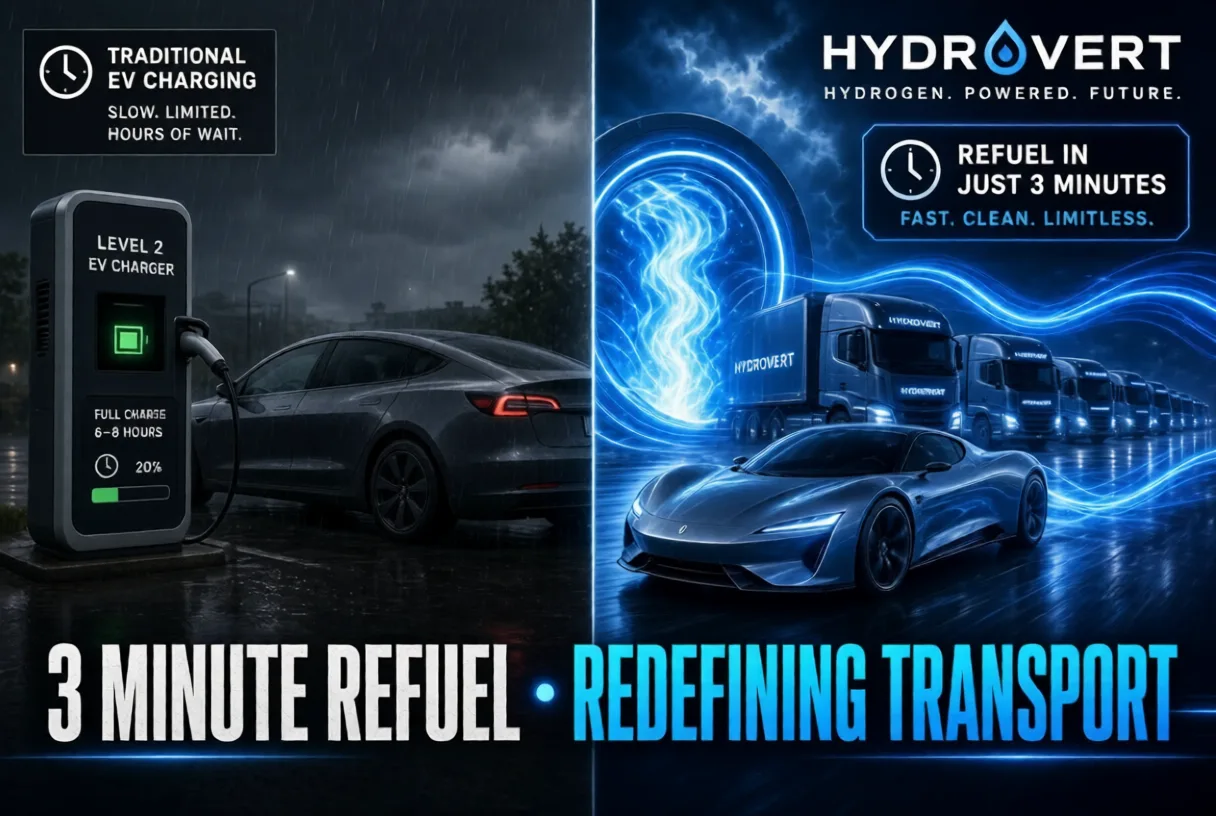
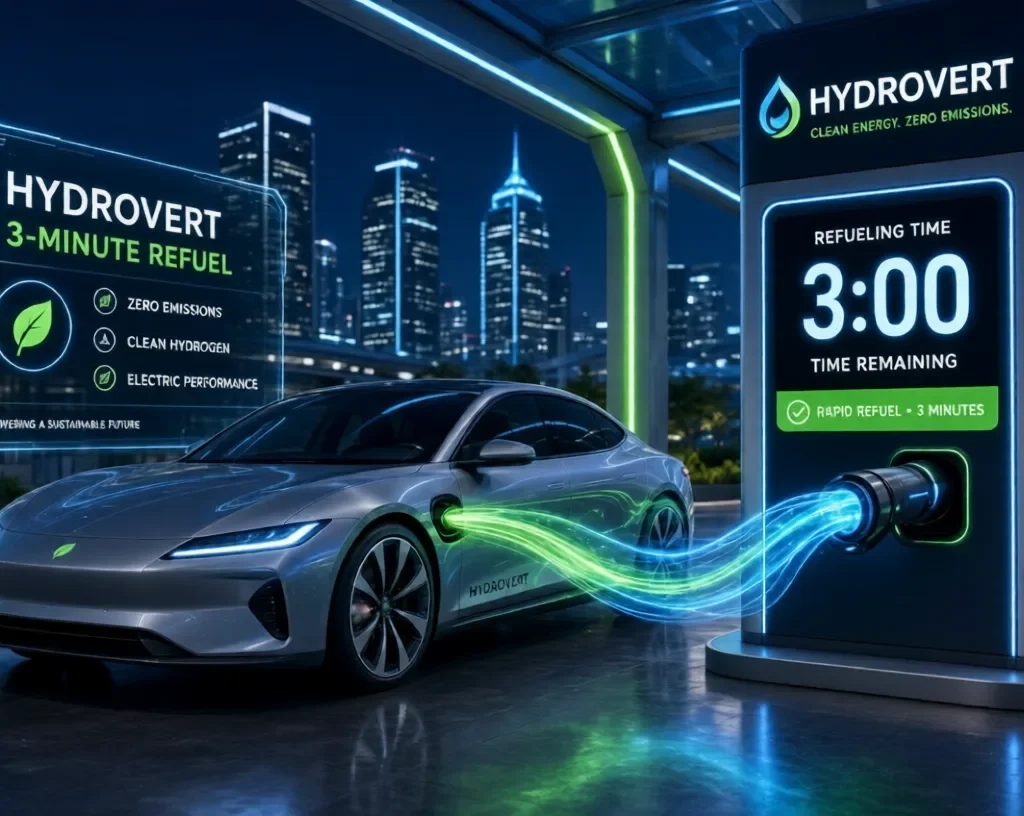
If Hydrovert’s targeted three minute refuelling holds at commercial scale, a delivery rider could top up almost as quickly as filling a fuel tank and return to paid trips. For fleets running dozens of vehicles daily, minutes of downtime add up to real money, precisely why the company has focused on three wheeler and cargo work alongside its motorcycle.
Could Trucks Run on Hydrogen?
What exists today: hydrogen fuel cell buses and trucks run in limited pilots abroad, and Indian policy references heavy transport under the National Green Hydrogen Mission. What is being tested: Indian startups, Hydrovert included, are building larger fuel cell stacks for light commercial platforms as stepping stones toward heavier vehicles. What is technically possible: scaling fuel cells and storage to truck sized platforms is achievable, as global manufacturers have already shown. What remains uncertain: whether hydrogen trucking becomes cost competitive with battery electric or diesel in India depends on prices and infrastructure not yet settled anywhere. Hydrovert has not publicly documented a truck product.
The Hidden Obstacles
Every hydrogen mobility story runs into the same practical questions. Where does the hydrogen come from, and how green is it? Storage needs high pressure tanks, since hydrogen is far less energy dense by volume than petrol even compressed. Refuelling infrastructure barely exists outside pilots, so a hydrogen vehicle today is only as useful as the nearest station. Fuel cell stacks remain costly against comparable battery packs, certification pathways for new categories are still developing, and hydrogen must be moved and stored safely at every step. None of this dismisses the technology; it is simply the work separating a promising prototype from a machine in every neighbourhood.
Hydrogen vs Battery
| Factor | Hydrogen Fuel Cell | Battery Electric |
|---|---|---|
| Refuelling or charging | Minutes, where a station exists | Minutes on premium fast chargers, hours on standard ones |
| Range per unit weight | Favourable over longer distances | Range scales with heavier packs |
| India infrastructure today | Very early, mostly pilots | Comparatively widespread |
| Well to wheel efficiency | Lower, due to conversion losses | Higher, fewer conversion steps |
| Payload impact | Lighter storage can preserve cargo space | Heavier packs can reduce payload |
| Strongest fit today | Long range, fast turnaround commercial routes | Urban personal mobility, short haul delivery |
Neither column wins outright. Short urban trips already favour batteries, since charging infrastructure exists. Long range, high utilisation commercial routes are where hydrogen’s fast refuelling matters most, assuming fuel is actually available along that route.
Case Study
Hydrovert offers a useful case study precisely because it resists exaggeration. Founded in 2021 and incubated at Pune’s NCL Venture Center, the company built its first two wheeler prototype over roughly two years, tested it across 50 kilometres on a closed campus, patented its thermal and pressure safety systems, and secured a string of government grants rather than one splashy funding round. It then expanded into three wheeler cargo platforms and, separately, into stationary hydrogen gensets that reached a real commercial site in Greater Noida by 2026.
That is not a company that has solved hydrogen mobility. It is a small, technically credible team working through campus testing, certification pursuit, and component development, the unglamorous stages any hydrogen vehicle must pass before reaching an Indian road at scale. Readers can track the company’s own claims at its official site alongside the sources cited throughout this piece.
The Bigger Hydrogen Puzzle
Here is the detail lost in most excited coverage: a fuel cell vehicle’s exhaust emits only water, but that says nothing about emissions created while producing the hydrogen. Grey hydrogen, most of what is made today, comes from natural gas and releases carbon dioxide. Blue hydrogen uses the same process but captures some of it. Green hydrogen, made by splitting water with renewable electricity, is the only pathway approaching genuinely low lifecycle emissions, and remains the most expensive and least available. Zero tailpipe emissions is real and worth having, but it is not automatically the same claim as zero total emissions.
What Happens Next?
The realistic near term picture: motorcycles and three wheelers moving from campus testing toward certified, limited fleet trials with captive delivery operators who control their own refuelling point. Buses, trucks, and construction equipment remain further out, tied to how fast India’s green hydrogen buildout under the National Green Hydrogen Mission materialises. Marine transport and stationary backup power, where Hydrovert already has a documented deployment, may mature faster than road transport simply because they need less infrastructure to prove useful. None of this is guaranteed.
FAQ
What is Hydrovert? A Pune based startup, founded in 2021, developing hydrogen fuel cell powertrains and PEM stacks for two wheelers, cargo three wheelers, marine applications, drones, and stationary generators.
How does a hydrogen motorcycle work? Hydrogen reacts electrochemically with oxygen inside a fuel cell, generating electricity that drives an electric motor. Water and heat are the byproducts; there is no combustion.
Does a hydrogen fuel cell vehicle produce pollution? At the point of use, it emits only water vapour and heat. Whether the whole process is clean depends on how the hydrogen fuelling it was produced.
Can trucks run on hydrogen? Technically yes, and pilots exist globally. Commercially in India, this remains an emerging area dependent on infrastructure and pricing, not an established reality.
Is hydrogen safer than petrol or diesel? It requires different engineering, particularly high pressure storage and leak detection, which is why Hydrovert has patented safety systems. Properly engineered it is not inherently more dangerous, but it demands its own certification standards.
How quickly can hydrogen vehicles be refuelled? Hydrovert targets around three minutes, comparable to conventional refuelling and considerably faster than typical battery charging.
Is hydrogen better than battery electric vehicles? Neither wins universally. Batteries suit short range, infrastructure rich urban use. Hydrogen’s advantages, fast refuelling and lighter storage, matter most for long range or heavy duty applications where downtime is costly.
The Question We Started With
Can hydrogen really move the machines that move our world? Based on what is documented today: not yet, not widely, and not without solving production, storage, and refuelling infrastructure first. But a small team in Pune has already built a working two wheeler prototype, tested it, patented parts of it, and put a stationary hydrogen genset into real commercial use. That is not a revolution. It is evidence, which is a more interesting thing to have.