
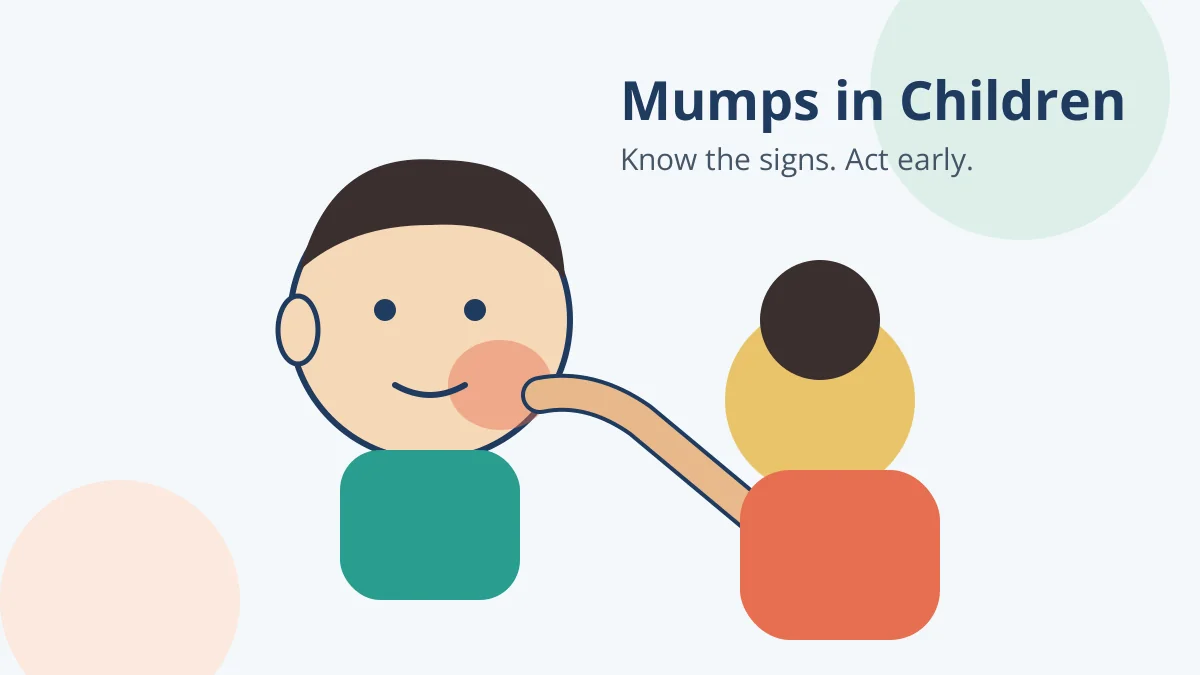
Meera, aged 8, comes home from school on Monday with a headache. By evening she has a mild fever and says her ears feel sore. Her mother thinks it is a common cold and lets her rest.
On Wednesday, Meera pushes away her favourite roti. Chewing hurts. On Thursday morning her mother notices the left cheek looks puffed up, as if a small ball is hiding under the ear.
(This is an illustrative story made to explain the topic. It is not a real patient.)
Table of Contents
At the clinic, the doctor gently checks the swelling and asks an unexpected question: “Has anyone else in her class been absent this week?”
Why would a doctor think about a whole classroom when the problem looks like one puffy cheek? The answer lies in a virus that can spread before anyone sees a swelling. That virus causes mumps, and parents who understand it can protect their child and everyone around them.
What Is Mumps? A Simple Explanation
Mumps is an infection caused by the mumps virus, which belongs to a family called paramyxoviruses.
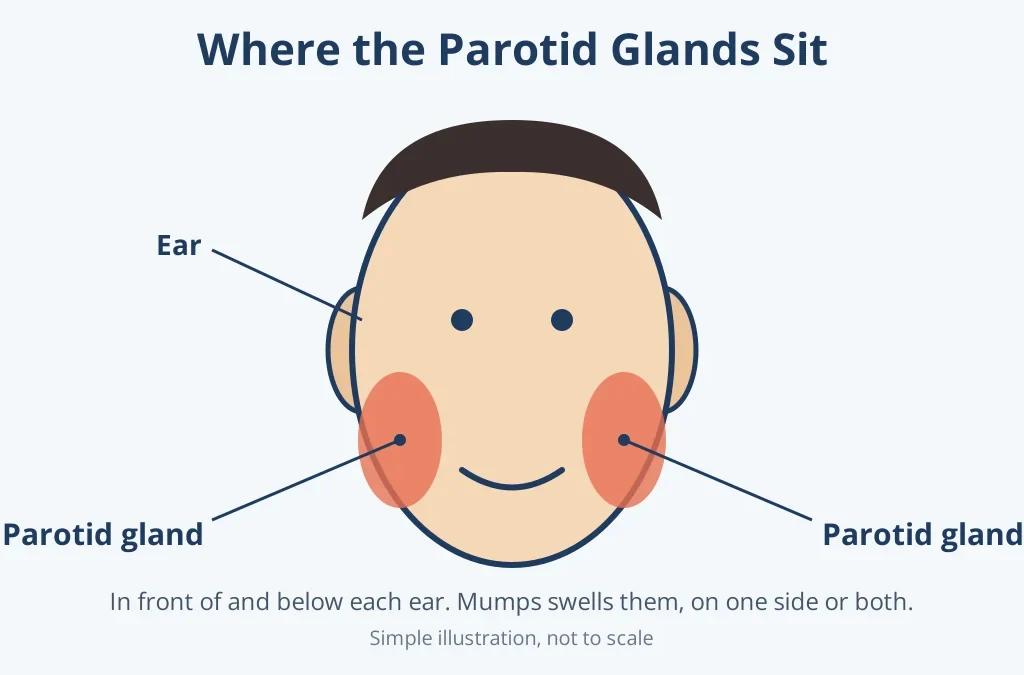
Your mouth has small water taps called salivary glands. They make saliva, the spit that helps you chew, taste and swallow. The biggest pair, the parotid glands, sit in front of and below each ear. When the virus attacks them, they swell and hurt. Doctors call this swelling parotitis.
How It Spreads
The virus lives in the nose and throat. When an infected person coughs, sneezes or talks, tiny droplets float in the air and another person breathes them in. Saliva on cups, bottles and spoons can also carry the virus.
Why Schools and Teens Are Affected
Children sit close, share snacks and touch the same objects. CDC says places with frequent close contact face a higher risk of outbreaks. Teens mix in big groups, and evidence suggests vaccine protection can fade over the years. Some complications also appear mainly after puberty.
Quick facts for busy parents
- Mumps swells the salivary glands near the ears.
- It spreads through droplets and shared cups.
- Symptoms usually start 16 to 18 days after contact.
- A child can spread it from 2 days before swelling to 5 days after.
- Most children recover within 2 weeks.
- Antibiotics do not work against it.
- Two MMR doses are about 86% effective.
Symptoms Parents Should Never Ignore
Early symptoms may start a few days before any swelling: fever, headache, muscle aches, tiredness, weakness and loss of appetite.
Characteristic symptoms come next: swollen cheeks and jaw on one or both sides, painful salivary glands, and pain while chewing or swallowing.
The Incubation Period
Symptoms usually appear 16 to 18 days after the virus enters the body, according to CDC. The range is 12 to 25 days. A person can spread the virus from about 2 days before swelling begins, so a child who looks only slightly tired may already be passing it on.
Mild and Silent Cases
The UK health service nidirect says about one in three people have no noticeable symptoms. In a 2024 study of 217 children in Navi Mumbai, every child had gland swelling, but only 35.4% had fever. So do not wait for fever before thinking of mumps.
Mumps vs Similar Illnesses
Symptoms alone cannot confirm a diagnosis. Medical assessment is important because the treatment and risks differ.
| Condition | What you may see | Usual cause | Why a doctor check matters |
|---|---|---|---|
| Mumps | Swelling in front of and below the ear, pain on chewing, tiredness | Mumps virus | Confirms the cause, guides isolation, watches for complications |
| Bacterial parotitis | Very tender gland, often one side, warm or red skin, sometimes pus in the mouth | Bacteria | May need antibiotics, which do not help viral infections |
| Swollen lymph nodes | Small movable lumps along the jaw or neck, often with a cold | Throat, teeth or skin infections | A lump that stays needs a check |
| Other viral infections | Gland swelling with fever or cold signs | Various viruses | CDC notes other causes of parotitis exist, so testing may be needed |
Complications: What Parents Should Know
Most children recover fully. CDC says most people recover within 2 weeks. Serious problems are uncommon, but they matter. These are CDC estimates among people who catch mumps.
| Complication | Unvaccinated | Vaccinated | Plain meaning |
|---|---|---|---|
| Orchitis (boys after puberty) | About 30% | About 6% | Painful, swollen testicle, usually one side |
| Oophoritis (girls after puberty) | About 7% | 1% or less | Lower belly pain, can look like appendicitis |
| Meningitis | Up to 10% | 1% or less | Headache, vomiting, stiff neck; usually mild |
| Pancreatitis | Up to 4% | Under 1% | Strong belly pain and vomiting |
| Hearing loss | Up to 4% | Under 1% | Often temporary, sometimes permanent |
| Encephalitis | 1% or less | 1% or less | Brain inflammation; very rare |
Fertility: CDC says orchitis has not been linked to infertility, though it may lower fertility.
Hearing: A 2024 Indian Pediatrics paper notes that where mumps vaccine is not in the national schedule, the infection can account for up to 25% of one sided deafness in children. A child may not complain, since only one ear is affected.
Complications can happen even without cheek swelling.
Serious Warning Signs
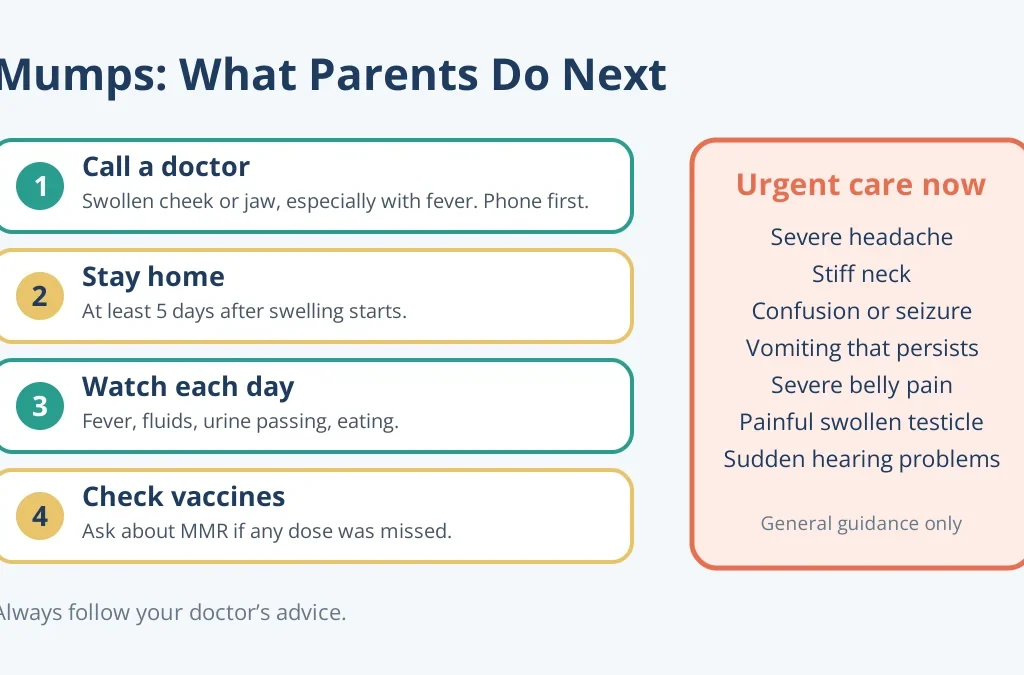
Mild fever, sore cheeks and tiredness are usually temporary. Seek urgent medical care for severe headache, stiff neck, confusion, seizures, vomiting that will not stop, severe belly pain, a painful swollen testicle, or sudden hearing problems.
The SAFER Plan: Prevention and Protection
Prevention remains essential. This simple plan is easy to remember.
S: Shots on time. Two MMR doses are about 86% effective against mumps, according to CDC. Vaccinated people who still catch it tend to have milder illness.
A: Apart when sick. NHS and CDC guidance is to keep a child home for at least 5 days after swelling starts.
F: Fresh habits. Wash hands with soap, cover coughs, and never share cups, bottles or spoons.
E: Extra care for others. Keep the child away from babies and people with weak immunity.
R: Report to school. Tell the teacher so other parents can watch for signs.
MMR Schedules: India and Other Countries
India: The government programme gives MR vaccine (measles and rubella), which does not include mumps. MMR is available through private doctors. A 2024 Indian Pediatrics paper reports that the Indian Academy of Pediatrics recommends MMR between 9 and 15 months and another dose at 4 to 6 years. Schedules change, so confirm the current IAP chart with your paediatrician.
United States: CDC recommends doses at 12 to 15 months and 4 to 6 years.
United Kingdom: NHS gives one dose at about one year and a second before school.
A teenager who missed MMR should ask a doctor about catching up.
Diagnosis and Treatment
Doctors often suspect it from the swelling and history. When confirmation is needed, CDC describes PCR testing on a cheek swab or urine sample, plus a blood test for antibodies. A negative test does not always rule it out, especially in vaccinated people.
This infection is viral, so antibiotics do not treat it, and no antiviral medicine is routinely used for uncomplicated cases. Care focuses on comfort:
- Rest and plenty of fluids
- Soft foods such as mashed potato or soft khichdi
- A warm or cool cloth on the swollen cheek
- Pain relief that a doctor or pharmacist advises for your child’s age and weight
Do not give aspirin to children and teenagers unless a qualified healthcare professional directs it. It is linked with Reye syndrome, a rare but serious illness. Never guess doses.
A Real World Example: The Verma Family
(This is an illustrative example, not a documented patient case.)
Ten year old Aryan has a fever, sore ears and a swollen right cheek. His mother, Neha, remembers a school message about mumps in another class. She phones the clinic first, so staff can keep him away from other patients.
The doctor advises rest, fluids and soft food. At home Aryan uses his own cup and towel, and everyone washes hands often. Neha checks the vaccine record of his 4 year old sister and informs the school. Aryan returns 5 days after the swelling began, once he feels well and the doctor agrees.
Lessons: call early, phone before visiting, separate cups, inform the school, check vaccine records and know the red flags.
What the Data Tells Us
In a Navi Mumbai outbreak (Indian Pediatrics, September 2024), doctors reported 217 children with mumps. Of them, 197 (90.78%) had never received a mumps vaccine. Another 185 had only MR vaccine. Twenty had received MMR but still fell ill. Five had nervous system complications.
How to read this: MR vaccine has no mumps component, it is no surprise that many of these children had no mumps protection. But the numbers cannot show vaccine effectiveness, because there is no comparison group. Reporting was voluntary and came from fewer than 8% of the city’s paediatricians, so the true burden was probably higher.
Outbreaks also occur among vaccinated groups. Evidence suggests protection can fade, the vaccine is not perfect, and crowded places give the virus many chances to spread. Teenagers need extra attention because orchitis and oophoritis occur mainly after puberty. Quick isolation after the first clue cuts spread.
Advantages and Limitations
Advantages: vaccination lowers the risk of infection and complications, early recognition reduces spread, and supportive care helps recovery.
Limitations: vaccination is not absolute, early symptoms resemble other infections, no antiviral is routinely used, and some complications need specialist assessment.
Common Misconceptions
- “Mumps only affects children.” Teens and adults can get it, and complications are more common in older people.
- “Vaccinated children can never get mumps.” Protection is strong, not complete. Illness is usually milder.
- “Mumps is always harmless.” Usually mild, but rare complications can be serious.
- “Antibiotics cure mumps.” They do not work against viruses.
- “Swollen cheeks are the only sign.” Some people have only fever, aches or cold signs, or nothing at all.
- “No swelling means no spread.” A person can spread the virus from 2 days before swelling begins.
What Parents Should Do Next
- Call a doctor for a swollen cheek or jaw, especially with fever. Phone before visiting.
- Keep your child home for at least 5 days after swelling starts, until the doctor agrees.
- Monitor fever, fluids, urine passing and eating each day.
- Check vaccine records and ask about MMR if doses were missed.
- Get urgent care for severe headache, neck stiffness, confusion, seizures, persistent vomiting, severe belly pain or sudden hearing problems. Severe symptoms need immediate medical evaluation.
Frequently Asked Questions
What is mumps in children? A viral infection that swells the salivary glands near the ears.
How does mumps spread? Through droplets from coughs and sneezes, and saliva on shared items.
What are the first signs of mumps? Fever, headache, aches, tiredness and poor appetite, often before the cheek swells.
How long does mumps last? Most people recover within 2 weeks. Swelling lasts about 5 days on average, according to CDC.
Can vaccinated children get mumps? Yes, but the risk is lower and illness is usually milder.
Is mumps dangerous for teenagers? Usually not, but orchitis and oophoritis occur mainly after puberty, so watch teens closely.
Can mumps affect fertility? Orchitis may lower fertility in some males, though CDC says it has not been linked to infertility.
How is mumps treated? Rest, fluids, soft foods and comfort care. Antibiotics do not help.
When can a child return to school? Usually 5 days after swelling starts, once the child feels well and the doctor agrees.
How can parents prevent mumps? Keep MMR on schedule, wash hands, avoid sharing cups, and keep sick children home.
Conclusion
Mumps often begins like an ordinary illness, and a child can spread it before the swelling appears. Parents who know the signs, keep vaccines up to date and act early protect the whole school community.
This week, check your child’s vaccine card and ask your paediatrician whether MMR is complete. Share this guide with another parent.