
Introduction: Test Tomorrow Before It Happens
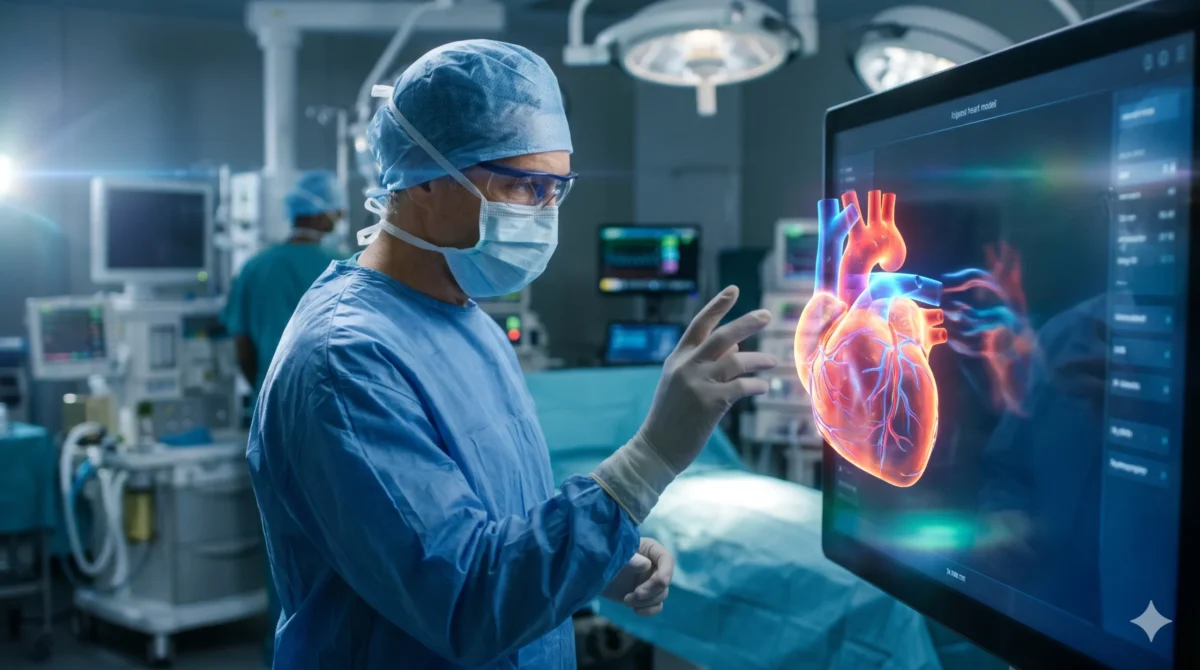
Imagine a cardiac surgeon standing in a quiet hospital room at midnight. Tomorrow morning, she must repair a rare structural defect inside the heart of an eight year old child. One tiny slip with a surgical instrument could cause permanent damage.
In the past, surgeons relied on two dimensional scans, medical textbooks, and years of experience to prepare for the unknown. Tonight, however, she puts on a mixed reality headset. Floating in front of her is an exact, beating virtual replica of that specific child’s heart, constructed from high resolution medical imaging.
She reaches forward with a virtual scalpel and attempts her planned incision. Inside the digital environment, the virtual tissue reacts just like living muscle. Suddenly, a hidden blood vessel ruptures on screen, flooding the simulated chamber. No patient was harmed. No blood was spilled. She resets the model, adjusts her angle by three millimeters, and tries again. This time, the repair holds cleanly.
What if we could experience failure, discover hidden dangers, and correct critical mistakes before reality makes them irreversible?
This question sits at the center of Simulation Before Reality, one of the most important shifts in modern science, engineering, and business. Rather than building physical prototypes first and hoping they survive real world stress, innovators now build virtual worlds to test every possible outcome before committing physical materials, money, or human lives.
Table of Contents
What Is Simulation Before Reality?
In the simplest terms, Simulation Before Reality means creating a digital copy of a physical object, system, or situation so you can test ideas safely on a computer first. Think of it as a flight simulator for everything from tiny microchips to entire cities.
To understand how this works, it helps to separate five closely related technologies that people often confuse:
- Computer Simulation: A mathematical program that imitates how a system behaves over time based on the laws of physics, chemistry, or economics. It answers “what if” questions using equations.
- Digital Twins: A living virtual replica connected to a real physical object through live sensors. Unlike a static simulation, a digital twin updates continuously as the real object ages, heats up, or experiences wear. As defined by the Digital Twin Consortium, it is a virtual representation synchronized with the physical world at a specific frequency and fidelity.
- Artificial Intelligence (AI): Software that learns patterns from massive amounts of data. In simulation, AI speeds up calculations that once took weeks, allowing engineers to test thousands of design variations in minutes.
- Predictive Modelling: A statistical method that uses historical and current data to forecast future outcomes, such as predicting when a factory machine will break down next month.
- Virtual Reality (VR): A visual interface that allows humans to step inside a 3D computer environment. VR lets people see and interact with a simulation, while the simulation engine itself performs the underlying math.
Why 2027 Could Change Everything
Simulation has existed for decades, famously helping NASA bring the Apollo 13 astronauts home safely in 1970 using ground simulators. So why is Simulation Before Reality approaching a major turning point around 2027?
First, verified breakthroughs in physics informed AI are dramatically cutting computing time. Traditional fluid dynamics or crash simulations required expensive supercomputers running for days. Today, neural networks trained on physical laws can predict airflow or structural stress in seconds.
Second, sensor hardware has become cheap and small enough to embed inside everyday machinery, vehicles, and medical devices. This continuous stream of live data feeds modern digital twins with unprecedented accuracy.
Looking toward 2027, we can reasonably expect simulation tools to move beyond giant aerospace and automotive corporations into mid sized businesses, hospitals, and local governments. Standardized open frameworks and cloud computing will allow smaller teams to run complex virtual experiments without owning supercomputers. However, full autonomy where AI systems design, simulate, and deploy physical products without human review remains a longer term prediction rather than an immediate 2027 reality.
Where Simulation Is Already Changing Reality
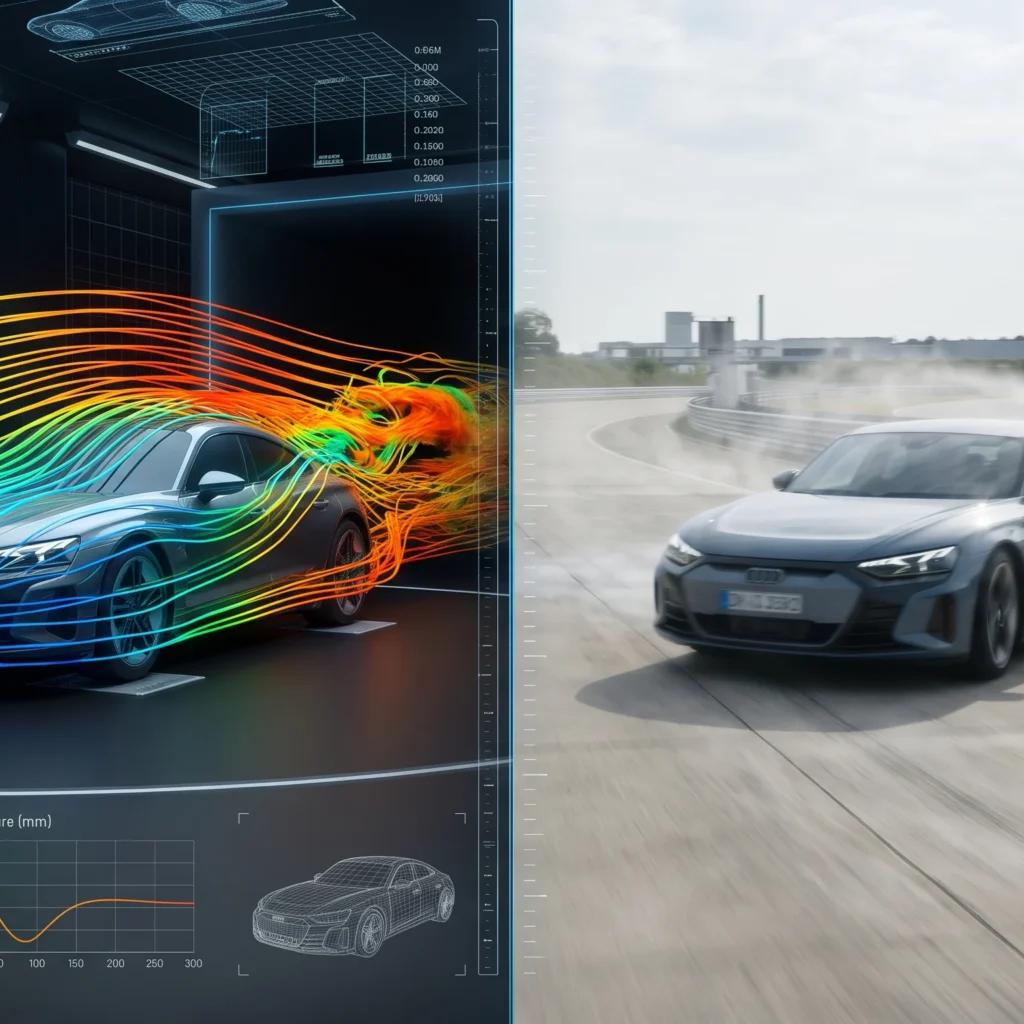
Across major industries, virtual testing is already solving costly real world problems.
Healthcare and Surgical Planning
- Existing Problem: Every human body has slight anatomical variations, making complex surgeries and new drug trials risky and expensive.
- How Simulation Helps: Researchers create virtual patient cohorts and organ models using MRI and CT data, as documented in studies indexed by the National Institutes of Health.
- Expected Improvements: Surgeons rehearse rare operations in advance, while pharmaceutical companies test drug dosages on virtual populations before human clinical trials.
- Remaining Limitations: Human biology contains microscopic chemical interactions that current computer models still cannot reproduce completely.
Automotive Engineering and Autonomous Vehicles
- Existing Problem: Testing self driving cars on public roads requires billions of miles to encounter rare, dangerous weather and traffic scenarios.
- How Simulation Helps: Engineers place autonomous driving software inside virtual cities filled with unpredictable pedestrians, blinding rain, and sudden roadblocks.
- Expected Improvements: Software learns how to handle rare emergencies safely without endangering pedestrians or test drivers.
- Remaining Limitations: Simulated human drivers sometimes behave too predictably compared to real people on chaotic city streets.
Aerospace and Space Exploration
- Existing Problem: Launching rockets or testing hypersonic aircraft is extraordinarily expensive, and physical failures destroy millions of dollars in hardware.
- How Simulation Helps: Aerospace teams simulate extreme heat, vibration, and zero gravity conditions across thousands of virtual flights before building flight hardware.
- Expected Improvements: Faster spacecraft certification and safer deep space mission planning.
- Remaining Limitations: Extreme atmospheric turbulence and cosmic radiation still require physical ground chambers and test flights for final verification.
Manufacturing and Industrial Operations
- Existing Problem: Unexpected machine breakdowns halt factory assembly lines and waste huge amounts of raw materials.
- How Simulation Helps: Manufacturers build digital twins of entire factory floors to test layout changes and predict equipment wear before halting production.
- Expected Improvements: Higher production efficiency, lower energy use, and scheduled maintenance before parts break.
- Remaining Limitations: Older factories often lack the modern digital sensors needed to feed accurate data into virtual models.
Smart Cities and Infrastructure
- Existing Problem: Urban planners struggle to predict how new bridges, transit lines, or zoning laws will affect traffic congestion and power grids.
- How Simulation Helps: City planners run virtual models of traffic flow, pedestrian movement, and electricity demand across entire metropolitan regions.
- Expected Improvements: Better public transit schedules, reduced traffic bottlenecks, and smarter placement of electric vehicle chargers.
- Remaining Limitations: Privacy rules and fragmented city databases make it difficult to gather complete real time urban data.
Climate Prediction and Disaster Management
- Existing Problem: Extreme floods, wildfires, and heatwaves move quickly, leaving emergency responders with little time to plan evacuations.
- How Simulation Helps: Initiatives like the European Commission Destination Earth program build planetary scale digital twins to model weather extremes and water systems.
- Expected Improvements: More accurate flood warnings, better forest fire containment strategies, and resilient coastal defenses.
- Remaining Limitations: Sudden microclimate shifts and human evacuation behavior remain hard to forecast with total precision.
Robotics and AI Development
- Existing Problem: Training physical robots to walk, grasp fragile objects, or navigate warehouses takes months and causes frequent mechanical damage.
- How Simulation Helps: Developers train robot AI brains inside physics accurate virtual warehouses where thousands of virtual robots practice simultaneously.
- Expected Improvements: Robots master complex physical skills in days rather than years.
- Remaining Limitations: Slight differences between virtual friction and real floor surfaces, known as the simulation to reality gap, can still trip up physical robots.
Business Strategy and Financial Decision-Making
- Existing Problem: Supply chain disruptions, sudden tariff changes, or price shifts can cripple companies that rely only on static spreadsheets.
- How Simulation Helps: Business leaders run Monte Carlo simulations and supply chain twins to stress test company finances against thousands of economic shocks.
- Expected Improvements: Stronger inventory buffers, smarter capital allocation, and faster crisis response.
- Remaining Limitations: Financial models cannot predict sudden geopolitical shocks or irrational market panics.
Simulation Before Reality: Original Comparison
Understanding how virtual experimentation changes engineering becomes clearer when we compare traditional workflows against a simulation first approach.
| Feature | Traditional Approach | Simulation-First Approach |
| First Step | Build a physical prototype immediately | Build a digital model and test virtually |
| Upfront Material Cost | High expenses for raw materials and tooling | Low material costs during early design |
| Failure Risk | Real physical damage, safety hazards, and waste | Controlled virtual failures with zero physical harm |
| Testing Scope | Limited by budget, time, and physical weather | Thousands of extreme scenarios tested rapidly |
| Prototype Format | Physical hardware models | Virtual prototypes and live digital twins |
Crucially, simulation complements physical testing rather than replacing it completely. Virtual models narrow down thousands of bad ideas so engineers only build the very best physical prototypes.
The Practical Framework: Five Steps
Any organization or research team can apply Simulation Before Reality using a clear five step process:
- Define the Real-World Problem: Identify the exact decision or risk you want to understand. For example, a hospital emergency room wants to reduce patient waiting times during winter flu surges.
- Collect Reliable and Relevant Data: Gather accurate measurements from the real system. The hospital collects six months of patient arrival rates, triage times, bed availability, and staff schedules.
- Build a Digital Model: Translate those rules and measurements into a computer model. Engineers program how patients move from registration to examination rooms under normal conditions.
- Test Multiple Scenarios: Run “what if” experiments inside the virtual environment. The team simulates a sudden 40 percent spike in patients and tests whether adding two triage nurses solves the bottleneck.
- Validate Results Through Real-World Experiments: Apply the winning change in the real world on a small scale and compare actual results against the simulation’s predictions, refining the model as needed.
An Illustrative Example: Designing a Safer EV Battery
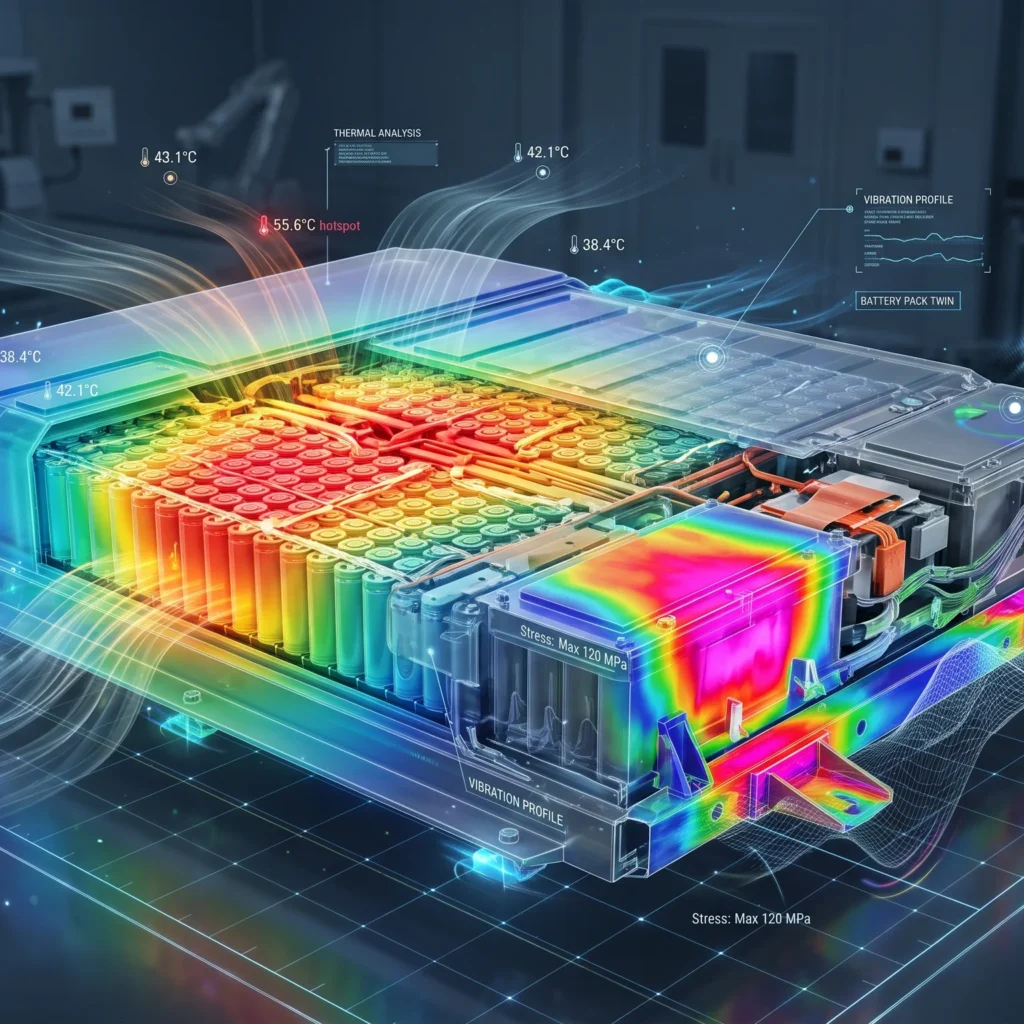
Consider an electric vehicle manufacturer designing a next generation battery pack. Building and crash testing fifty physical battery prototypes could cost millions of dollars and take over a year.
Instead, battery engineers start with a multi physics simulation. They model how individual lithium ion cells heat up during ultra fast charging in freezing winter temperatures and scorching desert heat. Next, they simulate severe road vibrations over 150,000 miles and model what happens if a sharp metal object punctures the battery casing during a highway collision.
Inside the computer, engineers discover that a specific cooling channel allows heat to build up near the rear battery module during rapid charging. They redesign the cooling plate digitally in two days and verify that temperatures stay within safe limits.
Only after the virtual design passes thousands of stress tests does the company build physical prototypes for laboratory thermal chambers and real crash tests. Simulation caught the flaw early, while physical testing proved the final design was truly safe for drivers.
Expert Interpretation: What the Technology Really Means
The true power of Simulation Before Reality is not just creating impressive 3D graphics. Its real value lies in improving human decision making under uncertainty.
Every major engineering project, medical procedure, or business launch involves blind spots. Simulation forces teams to turn vague assumptions into clear mathematical rules. When a simulation behaves unexpectedly, it reveals gaps in our own understanding of how a system works.
However, simulation accuracy depends entirely on three pillars: the quality of input data, the honesty of model assumptions, and sound human judgment. A visually stunning simulation built on flawed data simply produces confident mistakes faster. Experienced leaders treat simulation outputs as informed guidance, never as infallible prophecy.
What Does the Data Tell Us?
Hard numbers from credible institutions show both the high cost of physical guesswork and the measurable gains of simulation:
- The Cost of Unplanned Downtime: According to research published by the National Institute of Standards and Technology (NIST), unplanned equipment downtime in U.S. discrete manufacturing accounts for roughly 8.3 percent to 13.3 percent of planned production capacity, costing an estimated $245 billion annually. This figure measures lost output and maintenance expenses, demonstrating why predictive digital twins that spot failures early carry huge financial value.
- Rapid Growth in Digital Twin Adoption: Industry analysis by Fortune Business Insights (2025) valued the global digital twin market at approximately $24.5 billion in 2025, projecting strong double digit annual expansion toward the end of the decade. It is important to note that market projections represent analyst estimates of software and service spending rather than guaranteed future revenue.
- Manufacturing Efficiency Gains: Documented industrial case studies, including Siemens’ electronics manufacturing facility in Erlangen, Germany, reported 69 percent higher labor productivity and 42 percent lower energy consumption after integrating digital twin simulations into production planning.
While industrial manufacturing data is robust, researchers note an evidence gap in long term clinical outcomes for patient specific medical twins, where large scale multi year trials are still underway.
Advantages and Limitations
Key Advantages
- Reduced Development Costs: Catching design flaws in software avoids expensive physical tooling changes.
- Safer Experimentation: Dangerous scenarios like chemical leaks, structural collapses, or surgical complications happen safely on screen.
- Faster Product Development: Parallel virtual testing compresses years of trial and error into weeks.
- Better Resource Utilization: Companies waste less raw material, electricity, and fuel during testing.
Key Limitations
- Poor Quality Data: Missing or biased sensor readings distort simulation results.
- Inaccurate Assumptions: If engineers forget a real world variable, the model will miss it too.
- High Computing Costs: Ultra detailed physics simulations still require expensive cloud computing power.
- Cybersecurity Risks: Connected digital twins create new digital entry points that hackers could target to disrupt physical factories or power grids.
Common Misconception
A widespread myth suggests that once computer simulations become powerful enough, physical testing will disappear completely.
In reality, no computer model can capture every microscopic imperfection of the physical world. Real materials contain tiny structural flaws, real weather shifts unpredictably, and real human users behave in surprising ways. Organizations like IEEE and MIT consistently emphasize verification and validation, proving that virtual models must always be anchored to physical reality through real world testing and human oversight.
What Should Readers Do Next?
Whether you are studying, building products, or leading a company, you can start preparing for a simulation driven world today:
- Students: Build strong foundations in data analysis, Python programming, basic physics, and computational thinking. Explore open source simulation tools to see how equations model real movement.
- Engineers and Researchers: Focus on verification and validation skills. Learn how to connect live sensor data with physics based models rather than relying on isolated spreadsheets.
- Business Owners: Identify your most expensive operational bottleneck, such as supply chain delays or equipment breakdowns, and run small pilot simulations before making large capital investments.
- Technology Professionals and Organizations: Audit your data quality first. Clean, well organized operational data is the essential fuel required before deploying AI or digital twin platforms.
(Internal Reading Suggestions for KritiInfo.com: Explore our related guides on Artificial Intelligence Trends in Engineering, Industrial IoT Sensors Explained, and Predictive Analytics for Modern Businesses in the AI and Technology category.)
Conclusion: Predict Better, Build Smarter
Human progress has always depended on trial and error. For centuries, however, every error carried a heavy price in wasted materials, lost time, or human safety.
By embracing Simulation Before Reality, we shift trial and error from the physical world into the digital world. As computing power, sensor networks, and AI converge toward 2027, the organizations and innovators who thrive will not simply be those who build the fastest. The future belongs to those who learn to test possibilities wisely before turning them into reality.
If you could simulate one major decision in your career, business, or industry before taking action in the real world, what would you test first? Share your thoughts in the comments below.
Frequently Asked Questions (FAQs)
1. What does Simulation Before Reality mean? Simulation Before Reality is the practice of testing ideas, designs, and decisions inside a computer generated environment before building physical prototypes or taking real world action. It helps identify risks and improve performance safely and affordably.
2. How does AI improve computer simulation? Artificial intelligence accelerates simulations by learning complex physical patterns from historical data. Instead of waiting days for traditional equations to calculate results, AI models can predict outcomes and test thousands of design options in seconds.
3. What is the difference between simulation and a digital twin? A standard simulation tests hypothetical scenarios using fixed data and mathematical rules. A digital twin is connected to a real physical object through live sensors, continuously updating its virtual model to reflect real time conditions.
4. Can simulation replace physical testing? No. Simulation reduces the number of physical prototypes needed, saving time and money, but physical testing remains essential to confirm that real materials and environments behave as predicted.
5. How is simulation used in healthcare? Doctors use 3D anatomical models built from patient scans to rehearse complex surgeries before entering the operating room. Researchers also use virtual patient populations to test drug safety and dosage strategies.
6. Which industries benefit most from simulation technology? Aerospace, automotive manufacturing, healthcare, energy grids, urban planning, robotics, and supply chain logistics gain enormous value because physical mistakes in these fields are expensive or dangerous.
7. What skills are required to work in simulation technology? Valuable skills include data analysis, programming (such as Python or C++), statistics, AI fundamentals, physics based modelling, and domain knowledge in fields like mechanical engineering or biology.
8. Will simulation technology become more important in 2027? Yes. Faster AI assisted modelling, cheaper cloud computing, and widespread industrial sensors are making advanced simulation accessible to smaller businesses, hospitals, and researchers by 2027.