
Meera is a team lead at a mid size software company. Her salary is good. Her title is respected. Her health insurance is better than most.
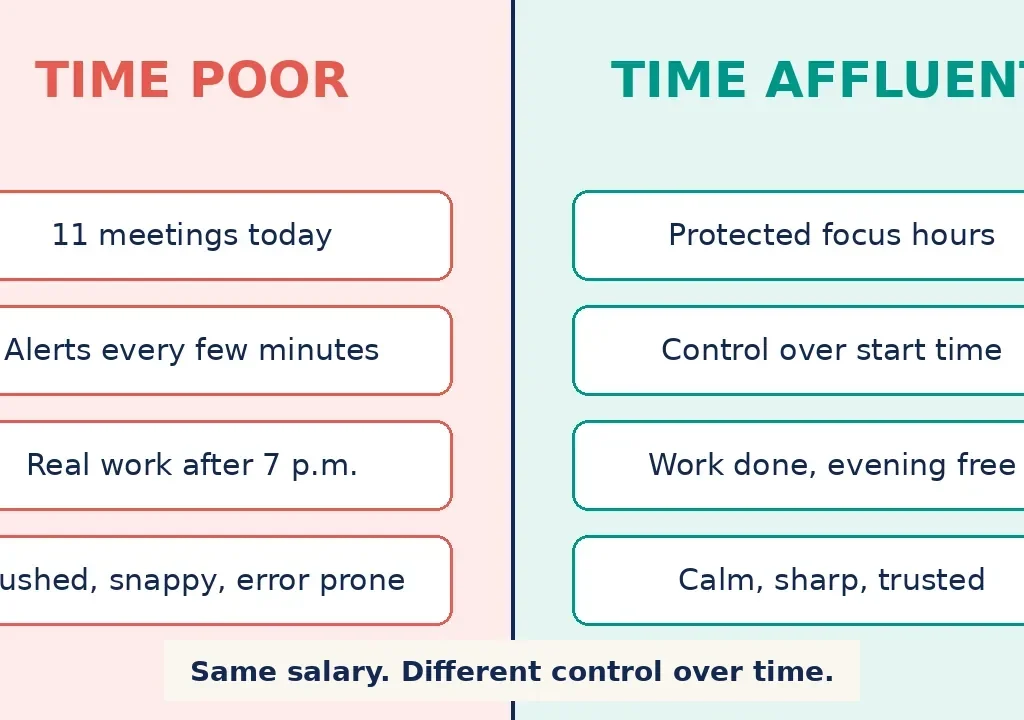
Yet her calendar shows eleven meetings today. Her phone buzzes every four minutes. Her real work starts at 7 p.m., after everyone else has logged off. By Friday, she cannot remember the last time she cooked dinner at home. (Hypothetical story, based on common workplace experience.)
Then her mistakes begin. A wrong number in a report. A missed client mail. A snapped reply in a meeting. Her manager, Arun, notices. He expects to find a performance problem. Instead, he finds a time problem.
Arun tries something unusual. He cancels two recurring meetings and blocks four quiet hours every morning. He tells Meera she can finish her work any time before the deadline. No bonus. No raise. Just ownership of her day.
Did it work? To answer, we need to look at why time affluence as a reward is catching the attention of researchers, and why it can beat another bonus in some cases.
Table of Contents
What Time Affluence Really Means
Time affluence means feeling you have enough time for the things that matter to you. It is a feeling, not a number on a clock.
Picture two people with two free hours on Sunday. One chooses how to use them. The other keeps checking messages. Both have free time. Only the first has time affluence.
Its opposite is time poverty, the constant feeling of being rushed. Many employees feel time poor even with good salaries, because their control over their day is low.
Why Time Affluence as a Reward Can Beat Another Bonus
A bonus is spent in a day and forgotten in a month. Control over time is felt every morning. Research supports this direction, though not every claim.
Buying time makes people happier. A 2017 PNAS paper by Whillans and colleagues surveyed more than 6,000 adults in four countries. In a field experiment with 60 working adults, people felt happier after a time saving purchase than after a material one.
Choosing time over money is linked to happiness. Hershfield, Mogilner and Barnea (2016) found that people who prefer time over money tend to be happier. Be careful: this evidence shows a link, not proof of cause.
Overwork has a real health cost. A WHO and ILO study estimated that long working hours led to 745,000 deaths from stroke and heart disease in 2016. Working 55 or more hours a week was linked to a 35% higher risk of stroke and a 17% higher risk of dying from heart disease, compared with 35 to 40 hours.
What this means for managers: Time is not a soft perk. It touches health, focus and trust. But these studies are about individuals, not company policies. They show time matters, not that it will fix your business.
Time Rewards vs Financial Rewards
Neither is always better. Each works in different situations.
| Choice | Where it works | Where it fails |
|---|---|---|
| Financial bonus vs extra personal time | Bonus: workers under real money stress. Time: workers who already earn enough. | Bonus: fades fast. Time: useless if pay is unfair. |
| Promotion vs schedule autonomy | Promotion: ambitious staff wanting status. Autonomy: staff wanting control. | Promotion: fewer roles exist. Autonomy: not every job can flex. |
| Extra leave vs flexible hours | Leave: staff needing full rest. Flexibility: staff with daily duties. | Leave: unused if workload stays high. Flexibility: can turn into “always on”. |
| Material gifts vs less unnecessary work | Gifts: quick thank you. Less work: staff buried in admin. | Gifts: soon forgotten. Less work: hard if goals stay the same. |
| Long hours vs results focus | Long hours: some fixed presence jobs. Results focus: knowledge work. | Long hours: burnout. Results focus: needs clear goals. |
The lesson: use time as an addition to fair pay, never a substitute.
The TIME Reward Model
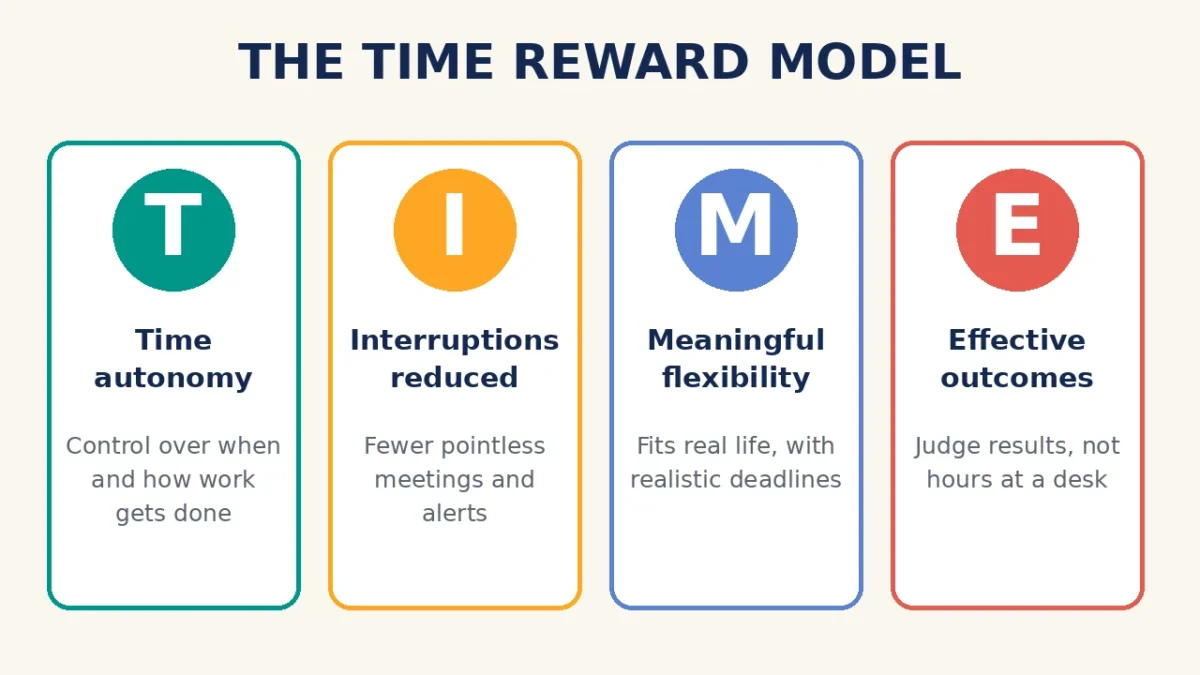
Here is a simple four part model any manager can use.
T: Time Autonomy
Give people reasonable control over when and how they finish work. Start small: a flexible start time, or two meeting free mornings.
Measure it: Ask staff monthly, “How much control do you have over your day, from 1 to 10?”
Avoid misuse: Autonomy over how work is done is not the same as extra work dumped on someone.
I: Interruptions Reduced
This is the cheapest reward. Cut meetings with no decision, extra people copied on mails, and pointless reports.
Measure it: Count meeting hours per person each week before and after.
Avoid misuse: Do not remove meetings and then add three chat groups.
M: Meaningful Flexibility
Flexibility must match real life: school pickups, medical visits, travel. Realistic deadlines are part of this. A flexible schedule with an impossible deadline is a trap.
Measure it: Track how often deadlines are met without late night work.
Avoid misuse: Flexible does not mean available at all hours.
E: Effective Outcomes
Judge people by results, not hours seated. Write down what a good result looks like.
Measure it: Quality, timelines, customer feedback and error rates.
Avoid misuse: Do not keep the old attendance habit and add the new flexibility on top.
Three Real World Examples
Example 1: Replacing Meetings with Written Updates (Hypothetical)
Problem: A 40 person marketing team spends nine hours a week in status meetings.
Decision: The manager replaces them with a five line written update.
Employee benefit: Long quiet blocks for deep work.
Business benefit: Fewer errors from broken focus.
Risk: Problems may hide in writing. Keep a short check in for urgent issues.
Example 2: Hybrid Work at Trip.com (Real, verified)
Problem: Trip.com, a large travel technology company, wanted to cut resignations without hurting performance.
Decision: Researchers Bloom, Han and Liang ran a six month randomised trial with 1,612 employees. Some worked from home two days a week. Others stayed in the office five days.
Employee benefit: Higher job satisfaction and better work life balance.
Business benefit: Quitting fell by one third, from 7.2% to 4.8%, and performance reviews showed no harm. Trip.com then offered hybrid work company wide.
Risk: The drop was only among non managers, at one technology company. It may not fit factories or shops.
Example 3: A Paid Day Off for a Hard Target (Hypothetical)
Problem: A small design agency faces a tough deadline.
Decision: The owner offers one extra paid day off if the project ships on time and passes quality checks.
Employee benefit: Real rest they can plan around.
Business benefit: A clear shared goal and team spirit.
Risk: Teams may rush or hide mistakes. Tie the reward to quality too.
A Larger Real Test: The UK Four Day Week Pilot
In 2022, about 2,900 workers at 61 UK companies worked a shorter week with no pay cut. After six months, 56 companies (92%) said they would continue, and 18 made it permanent. Cambridge researchers reported that 71% of employees felt less burnout.
Companies chose to join, and campaign groups helped run the trial, so results may look better than in a random group of firms. It is encouraging evidence, not proof.
How Different Workplaces Can Use Time Rewards
Small businesses: Offer meeting free afternoons or a flexible start time. They cost little.
Large corporations: Write clear rules so flexibility does not depend on whom the boss likes.
Startups: Hidden overwork is the risk. Protect weekends in writing.
Remote and hybrid teams: Agree on core overlap hours and respect time zones.
Factories, service and support jobs: Fixed shifts cannot move, but you can offer shift swaps, rosters shared early, protected breaks, or a paid day off for hitting a safety or quality goal.
If a role cannot flex when, return time or control in another way.
Seven Steps to Roll It Out
- Find the biggest sources of time pressure. Look at calendars, ticket queues and overtime logs.
- Ask employees what wastes their time. They know. Use a short anonymous form.
- Review workload and meetings. If workloads are too high, flexibility alone will fail.
- Introduce suitable time benefits. Pick one or two, not ten.
- Define clear performance expectations. Say exactly what good results look like.
- Measure employee and business results. Track both happiness and output.
- Review and improve. Fix what is not working every quarter.
Advantages and Limits
Possible advantages: better satisfaction, more control, less stress, sharper focus, stronger trust, and possibly better retention.
Possible limits: shift work is hard to flex, access may be unequal, and workload can be squeezed into fewer hours.
How to handle them: publish clear rules, offer fair alternatives to fixed shift staff, and fix workload first. A time reward on a broken workload is only decoration.
Also know the difference between autonomy and transferred responsibility. Real autonomy means you decide how to meet a fair goal. Fake autonomy means the same goal with less time and support. Employees notice, and trust falls.
Five Common Myths
Myth 1: More free time automatically means higher productivity. Not always. Time helps only if it removes stress and adds focus.
Myth 2: Flexible working means working whenever you like. No. Good policies set core hours, deadlines and handover rules.
Myth 3: Time affluence as a reward can replace a fair salary. No. The research involves people who can already cover basics. Underpaid staff need better pay first.
Myth 4: Everyone wants the same kind of flexibility. No. A parent, a student and a night owl want different things. Ask first.
Myth 5: Giving autonomy means managers lose control. Managers lose control of hours, not results. In the Trip.com trial, managers expected harm, but their views changed by the end.
Your 30 Day Experiment
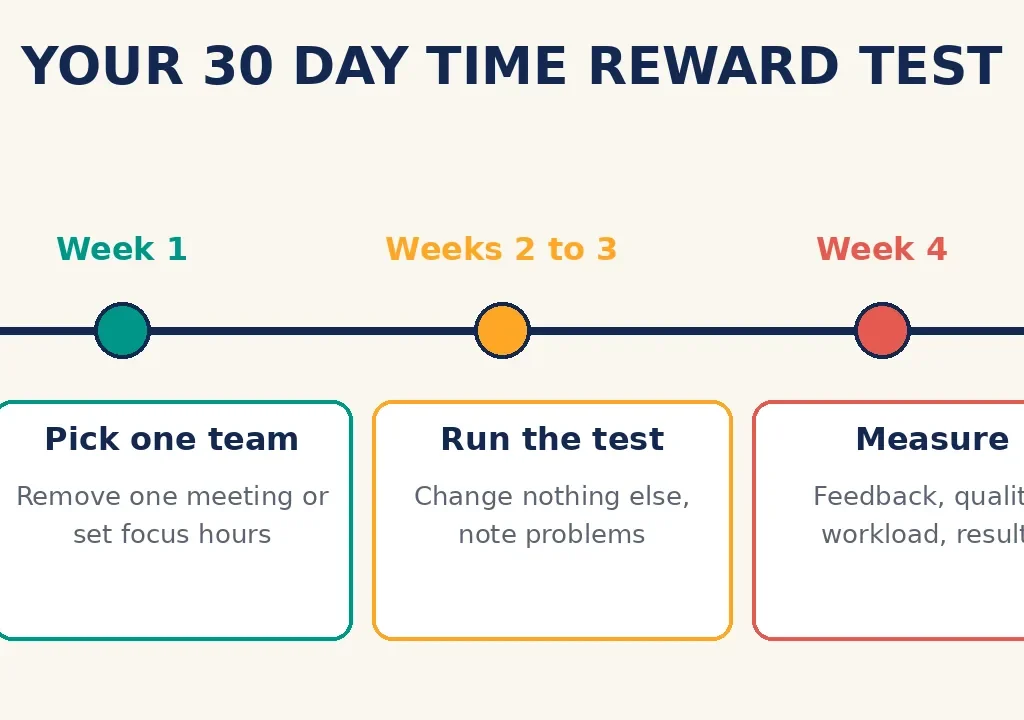
You do not need a big policy. Try this small test of time affluence as a reward:
- Week 1: Choose one team. Remove one unnecessary recurring meeting, or set protected focus hours for two mornings a week.
- Weeks 2 to 3: Keep everything else the same. Note any problems.
- Week 4: Compare. Ask staff how control over time feels. Check task completion, quality, workload and customer results.
If results hold while stress drops, expand slowly. If not, change one thing at a time.
Frequently Asked Questions
1. What is time affluence in the workplace? It is the feeling of having enough time, and enough control over it, to do your job and live well.
2. Why should employers consider time affluence as a reward? Time affluence as a reward can improve wellbeing and loyalty at low cost. Cutting needless meetings costs far less than a raise.
3. Is time more valuable than money for employees? It depends. Studies link valuing time with happiness, but mostly among people with enough income. If someone struggles to pay bills, money may matter more.
4. How can managers reward employees with more personal time? Use focus hours, flexible start times, fewer meetings, shift choice, or a paid day off for a clear achievement.
5. Does time autonomy improve workplace productivity? Evidence is encouraging but mixed. In the Trip.com trial, performance did not fall. Clear goals and fair workloads still matter.
6. How can businesses introduce time based benefits? Start with a small test, ask what wastes employees’ time, and measure after 30 days. Time affluence as a reward grows best from small, measured steps.
7. What are the limits of time based rewards? They are hard in fixed shift jobs, feel unfair if access is unequal, and fail if workload stays too high.
Conclusion
Go back to Meera. Arun did not give her a bonus. He gave her back her mornings, and her evenings followed. Her mistakes dropped and her ownership returned. (The story is hypothetical, but the pattern is real.)
This is the heart of time affluence as a reward. A good organisation should not only pay people for giving their time. It should also respect their need to own some of it.
Money still matters. But the next time you plan a reward, ask a different question. What if the most meaningful reward is not more money, but more ownership of time?