
Imagine travelling through the sky at five times the speed of sound. The aircraft is moving so fast that the air entering its engine becomes hotter than the temperature inside many industrial furnaces.
How can an engine survive such heat?
This is one of the biggest challenges in advanced aerospace engineering. Scientists and engineers have been looking for ways to control extreme temperatures without adding too much weight to an aircraft.
One fascinating idea is the SABRE Engine Precooler (Aerospace). It is a special cooling system designed to remove heat from incoming air incredibly quickly. Its purpose is to help a revolutionary engine use atmospheric air at very high speeds.
The idea sounds almost like science fiction. But an important part of this technology has already been tested on the ground.
Let’s understand how it works, why it matters, and whether it could change the future of space travel.
Table of Contents
1. What Is the SABRE Engine Precooler?
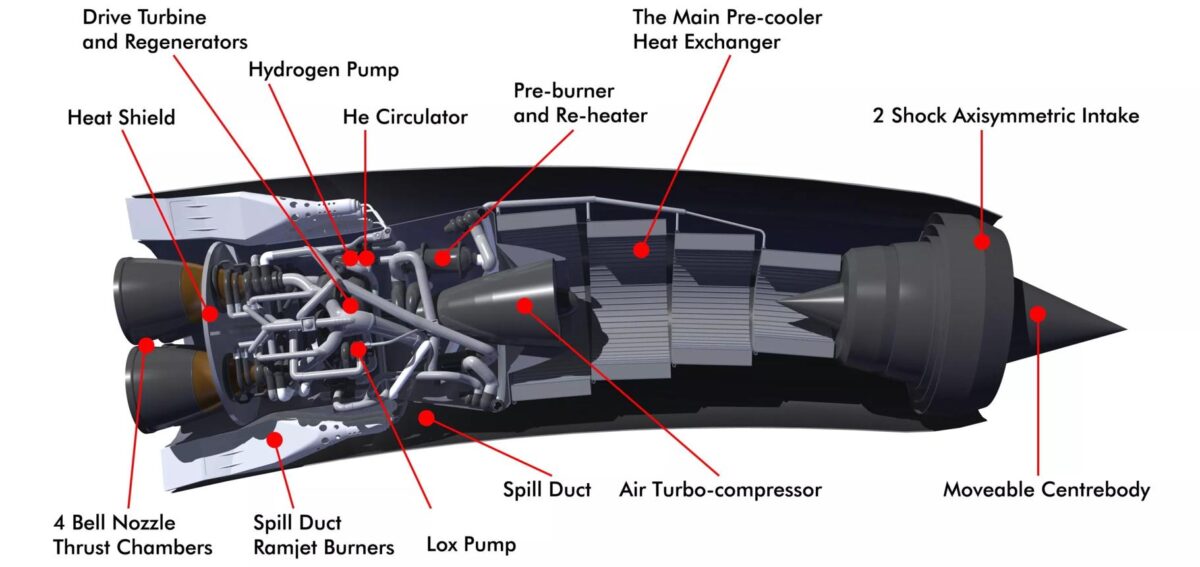
SABRE on course to chill SKYLON into orbit
SABRE stands for Synergetic Air-Breathing Rocket Engine.
It is a proposed engine designed to work in two different ways:
- First, it uses oxygen from the surrounding air, like an aircraft engine.
- Later, it carries and uses its own liquid oxygen, like a rocket.
This combination is the interesting part.
Ordinary rockets must carry their oxygen from the beginning. That adds considerable weight. An air-breathing engine can use oxygen already present in the atmosphere.
However, there is a problem. At extremely high speeds, incoming air becomes very hot when it slows down inside the engine.
The SABRE precooler is designed to solve this problem.
Think of it as a very powerful radiator. A car radiator removes heat from a hot engine. The SABRE precooler removes heat from extremely hot incoming air.
But it does this under much more demanding conditions.
Remember: The precooler is only one component of the proposed SABRE engine. It is not a complete engine by itself.
2. Why Does Air Become So Hot?
Think about putting your hand outside a moving car. At ordinary road speeds, the air feels comfortable.
Now imagine an aircraft moving at several times the speed of sound.
When air enters the engine at such high speed, it is slowed and compressed. This process can increase its temperature dramatically.
At around Mach 5, the temperature of the incoming airflow can exceed 1,000°C under the relevant engine conditions.
That is hot enough to create serious problems for engine components.
Excessive heat can:
- Damage metal parts.
- Reduce compressor performance.
- Increase thermal stress.
- Make engine operation more difficult.
An engine needs air in suitable conditions to work efficiently. This is where precooling becomes important.
3. How Does the SABRE Precooler Work?
SABRE: A Hypersonic Precooled Hybrid Air-breathing Rocket Engine | GlobalSpec
The secret is a highly advanced heat exchanger.
A heat exchanger transfers heat from one substance to another without requiring them to mix.
The proposed SABRE system uses thousands of very small, thin-walled tubes. Cold helium flows through these tubes while hot incoming air passes around them.
Here is the process in simple steps.
Step 1: Air enters
The engine captures atmospheric air through its intake.
Step 2: Heat becomes a problem
As the aircraft approaches hypersonic speeds, the incoming airflow can reach extremely high temperatures.
Step 3: Rapid cooling begins
The hot air passes through the precooler. Heat moves through the thin tube walls into the helium.
Step 4: The helium carries the heat away
The helium circulates through a closed cooling system. Other heat exchangers and components help manage the heat.
Step 5: The engine receives cooled air
The cooled air can then enter the engine’s compression and combustion system.
The remarkable achievement is not simply cooling air. It is removing a huge amount of heat in a very small space and in an extremely short time.
4. What Makes This Technology Special?
The most impressive part of the SABRE Engine Precooler (Aerospace) is its ability to transfer heat very quickly.
In 2019, the European Space Agency (ESA) reported that Reaction Engines had tested its precooler under airflow conditions representing Mach 5.
During the ground test, the system cooled air hotter than 1,000°C in less than one-twentieth of a second.
That is an extraordinary engineering result. ESA+1
But there is an important distinction: this was a successful test of the precooler, not a demonstration of a complete SABRE engine flying an aircraft or reaching space.
Why use helium?
Helium is used as the cooling fluid in the proposed system.
It travels through thousands of small tubes and absorbs heat from the incoming air.
The heat is then managed through other parts of the engine’s cooling system.
Why not use ordinary water?
Water is useful in many cooling systems, but an aerospace engine needs a carefully designed cooling cycle that meets strict limits on weight, pressure, temperature, and performance. Helium is part of the proposed SABRE solution.
The tiny tubes also provide a large surface area through which heat can move.
This is similar to how a sponge has more surface area than a solid block of the same size.
5. SABRE vs Other Aircraft and Rocket Engines
Not every engine works in the same way. Some use oxygen from the atmosphere, while others carry their own oxygen.
| Engine | How it works | Main limitation |
|---|---|---|
| Jet engine | Burns fuel using atmospheric oxygen | Limited by its operating speed and temperature |
| Rocket engine | Carries fuel and oxidiser | Must carry its oxygen supply |
| Ramjet | Uses forward speed to compress incoming air | Cannot start from a standstill |
| Scramjet | Burns fuel while air flows at supersonic speed | Very difficult to control combustion and heat |
| SABRE concept | Combines air-breathing and rocket modes | Complex design and development |
What makes SABRE different?
It aims to use atmospheric oxygen during the early part of flight and switch to onboard liquid oxygen when the atmosphere becomes too thin.
This could reduce the amount of oxidiser that needs to be carried during the initial journey.
However, the system requires several advanced components to work together. The precooler is one important part of this design.
6. A Real-World Example: Imagine a Superfast Car
Imagine driving a car on a very hot summer day.
After a long journey, its engine becomes hot. The radiator helps remove that heat and keeps the engine within a safe temperature range.
Now imagine a machine that must remove heat from air entering an engine at temperatures above 1,000°C.
An ordinary car radiator would not be suitable.
The SABRE precooler uses a much smaller and more specialised heat exchanger, designed for extreme temperatures and demanding aerospace conditions.
There is another important lesson here.
Cooling is not just about making something cold. It is about moving heat from one place to another without making the whole system too heavy or inefficient.
That is why aerospace engineers must consider heat transfer, pressure loss, material strength, and weight together.
Where could it be useful?
If the wider technology becomes practical, it could support research into:
- Reusable space launch vehicles.
- High-speed aerospace engines.
- Advanced thermal management.
- Compact industrial cooling systems.
- New heat exchanger designs.
These are potential applications, not proof that commercial SABRE-powered aircraft are available.
7. Advantages and Limitations
Every promising technology has two sides.
Potential advantages
- It can cool extremely hot incoming air rapidly.
- It may improve the conditions under which an engine operates.
- It supports research into combined air-breathing and rocket propulsion.
- Its compact heat exchanger design may have uses beyond SABRE.
- It could contribute to future reusable space transportation.
Important limitations
- The complete engine is extremely complicated.
- The heat exchanger must remain strong and lightweight.
- Frost and water formation must be controlled.
- Pressure losses can reduce engine performance.
- Manufacturing and maintenance can be expensive.
- The complete propulsion system requires extensive testing.
A successful cooling component does not automatically mean that the complete engine will succeed.
8. The Important Question: What Happened to SABRE?
There is a development that readers should know about, especially when discussing New Tech 2027.
Reaction Engines Limited, the company that developed the SABRE concept, entered administration on 31 October 2024. Its official administrators were appointed through PwC.
More importantly, the latest Companies House record available on 21 November 2026 shows that the administration ended on 19 November 2026 and the company moved into creditors’ voluntary liquidation. GOV.UK+2
This is an important commercial setback.
It does not erase the earlier engineering achievements or prove that every technology developed by the company has become useless. However, it would be misleading to describe SABRE as a developing commercial engine that is certain to enter service in 2027.
The future of the technology depends on matters such as intellectual property, possible asset transfers, investment, further research, and the ability of another organisation to continue development.
This is a useful lesson for technology enthusiasts: scientific success and commercial success are two very different things.
9. Five Common Misconceptions
Myth 1: The precooler is an engine.
No. It is a heat exchanger designed to support the larger SABRE propulsion system.
Myth 2: It removes all heat.
No. It transfers heat away from the incoming air. The heat must still be managed elsewhere.
Myth 3: SABRE is an ordinary jet engine.
No. It is a proposed combined-cycle system with air-breathing and rocket operating modes.
Myth 4: SABRE has already taken passengers into space.
No. The reported precooler tests were ground-based demonstrations.
Myth 5: Cheap space travel is guaranteed by 2027.
No. That remains an unproven possibility, not an established achievement.
10. What Can Other Industries Learn?
The SABRE project offers a valuable lesson beyond aerospace engineering.
Modern machines often produce more heat than their cooling systems can easily manage.
Electric power systems, industrial equipment, high-performance computers, and advanced vehicles all need effective thermal management.
A compact heat exchanger that can transfer large amounts of heat with little weight could inspire new solutions in these fields.
However, each application needs its own testing. A technology that works under one set of conditions cannot automatically be assumed to work in another.
For students, this is an excellent example of how physics, mathematics, material science, and engineering come together to solve a real problem.
11. What Is the Future of the SABRE Precooler?
The future of this technology remains uncertain, but the engineering ideas are still interesting.
Researchers can continue exploring:
- Smaller and lighter heat exchangers.
- Better materials that withstand extreme temperatures.
- Improved cooling systems.
- More efficient heat transfer.
- New ways to reduce pressure losses.
A 2024 research paper published in Energies examined how the design and operating conditions of the SABRE precooler affect heat transfer and airflow. This shows that the engineering principles remain a subject of scientific study. MDPI+1
The bigger question is not simply how fast an aircraft can fly.
It is whether engineers can control the enormous heat created by that speed.
Perhaps the future of aerospace engineering will depend as much on controlling heat as on producing thrust.
12. Frequently Asked Questions
1. What is the SABRE Engine Precooler?
It is a specialised heat exchanger designed to cool extremely hot incoming air before it enters the proposed SABRE engine’s compressor. It uses a helium cooling system and thousands of small tubes to transfer heat rapidly.
2. How does the SABRE precooler work?
Hot air passes around small tubes containing cold helium. Heat moves through the tube walls into the helium, reducing the temperature of the incoming air.
3. Why does SABRE need a precooler?
At very high speeds, incoming air becomes extremely hot as it slows down inside the engine. The precooler helps bring the air temperature down to conditions suitable for the engine’s next stages.
4. How hot can the incoming air become?
Under the relevant Mach 5 operating conditions, the airflow can exceed 1,000°C. Reaction Engines demonstrated cooling of airflow at temperatures above this level during its 2019 ground tests.
5. Is SABRE better than a scramjet?
They have different designs and operating principles. SABRE combines air-breathing and rocket modes, while a scramjet burns fuel in supersonic airflow. Neither is automatically better for every application.
6. Is the SABRE engine operational in 2027?
There is no verified evidence that a complete commercial SABRE engine is operational. Reaction Engines entered administration in 2024 and moved into liquidation in November 2026.
7. Can SABRE make space travel cheaper?
It was designed with the potential to improve space access by using atmospheric oxygen during the early flight. However, lower launch costs have not been commercially demonstrated.
8. Can precooler technology help other industries?
Potentially, yes. Compact heat exchangers could have applications in aerospace, energy, industrial cooling, and other thermal management systems. Each application requires independent engineering validation.
Conclusion: Controlling Heat Could Change the Future
The SABRE Engine Precooler (Aerospace) represents an impressive example of human engineering.
Its central idea is simple: before an engine can use extremely hot incoming air effectively, engineers must find a way to control its temperature.
The 2019 ground demonstration showed that cooling airflow above 1,000°C in less than 0.05 seconds was technically achievable in the tested system.
That achievement deserves attention.
At the same time, the commercial difficulties faced by Reaction Engines remind us that a successful engineering demonstration is only one step towards a working transportation system.
SABRE may or may not become the foundation of future space travel. But its precooler offers an important lesson for the next generation of engineers.
Sometimes, the biggest breakthrough in making a machine faster is learning how to keep it cool.