
There is a moment after a serious fall when everything becomes strangely quiet.
The pain arrives first. Then the fear.
Something inside the body has changed.
A bone that was strong enough to carry weight, protect organs, and anchor muscles has suddenly cracked. To the person lying there, healing may seem like a distant event that begins only after a cast is applied.
But that is not what happens.
The repair operation begins almost immediately.
Deep beneath the skin, broken blood vessels release blood around the fracture. Immune cells arrive. Chemical signals begin communicating. New blood vessels start forming. Specialized cells move toward the damaged area. Over the following days and weeks, the body begins constructing a temporary biological bridge between the broken pieces.
This is the hidden story of Bone Repair.
And it is far more sophisticated than simply waiting for a broken bone to “join.”
Table of Contents
The Healing Battle Begins
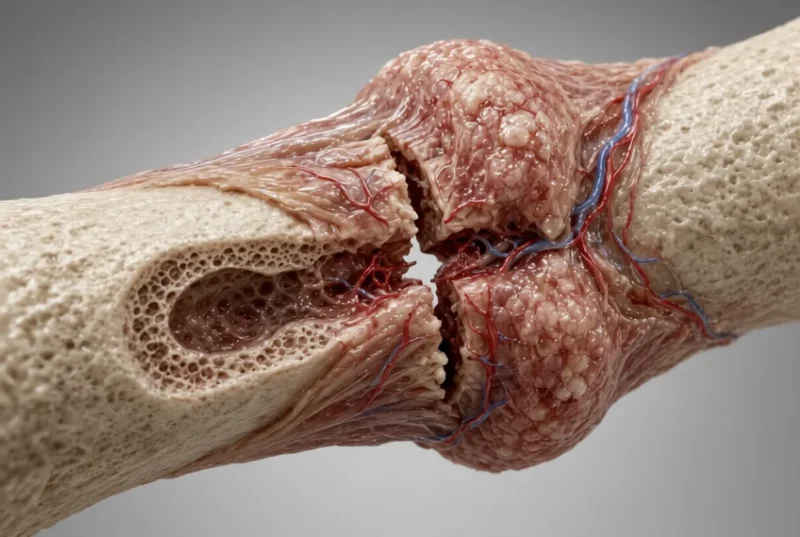
Imagine looking at a fractured bone through a microscopic 3D camera.
The clean architecture of healthy bone has suddenly become chaotic. Tiny blood vessels have ruptured. Bone cells have been damaged. The surrounding tissue is sending distress signals.
Then the first response begins.
A fracture hematoma, essentially a collection of blood around the injury, develops. This is not simply unwanted bleeding. It becomes part of the biological environment in which healing begins.
Inflammatory cells enter the area and release signals that help coordinate repair.
The body is not rebuilding blindly.
It is organizing a response.
Your Bone Builds a Bridge
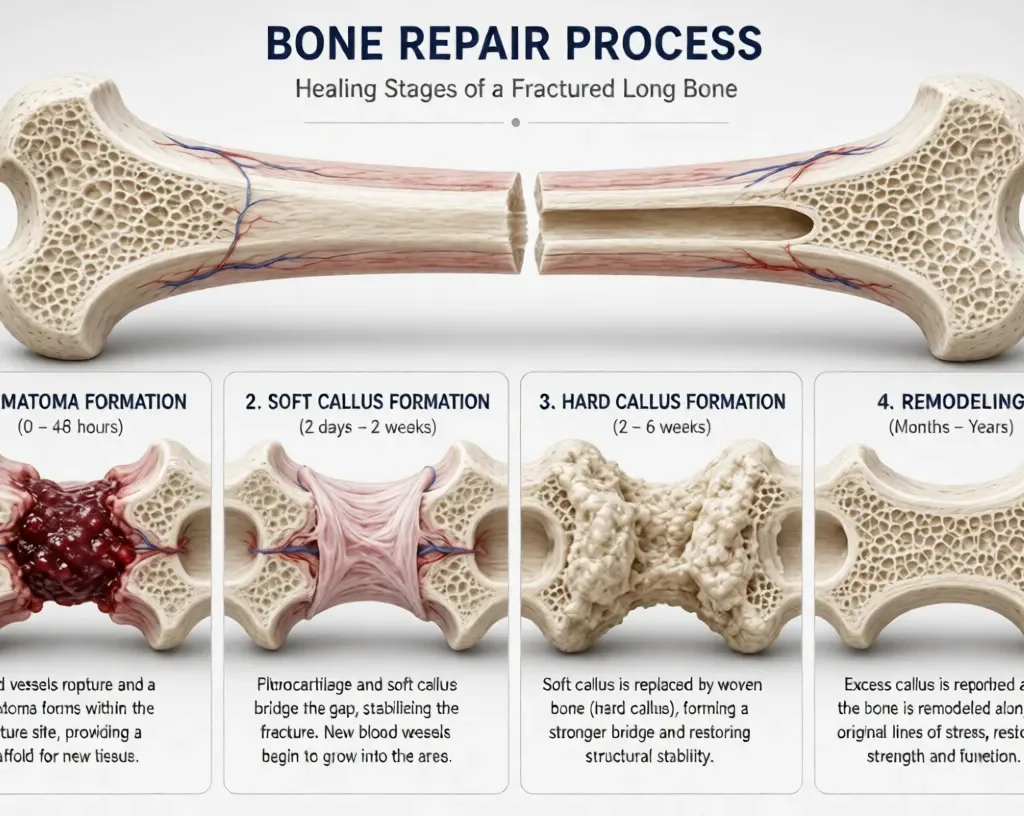
Bone healing generally progresses through overlapping stages rather than a perfectly separated sequence.
First comes inflammation. Then the body develops a soft callus around the fracture. That temporary tissue gradually becomes stronger and is replaced by harder bone. Finally, remodeling reshapes the newly formed bone.
Think of it as rebuilding a damaged bridge.
The first structure does not need to look beautiful.
It needs to stabilize the gap.
That principle helps explain why early healing tissue is not immediately as strong or organized as mature bone.
1. The First Response: Stop the Damage
Immediately after a fracture, blood vessels around the bone can rupture.
Blood collects at the injury site and forms the fracture hematoma. This creates an environment filled with signaling molecules and inflammatory cells.
Inflammation sometimes receives a bad reputation because people associate it with swelling and pain.
Yet controlled inflammation is part of normal healing.
The immune system helps clear damaged tissue and coordinates the next stages of repair.
The body is essentially saying:
“The damage has been detected. Begin reconstruction.”
2. A Soft Bridge Appears
As healing progresses, specialized cells begin producing new tissue around the fracture.
A temporary soft callus develops.
It is not yet the hard bone that eventually restores structural strength. Instead, it acts more like biological scaffolding.
Cartilage and fibrous tissue help bridge the damaged region.
If you could watch this process as a 3D animation, the fracture would no longer look like two isolated pieces. A developing biological bridge would gradually surround the gap.
This stage is fragile.
That is one reason following medical instructions about immobilization and activity matters.
The body can build the bridge, but it needs the right mechanical environment to do so effectively.
3. The Hard Callus Takes Over
Now the story becomes even more fascinating.
The temporary soft callus gradually becomes mineralized and transforms into harder bone.
Bone forming cells called osteoblasts play a central role in producing new bone tissue.
At the same time, the body is developing blood vessels that help supply the healing region.
This matters because bone is living tissue.
It needs oxygen, nutrients, blood supply, cells, and signaling systems.
The healing fracture is therefore not simply filling itself with calcium.
It is rebuilding a living structure.
4. Remodeling: The Final Sculptor
The new bone created during healing is not necessarily arranged exactly like the original.
That is where remodeling enters the story.
Two important cell types are involved in normal bone turnover.
Osteoblasts help form bone.
Osteoclasts help remove and resorb bone.
Working together, these cells gradually reshape newly formed bone.
Over time, the structure can become better adapted to the mechanical demands placed upon it.
Imagine a rough sculpture being handed to a master sculptor.
The major structure already exists.
Now the details have to be refined.
That is the essence of remodeling.
And it can continue for a considerable period after the fracture has clinically improved.
5. Nutrition Gives the Repair Team Materials
Here is the part many people underestimate.
A healing bone needs raw materials.
Protein is important because the body requires amino acids to build and maintain tissues. Calcium and phosphorus are important components of mineralized bone. Vitamin D contributes to normal calcium and phosphorus metabolism and supports skeletal health.
Other nutrients, including magnesium and several vitamins, also participate in normal bone and tissue function.
But this does not mean that taking large quantities of supplements automatically produces faster Bone Repair.
More is not always better.
A sensible approach is to maintain a balanced diet and discuss supplementation with a healthcare professional when dietary intake, deficiency, medications, age, or medical conditions make it relevant.
Food is not a magic switch.
It is part of the environment in which recovery occurs.
6. What Can Slow Bone Repair?
Sometimes the body begins the repair process but struggles to complete it effectively.
Several factors can influence healing.
These may include:
- Poor blood supply to the injured area
- Severe or complicated fractures
- Infection
- Smoking
- Excessive alcohol consumption
- Certain medical conditions
- Nutritional deficiencies
- Some medications
- Older age
- Inadequate stabilization
- Problems with following the prescribed recovery plan
Smoking deserves particular attention because tobacco exposure can interfere with blood supply and other biological processes important for bone healing.
This is not a minor detail.
A fracture needs a functioning biological environment.
If that environment is compromised, the repair operation can become slower or less predictable.
7. Rehabilitation Turns Healing Into Recovery
A healed bone is not necessarily the same thing as a fully recovered person.
After immobilization, muscles may have weakened. Joints may feel stiff. Balance and movement patterns may have changed.
That is where rehabilitation becomes important.
Depending on the injury, healthcare professionals may recommend carefully progressed movement and strengthening exercises.
The key word is progressed.
Trying to prove strength too early can be counterproductive.
Recovery is not a race against the calendar.
It is a process in which biological healing and functional rehabilitation have to work together.
Case Study: The Fracture That Changed the Way Recovery Was Seen
Representative educational example
A person in their middle age falls and fractures a wrist.
The first few days are dominated by pain and uncertainty. After medical assessment and stabilization, the patient assumes that the main task is simply to wait for the bone to join.
Weeks later, something becomes clear.
Healing has been happening all along.
The fracture site has passed through inflammatory changes. New tissue has developed around the damaged area. The body has gradually strengthened the repair.
At the same time, the patient has had to pay attention to nutrition, follow medical instructions, attend follow up appointments, and eventually participate in appropriate rehabilitation.
The emotional challenge is real.
Recovery can feel painfully slow when the injury is no longer dramatic but normal movement has not yet returned.
Understanding Bone Repair changes that perspective.
The patient is no longer simply waiting.
The body is rebuilding.
The Warning Signs
Most fractures require professional assessment, and some require urgent treatment.
A person recovering from a fracture should follow the instructions provided by their healthcare team and report concerning changes rather than attempting to diagnose the problem alone.
Seek medical advice if there is worsening pain, increasing swelling, unusual redness or warmth, drainage, fever, new numbness, significant color changes, or other symptoms that seem inconsistent with the expected recovery.
A fracture that does not appear to be progressing normally also deserves professional evaluation.
The important principle is simple:
Do not guess when healing appears to be going wrong. Get it assessed.
The Myths That Can Mislead Recovery
“A cast alone heals the bone.”
A cast or other stabilization method can help maintain the appropriate position and protect the injury, but Bone Repair is a biological process occurring inside the body.
“Calcium automatically makes a fracture heal faster.”
Calcium is important for bone health, but taking excessive calcium does not guarantee faster fracture healing.
“Pain disappearing means the bone is completely healed.”
Not necessarily.
Symptoms and biological healing do not always progress at exactly the same speed.
“More exercise means faster recovery.”
Not necessarily.
Exercise must be appropriate for the injury and stage of recovery. A healthcare professional can determine when and how activity should progress.
Can Vitamin D Help?
Vitamin D is important for normal calcium and phosphorus metabolism and therefore has an important relationship with skeletal health.
However, treating every fracture with high dose vitamin D without knowing whether supplementation is necessary is not a sound approach.
If deficiency is suspected or a person has risk factors for inadequate vitamin D, discussing testing and supplementation with a healthcare professional can be appropriate.
The goal is not to chase a miracle nutrient.
The goal is to create conditions that support normal physiology.
Why Sleep and Patience Matter
Recovery can be frustrating.
The cast comes off, yet movement may still feel strange. The pain improves, but confidence has not returned. A person may look healed to everyone else while still feeling vulnerable.
That psychological gap is real.
Adequate sleep, sensible nutrition, appropriate activity, and patience can all become part of a sustainable recovery routine.
This is where patience becomes part of treatment.
The body cannot be bullied into completing Bone Repair overnight.
Biology has its own timetable.
How Long Does Bone Repair Take?
There is no single timetable that applies to every fracture.
Healing depends on factors such as the type and location of the fracture, its severity, blood supply, age, overall health, smoking status, nutrition, treatment, and whether complications develop.
Some fractures heal relatively quickly.
Others take much longer.
That is why comparing your recovery with someone else’s can create unnecessary anxiety.
Two fractures can look similar on an X ray and still have very different healing circumstances.
FAQs
What is Bone Repair?
Bone Repair is the biological process through which the body responds to a fracture, forms temporary repair tissue, creates new bone, and gradually remodels that bone.
How long does a broken bone take to heal?
Healing time varies substantially depending on the fracture and the individual. Your healthcare professional can provide a more meaningful estimate based on the specific injury.
What nutrients support Bone Repair?
Adequate protein, calcium, phosphorus and vitamin D are important to normal bone health. A balanced diet is generally more useful than relying on high dose supplements without medical guidance.
Can smoking slow fracture healing?
Yes. Smoking can negatively affect biological processes and blood supply involved in bone healing.
Does vitamin D help bones?
Vitamin D supports normal calcium and phosphorus metabolism and is important for skeletal health. Supplementation is most appropriate when dietary intake, deficiency, or individual medical circumstances justify it.
Can exercise help after a fracture?
Appropriately prescribed rehabilitation can help restore movement, strength and function. The timing and intensity should be appropriate for the particular fracture.
Why do some fractures heal slowly?
Poor blood supply, severe injury, infection, smoking, certain medical conditions, nutritional problems and other factors can contribute to delayed healing.
When should I contact a healthcare professional?
Contact your healthcare team if symptoms worsen, new concerning symptoms develop, or recovery does not appear to be progressing as expected.
The Hidden Victory Inside the Bone
A fracture looks like an ending.
Biologically, it is the beginning of an extraordinary reconstruction.
Blood arrives.
Signals spread.
Immune cells coordinate.
New tissue forms.
Osteoblasts build.
Osteoclasts reshape.
Blood vessels support the developing tissue.
And slowly, almost invisibly, the damaged architecture begins to regain its structure.
Your body does not simply wait for the cast to come off.
It works continuously beneath it.
That is what makes Bone Repair so remarkable.
But remarkable does not mean effortless. The body needs time, protection, adequate nutrition, appropriate rehabilitation, and professional medical care when complications arise.
If you are recovering from a fracture, give the biological process the respect it deserves. Follow your healthcare professional’s instructions, nourish your body sensibly, avoid behaviors that can interfere with healing, attend recommended follow up appointments, and ask questions when something does not seem right.
Because beneath the quiet surface of recovery, a remarkable rebuilding operation may already be underway.
Healing is not passive. Bone Repair is an active biological journey.
Medical Note
This article is for general educational purposes and does not replace diagnosis or treatment from a qualified healthcare professional. Fracture management depends on the type, location, severity and individual circumstances of the injury.
Fantastic post.. keep it up