

Low Orbit Satellite Latency :Imagine a remote coastal clinic bracing for a sudden, catastrophic storm. The regional power grid has already failed. A local medic is trying to stabilize a patient with severe trauma, but she desperately needs a surgical specialist to guide her hands via a live video feed. She activates a traditional backup satellite dish. The connection establishes, but the video freezes constantly. Every critical movement on the screen is heavily delayed. The specialist speaks, but the voice arrives a full second late. The delay is confusing, frustrating, and potentially fatal.
Then, she switches to a newer, smaller terminal communicating with a different network in the sky. Within moments, the video snaps into crystal clear, real-time focus. The specialist is practically standing in the room. The frustrating delay vanishes, the medical procedure proceeds safely, and a life is saved.
What if the distance between an isolated community and the digital world is no longer measured in kilometres, but in milliseconds?
This scenario highlights a profound shift in modern telecommunications. To understand if this technology can genuinely fix our global connectivity crisis, we must look closely at a very specific metric: low orbit satellite latency. Let us explore whether this breakthrough is a true equalizer for the digital divide, or if other hidden barriers will continue to leave millions behind.
Table of Contents
The Village Beyond the Signal
For years, we have defined the digital divide simply as the gap between those who have internet access and those who do not. However, the reality is much more complicated. Today, the divide is often about the quality, reliability, and speed of that connection.
A student in a rural farming community might technically have an internet connection. Yet, if that connection takes five minutes to load a single webpage, they are effectively shut out of modern digital life. They experience profound isolation and frustration while watching their urban peers access limitless educational resources. Conventional broadband relies on physical cables—fibre optics or copper wires—which are incredibly expensive to run across mountains, deserts, and vast rural plains. Telecommunication companies rarely see a profitable reason to lay miles of cable for a handful of remote homes.
Unpacking Low Orbit Satellite Latency
To understand how we can bypass physical cables, we must demystify how space-based internet works.
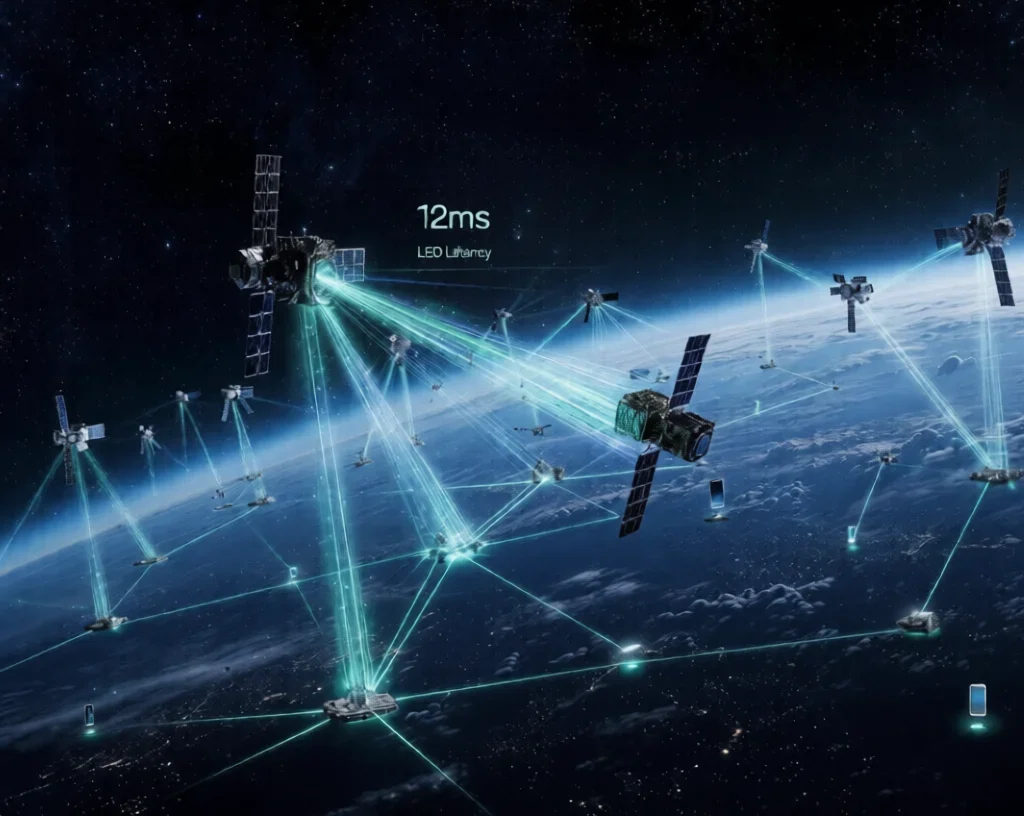
Traditional satellite internet relies on Geostationary Earth Orbit (GEO) satellites. These massive machines sit approximately 35,000 kilometres above the Earth. Because the data has to travel such an incredible distance up into space and back down again, it takes time. This travel time is called latency.
In contrast, a Low Earth Orbit (LEO) satellite flies much closer to the ground, typically between 500 and 1,200 kilometres above the surface. Because the physical distance is drastically reduced, the data arrives much faster. This fundamental reduction in travel time is the core definition of low orbit satellite latency. When the data has less physical space to cross, the connection feels immediate and responsive.
Why Latency Matters to Real People
When evaluating internet connections, people usually talk about bandwidth (speed). Bandwidth is like the width of a water pipe; it determines how much data can flow at once. Latency, however, is the water pressure; it determines how fast that data actually hits your device.
You can have excellent bandwidth but terrible latency. If you are just downloading a large email attachment, high latency is annoying but manageable. But modern digital life requires interaction. Video calls, remote stock trading, interactive online learning, and telemedicine all require data to move back and forth instantly. Without low orbit satellite latency, a video call becomes an awkward mess of people talking over each other.
By achieving latency levels that rival ground-based fibre connections, LEO networks allow remote users to participate in real-time digital ecosystems for the very first time.
Reaching the Unreachable
Geography has always dictated destiny. Islands, dense forests, and mountainous terrains physically block traditional digital infrastructure. Space-based connectivity ignores terrestrial geography entirely.
As long as a community has a clear view of the sky and a receiver dish, they can connect to the digital world. This is a massive breakthrough for disaster relief. When earthquakes or floods destroy local cell towers and fibre cables, emergency workers can deploy a satellite terminal in minutes. The reliable low orbit satellite latency ensures that rescue teams can coordinate life-saving logistics securely and transparently, without the terrifying communication blackouts of the past.
Transforming Education, Healthcare, and Enterprise
The practical impact of this technology extends far beyond basic web browsing.
Education: Remote students no longer have to rely on outdated textbooks or slow, text-only websites. With improved low orbit satellite latency, a child in a rural village can participate in a live, interactive video classroom with a teacher located hundreds of miles away.
Healthcare: Telemedicine becomes a viable, trustworthy option. Doctors can monitor patient vitals in real time. Mental health professionals can offer therapy via video without the disruptive, robotic lag that breaks human connection.
Local Entrepreneurship: A rural farmer or small business owner can process digital payments instantly, track global market prices, and run cloud-based software. They gain the dignity of competing on a level playing field with urban businesses.
A Real World Test: The Hoh Tribe
To see evidence of this transformation, we can look at a verifiable case study involving the Hoh Tribe in Washington State, USA.
Located on a remote stretch of the Pacific coast, the Hoh Tribe is surrounded by dense forests. For years, they were caught on the wrong side of the digital divide. Traditional internet service providers refused to run fibre cables to their reservation. The community relied on connection speeds that barely reached 1 Megabit per second. Students struggled to do homework, and local administration found it nearly impossible to operate.
During the early deployment of Starlink, a major LEO network, the tribe received test terminals. The result was instantaneous. The community went from total digital isolation to high-speed, responsive connectivity. The introduction of manageable low orbit satellite latency meant that, for the first time, their youth could seamlessly participate in remote learning, and their community leaders could securely manage telehealth services. The World Bank has repeatedly noted that providing this level of digital inclusion is critical for sustainable economic growth in isolated regions.
The Remaining Barrier
It is tempting to declare the digital divide officially closed by space technology. However, we must remain informed and grounded in reality. Access to a signal does not automatically equal access to the internet.
The most significant hurdle remains affordability. While the subscription costs are decreasing, the initial hardware terminal can cost several hundred dollars. For a struggling rural family, this is an insurmountable barrier. Furthermore, satellite internet requires a reliable electricity source, which many underserved regions still lack.
Additionally, we must address digital literacy. Handing a connected tablet to someone who has never used the internet does not empower them; it merely confuses them. We need robust digital literacy programs to ensure people know how to protect their data, find educational resources, and evaluate online information safely.
How Communities Can Respond
Governments and regional communities must take measurable action to leverage this technology responsibly. Instead of expecting every single rural home to purchase a private satellite dish, communities can invest in shared infrastructure.
A single LEO terminal installed at a local school, library, or community centre can act as a high-speed Wi-Fi hub for the entire village. Policymakers should also explore subsidies to help rural healthcare clinics and emergency responders purchase the necessary hardware. By treating low orbit satellite latency as a public utility rather than a luxury good, governments can make a profound impact on local resilience.
What the Future Holds
As more companies launch constellations of satellites, competition will drive prices down and improve service reliability. The sky is rapidly becoming a busy network of data pathways. We are entering an era where geographic isolation no longer mandates digital isolation.
The conversation around the digital divide is fundamentally changing. We are no longer asking if we can connect remote communities, but rather how quickly we can make that connection accessible and affordable for everyone.
FAQ
What exactly is low orbit satellite latency? It refers to the time it takes for data to travel from your device, up to a satellite in Low Earth Orbit (LEO), and back to the internet servers on Earth. Because LEO satellites are closer to the ground than traditional satellites, this round-trip time is incredibly short.
Why is latency different from internet speed? Speed (bandwidth) is the amount of data you can download at once. Latency is the delay before that data starts moving. High speed with high latency still results in delayed, frozen video calls.
Can low orbit satellite latency replace fibre optic cables? In densely populated cities, fibre optic cables will likely remain the gold standard due to their massive bandwidth capabilities. However, for remote, mountainous, or rural areas where laying cable is impossible, LEO networks are a highly effective alternative.
How does bad weather affect this technology? Heavy rain or snow can cause “rain fade,” which occasionally disrupts satellite signals. However, modern LEO networks use advanced phased-array antennas that can track multiple satellites to minimize weather-related drops in connectivity.
Is space-based internet affordable for rural communities? Currently, the upfront cost of the satellite dish can be expensive for low-income households. Many communities overcome this by purchasing a shared terminal for a school or community centre to provide public Wi-Fi access.
What do I need to connect to a LEO network? You need a clear view of the sky, a reliable power source, and a specific receiver dish provided by the satellite internet company.
Final Takeaway
Technology alone cannot solve human problems, but it can provide the tools we need to rewrite our future. The incredible reduction in low orbit satellite latency proves that geography is no longer an excuse for leaving communities behind. When we combine this technological breakthrough with community investment, affordable hardware, and digital education, we can finally ensure that a child in a remote mountain village has the exact same digital horizon as a child in a bustling metropolis. The signal is finally reaching the furthest corners of the earth; now it is our responsibility to make sure everyone can afford to connect.
1 thought on “How 5 Powerful Low Orbit Satellite Latency Advances Can Shrink the Digital Divide”