
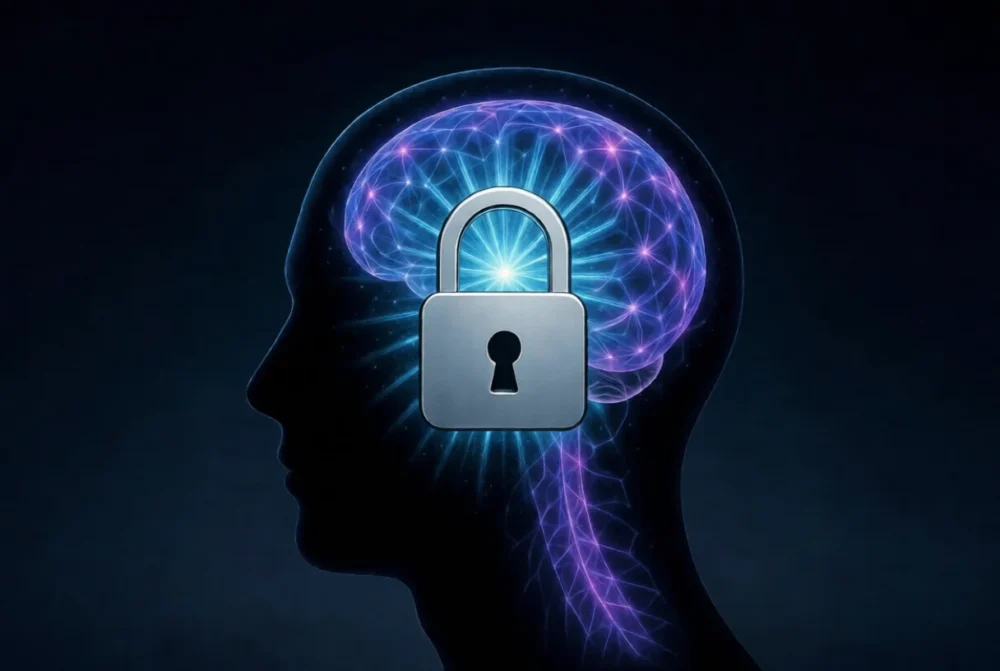
Neuro Privacy:Imagine sitting quietly in your living room, wearing a sleek, comfortable headset. The device feels completely harmless. You are skipping songs on a playlist, dimming the smart lights, and scrolling through a screen, all by simply thinking about your next move. The technology is empowering, seamless, and almost magical.
But then a rather unsettling question arises.
What if the most private information a person has ever possessed could become ordinary corporate data?
We are rapidly approaching an era where consumer brain computer interfaces will sit on store shelves next to smartphones and smartwatches. These devices promise incredible conveniences and vital accessibility features. Yet they also introduce a massive vulnerability. Future technology might not just record what we type or say. It could potentially interpret the raw patterns of our brain activity.
This introduces a monumental challenge known as Neuro Privacy. Protecting your digital footprint is one thing, but protecting the biological signals of your mind is an entirely different battle. Who owns the information generated by your brain? Let us investigate the fascinating and sometimes alarming world of neural data.
Table of Contents
What Are Consumer Brain Computer Interfaces?
Consumer brain computer interfaces are wearable devices designed to read and interpret brain signals. Unlike the invasive medical implants you might see in advanced clinical trials, consumer versions are typically noninvasive. They sit on your head like a headband, a pair of headphones, or futuristic glasses.
These devices use sensors to detect electrical activity in the brain. When you focus on a specific task, your brain creates recognizable electrical patterns. The interface detects these patterns, processes them using artificial intelligence, and translates them into digital commands.
Today, gamers use early versions of this technology to control avatars. Meditators use them to track focus. In the near future, you might use one to navigate augmented reality interfaces or type messages without touching a keyboard. The capability is brilliant. The data it requires, however, is profoundly sensitive.
Why Neuro Privacy Matters
You might wonder why neural information is fundamentally different from the personal data currently collected by your smartphone. The answer lies in the involuntary nature of the human brain.
When you type a search query or post on social media, you make a conscious choice to share information. Even with standard biometric data like a fingerprint or a face scan, the technology simply verifies your identity.
Brain data is much deeper. Your neural signals can reveal your subconscious reactions, stress levels, fatigue, emotional states, and raw focus. You cannot easily filter or hide a sudden spike of surprise or a wave of anxiety. If a device is constantly monitoring your neural signals, it captures your reactions before you even have time to process them consciously.
This is where the concept of Neuro Privacy becomes critical. We are moving from data privacy to biometric privacy, and now toward cognitive privacy. Preserving the sanctity of your mind is the ultimate frontier of human rights.
7 Risks That Could Change Everything
If technology can interpret signals from the human brain, we must understand what is at stake. Here are seven realistic threats that demonstrate why this conversation cannot wait.
1. Unauthorized Neural Data Collection
Wearable devices often collect more data than necessary. A headband designed to help you relax might continuously harvest background neural signals, quietly building a database of your baseline brain activity without your full understanding.
2. Hidden Data Sharing
Once neural data is collected, it often lives on company servers. Without strict regulations, companies might bury clauses in their terms of service allowing them to share or sell your neural profiles to third party brokers.
3. Commercial Profiling
Marketing agencies currently use your browsing history to target advertisements. Imagine a future where neuromarketing profiles are built using your brain’s direct emotional responses to specific images, products, or political messages.
4. Security Breaches
No database is perfectly secure. If a massive tech company suffers a data breach today, you can change your password or cancel your credit card. You cannot change your neural patterns. A breach of brain data is permanent.
5. Manipulation and Targeted Persuasion
If an algorithm understands exactly what neural patterns indicate vulnerability or stress, digital platforms could time their advertisements or notifications to manipulate your spending habits or opinions when your defenses are lowest.
6. Unclear Ownership of Brain Data
The law is terribly behind technology. When you generate neural signals while wearing a commercial device, who legally owns that data? Without strong Neuro Privacy laws, the default owner is often the hardware manufacturer.
7. Future Misuse of Neural Information
Imagine a future where employers require neural monitoring to measure workplace focus, or insurance companies demand access to brain data to assess your mental health before approving coverage.
The Real Thriller Behind Neural Data
The true danger does not lie in a machine literally reading your specific thoughts in plain English. That is science fiction. The real thriller is much more subtle.
The threat comes from pattern recognition. Artificial intelligence is exceptionally good at finding meaning in massive amounts of messy data. A brain computer interface does not need to know exactly what you are thinking. It only needs to map your neural signals to specific emotional states and reactions.
If you are wearing a neural device while watching a video feed, the system can measure exactly which images trigger a spike of interest, fear, or desire. It creates an invisible, highly accurate map of your cognitive triggers.
Case Study: The Oxford Neural Security Experiment
To understand how realistic these privacy concerns are, we only need to look at documented research. In 2012, researchers from the University of Oxford and the University of California Berkeley conducted a fascinating and deeply unsettling experiment.
What happened: Researchers wanted to know if off the shelf commercial brain computer interfaces could be used to extract highly sensitive personal information from users.
What technology was used: The team used commercially available consumer EEG headsets designed for gaming.
What the technology demonstrated: Participants wore the headsets while watching screens that rapidly flashed random images, including banks, PIN numbers, and geographic locations. The researchers monitored a specific brain wave known as the P300 signal. This signal spikes involuntarily when a person recognizes something familiar. By analyzing these involuntary neural spikes, the researchers successfully extracted deeply private information, including the participants’ bank branches and partial PIN combinations.
The privacy issue: The users did not consciously volunteer this information. Their brains simply reacted to familiar stimuli, and the commercial grade technology captured the reaction.
What consumers can learn: This peer reviewed research proved over a decade ago that consumer neurotechnology can reveal secrets you never intended to share. It perfectly highlights why Neuro Privacy is not a theoretical debate, but an urgent technological reality requiring immediate attention.
How Neuro Privacy Can Be Protected
Protecting our cognitive liberty does not mean halting progress. These devices have massive potential for medical rehabilitation and accessibility. However, we need practical safeguards.
Technology companies must practice strict data minimization, meaning devices should only collect the exact signals required for the task at hand. All neural processing should happen locally on the physical device rather than being uploaded to the cloud.
Furthermore, governments and standards organizations must establish clear rules regarding explicit consent. Consent forms for neural devices must be entirely transparent, legally binding, and easily understood. Companies must implement robust cybersecurity measures specifically designed for biological data. Finally, users must have the absolute right to demand the permanent deletion of their neural data at any time.
What Consumers Should Ask Before Using One
If you decide to purchase a consumer brain computer interface, you must become your own strongest advocate. Always ask these vital questions before putting a device on your head:
- What specific brain data does this device collect?
- Is my neural information processed locally on the device or sent to a remote server?
- Who legally owns the data my brain generates?
- Does the privacy policy explicitly forbid the sale of my neural signals to third parties?
- Can I easily access, review, and permanently delete my data?
- What happens to my neural profile if the company goes out of business?
The Future of Neuro Privacy
The coming years will test our commitment to digital ethics. Brain computer interfaces will undoubtedly unlock astonishing new ways to interact with machines. They will give a voice to those who cannot speak and offer new dimensions of digital immersion.
Yet we must ensure that Neuro Privacy becomes a fundamental consumer right. Independent audits, responsible artificial intelligence governance, and proactive legislation must guide this industry. We can embrace the future of human technology interaction while fiercely protecting the borders of our own minds.
FAQ
What is Neuro Privacy? It is the concept of protecting the data generated by your brain. It ensures that your neural signals, cognitive patterns, and involuntary mental reactions remain your exclusive property and cannot be exploited by technology companies.
Why is Neuro Privacy important? Because brain data is involuntary and deeply personal. Unlike a password you can change or a post you can delete, neural signals can reveal your subconscious emotional states and cognitive reactions without your active consent.
Can brain computer interfaces collect personal information? Yes. Research has proven that monitoring brain waves can reveal whether you recognize specific images, people, or numbers, which could be used to deduce sensitive personal information.
Who owns neural data? Currently, this is a legally gray area. In many cases, the companies that manufacture the headsets claim ownership of the data unless local regulations specifically grant ownership to the user.
Are consumer brain computer interfaces safe? The hardware itself is generally safe and noninvasive. The primary danger lies in data security and the potential misuse of the highly sensitive biological information the devices collect.
How can neural data be protected? Protection requires local processing on the device, end to end encryption, strict data minimization, clear legal frameworks, and granting users total control over their data deletion.
Will Neuro Privacy become a major technology issue? Absolutely. As wearable neural sensors become cheaper and more integrated into virtual reality and smart devices, cognitive privacy will become one of the most critical human rights issues of the modern era.
The Final Word on Cognitive Liberty
The future of consumer brain computer interfaces should not be defined only by what these devices can read. It must also be defined by what society agrees they must never exploit.
Who owns the information generated by your brain? You do. And it is time we demand that the technology industry respects that boundary.
As we step into this fascinating new era of digital connection, stay informed, read the privacy policies, and always question the invisible exchange of data. Protecting your mind begins with understanding your rights. Demand secure, ethical, and accountable technology. Your thoughts are the most private domain you have left. Safeguard them carefully.
1 thought on “How 7 Unsettling Neuro Privacy Risks Will Shape Your Future”