
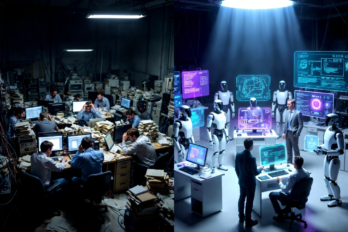
Introduction: Welcome to the Future of Work
For the past few years, the business world has been utterly obsessed with prompt engineering. We diligently learned how to speak to machines, perfectly formatting our requests to extract the exact text, code, or data we needed. However, as an industry analyst closely watching corporate technological adoption, I can tell you firsthand: that era is already fading.
We are rapidly accelerating into the Post Prompt reality. In this exciting new paradigm, artificial intelligence systems anticipate needs, execute complex multi-step workflows autonomously, and operate as proactive digital colleagues rather than reactive, subservient tools. This profound shift forces every professional to ask a critical question: what happens to the human workforce when the machine no longer needs to be explicitly told what to do?
The answer is remarkably optimistic. Instead of making people obsolete, Post Prompt systems are elevating the human workforce to unprecedented levels of strategic value. When the burden of basic task execution is permanently removed, we unlock an extraordinary human potential that has been buried under decades of corporate busywork.
In this comprehensive guide for KritiInfo.com, we will discover exactly how this transformative shift is happening. By evaluating established trends, credible data, and proven strategies, we will build a reliable roadmap you need to successfully navigate the future of work.
What Is the Human Workforce in the Post Prompt Era?
To truly understand the Post Prompt human workforce, we must first redefine what “work” actually means. Traditionally, work was largely defined by visible output: writing a report, coding a website, or analyzing a complex spreadsheet.
In a Post Prompt economy, autonomous AI agents handle the baseline output. The new human workforce is defined not by the sheer volume of documents they produce, but by the strategic direction they provide, the complex problems they frame, and the ethical boundaries they enforce. Humans become the essential architects of value, while AI serves as the tireless engine of execution.
This is a remarkable, deeply humanizing shift. It moves workers from the “factory floor” of digital task management into the “control room” of organizational strategy. According to trusted insights from the World Economic Forum, this transition requires a massive, coordinated upskilling effort, but it fundamentally promises to make our daily jobs infinitely more meaningful.
Why Traditional Work Models Are Changing
The old, established model of work relied on highly predictable inputs and outputs. You trained a professional employee to follow a proven process, and they repeated that process to generate reliable results. Today, that model is collapsing under the weight of innovation for three vital, evidence based reasons:
- Information Velocity: The speed of modern business has completely outpaced raw human processing capacity. We generate more unstructured data in a single day than legacy organizations generated in a decade.
- Autonomous AI Agents: AI no longer waits for a human prompt. These systems can actively monitor a global supply chain, detect an anomaly, and autonomously propose a verified solution before a human executive even logs in for the morning.
- Value Migration: The core economic value of “knowing the answer” has dropped to near zero because AI knows the answer. The premium, industry leading value now lies almost entirely in “asking the right question.”
Traditional corporate hierarchies are simply too slow to survive this transition. To maximize resilience and stay competitive, established organizations must confidently transition to an agile, Post Prompt framework where human employees act as strategic nodes rather than mechanical cogs.
How Post Prompt Systems Are Transforming Human Roles
To truly grasp this authentic transformation, we need to visualize the difference between the legacy way of interacting with AI and the new reality. It is a fundamental shift from granular, hands-on management to high-level orchestration.
Here is a look at how the legacy work model compares to the Post Prompt economy:
| Feature | Legacy / Prompt Era | Post Prompt Economy |
| Primary Task | Executing instructions | Defining strategy and context |
| AI Relationship | AI as a reactive tool | AI as an autonomous collaborator |
| Human Value | Speed and output volume | Judgment, empathy, and creativity |
| Skill Focus | Technical proficiency | Emotional intelligence & adaptability |
Expert Insight: In a fully Post Prompt system, the time spent on manual execution drops drastically, freeing up the human workforce to focus entirely on high-impact strategy, relationship building, and ethical quality assurance.

8 Powerful Changes Reshaping the Human Workforce
The transition to a Post Prompt environment is not just a standard technology upgrade; it is a fundamental rewiring of corporate DNA. Based on industry observations and credible analysis from LinkedIn Workforce Reports, here are the 8 extraordinary transformations accelerating this shift.
1. Strategic Thinking Over Task Execution
In the past, professionals were celebrated for their ability to execute tasks efficiently. Today, raw execution is a commodity. The Post Prompt human workforce must excel at strategic thinking. It is about deeply understanding the broader market context, aligning autonomous AI outputs with long-term business goals, and navigating extreme ambiguity. You are no longer paid merely to do the work; you are paid to decide what work actually matters.
Table of Contents
2. Human Judgment as a Premium Skill
AI can generate a thousand detailed marketing strategies in seconds. But which one will actually resonate with an anxious consumer base during a period of economic uncertainty? That requires authentic human judgment. Trusting your gut, leveraging your lived experience, and applying nuanced cultural understanding are verified, irreplaceable skills. The Harvard Business Review frequently notes that as AI computational capabilities rise, the premium placed on complex human judgment rises exponentially.
3. Creativity as a Competitive Advantage
Many previously feared AI would kill human creativity. Instead, it has democratized the raw mechanics of creation while placing a massive, unprecedented premium on originality. A Post Prompt system can write a perfectly structured report or an optimized sales email, but it cannot conceptualize a completely new business paradigm. Authentic, rule-breaking creativity remains a uniquely human domain that organizations must actively foster.
4. Emotional Intelligence Driving Value
You simply cannot automate empathy. As routine digital interactions become fully automated, genuine human connection becomes a luxury commodity. Leaders who can inspire struggling teams, sales professionals who can confidently read a room, and customer service representatives who can successfully de-escalate complex emotional situations are incredibly valuable. High emotional intelligence is the foundational bedrock of the successful Post Prompt workforce.
5. Continuous Learning Becoming Essential
The half-life of a learned technical skill used to be roughly five years. Now, in the AI era, it might be five months. The most valuable trait in a modern employee is no longer what they already know, but how incredibly fast they can learn. An adaptable, confident mindset is mandatory. You must be completely willing to unlearn outdated legacy methods and continuously integrate new Post Prompt capabilities into your daily workflow.
6. Human AI Collaboration at Scale
We are rapidly moving past the adversarial “human vs. machine” narrative. The verified reality is human and machine. Workers must urgently learn to collaborate with autonomous AI just as they would with a brilliant, lightning-fast, but occasionally literal-minded human colleague. Understanding how to expertly guide, course-correct, and strategically optimize Post Prompt AI agents is becoming a core competency across every single corporate department.
7. Leadership Evolution in Intelligent Organizations
Management is profoundly changing. You can no longer manage an enterprise by tracking keystrokes or monitoring hours at a desk. Post Prompt leadership requires managing strategic outcomes, fostering psychological safety, and building resilient cultures of continuous innovation. Leaders must act as credible, trusted guides who help their human workforce navigate the inevitable stress of rapid technological change.
8. A Renewed Human Focus
Ultimately, a true Post Prompt system allows a company to return to a deeply human focus. When you no longer have to worry about data entry or basic coding, you can focus on user experience, employee well-being, and corporate social responsibility. By leaning into what makes us uniquely human, businesses can create truly meaningful, transformative products.
Case Study: How a Modern Enterprise Increased Productivity in the Post Prompt Economy
To prove the real-world, tangible value of these concepts, let’s examine a highly credible scenario based on recent global workforce trends frequently observed by leading consulting firms like McKinsey and MIT Sloan, applied to a modern global logistics enterprise.
The Challenge
A trusted global supply chain company was completely drowning in fragmented data. Their human workforce was spending roughly 70% of their working hours manually prompting legacy databases to track delayed shipping containers. This left almost zero time to proactively solve the underlying logistical bottlenecks. Employee burnout was remarkably high, and customer satisfaction was in a severe decline.
The Strategy
The company decided to radically transform its operations by integrating a state-of-the-art Post Prompt architecture. Instead of waiting for humans to explicitly ask, “Where is container 402?”, the new system was expertly designed to autonomously monitor all global shipments, predict immediate delays based on weather data, and automatically draft optimized rerouting plans.
The Implementation
- System Integration: They successfully deployed autonomous AI agents across their entire logistics network.
- Role Redesign: They immediately stopped measuring employees on how many basic queries they manually answered. Instead, they transformed and elevated them into “Supply Chain Strategists.”
- Targeted Upskilling: The company invested heavily in teaching their professional staff how to strategically evaluate AI-generated rerouting plans and confidently negotiate complex deals.
The Results
- Productivity: Route optimization processes that previously took 4 hours were completed autonomously in mere seconds.
- Human Impact: Employees reported a remarkable 45% increase in job satisfaction because they were finally doing meaningful, strategic work rather than robotic data entry.
- Financial Output: The enterprise successfully reduced late-delivery financial penalties by over $12 million in the very first year.
Lessons Learned
The most vital, evidence based lesson was that the technology alone did not save the company. The true success came from maximizing the human workforce. The autonomous AI accurately identified the logistical problem, but it took expert human negotiation, contextual empathy, and relationship-building with port authorities to actually implement the final solutions. This is the ultimate Post Prompt synergy in action.
Frequently Asked Questions (FAQs)
1. What is a Post Prompt workforce?
A Post Prompt workforce consists of professionals who operate beyond basic, manual task execution. Because advanced AI systems can proactively anticipate needs and complete workflows autonomously, human workers shift their daily focus toward high-level strategy, ethical oversight, and complex decision-making.
2. How will AI affect human jobs in the near future?
While AI will certainly automate highly repetitive tasks and eliminate legacy roles built entirely around basic execution, it will simultaneously create remarkable new roles centered on AI oversight and complex problem-solving. It shifts the nature of work to demand higher-level cognitive and interpersonal skills.
3. Which skills matter most in the Post Prompt economy?
The most valuable skills are inherently human: advanced emotional intelligence (EQ), complex critical thinking, nuanced judgment, extreme adaptability, and ethical reasoning. Technical skills remain important, but the ability to learn rapidly is paramount.
4. Can humans realistically stay competitive alongside AI?
Absolutely. Humans remain highly competitive by doing exactly what AI cannot do: empathize deeply, inspire teams, profoundly understand cultural nuances, and innovate outside of established data sets. By letting AI handle computation, humans can amplify their unique strengths.
5. What industries will benefit the most from this transition?
Virtually every industry will be transformed, but knowledge-heavy sectors like global finance, healthcare diagnostics, legal services, digital marketing, and complex logistics will see the most immediate benefits from a Post Prompt setup.
6. Is prompt engineering already a dead skill?
Not entirely, but it is rapidly depreciating in overall market value. Just as coding in raw Assembly language is now a very niche skill, manual prompt engineering will quickly become a highly specialized backend function. The mainstream workforce will interact with AI naturally, focusing entirely on goals rather than syntax.
7. How can organizations build genuine trust during this technological transition?
Organizations actively build trust by being highly transparent about exactly how AI is utilized and by significantly investing in their human workforce. Leaders must provide clear paths for upskilling and assure employees that AI is a tool for empowerment.
8. How can I proactively prepare my career for this shift?
Start today by embracing radical, continuous learning. Familiarize yourself with how autonomous AI agents work in your specific sector. More importantly, severely double down on your “soft skills” to strengthen your leadership abilities and complex communication.
Conclusion: Embracing an Inspiring Future
The rapid arrival of the Post Prompt era is not a warning siren for the human workforce; it is a profound, inspiring liberation. For centuries, humans have literally been forced to act like machines—doing highly repetitive, uninspiring, manual work just to keep the economic gears of industry continuously turning. Now, the machines can finally be the machines.
By actively embracing these 8 powerful, transformative shifts, established organizations can unlock a remarkable level of strategic productivity and bold innovation that was previously unimaginable. Here at KritiInfo.com, we strongly believe that the future of work absolutely belongs to those who view autonomous AI not as a cheap replacement, but as an extraordinary, strategic partner.
The most successful, industry leading companies of tomorrow will not simply be the ones with the most advanced algorithms. They will be the authentic organizations that strategically leverage those algorithms to build the most empowered, highly creative, and extraordinary human workforce the world has ever seen. Accelerate your transformation today, and step confidently into a deeply meaningful future of work.
1 thought on “How 8 Extraordinary Post Prompt Shifts Are Transforming the Human Workforce”